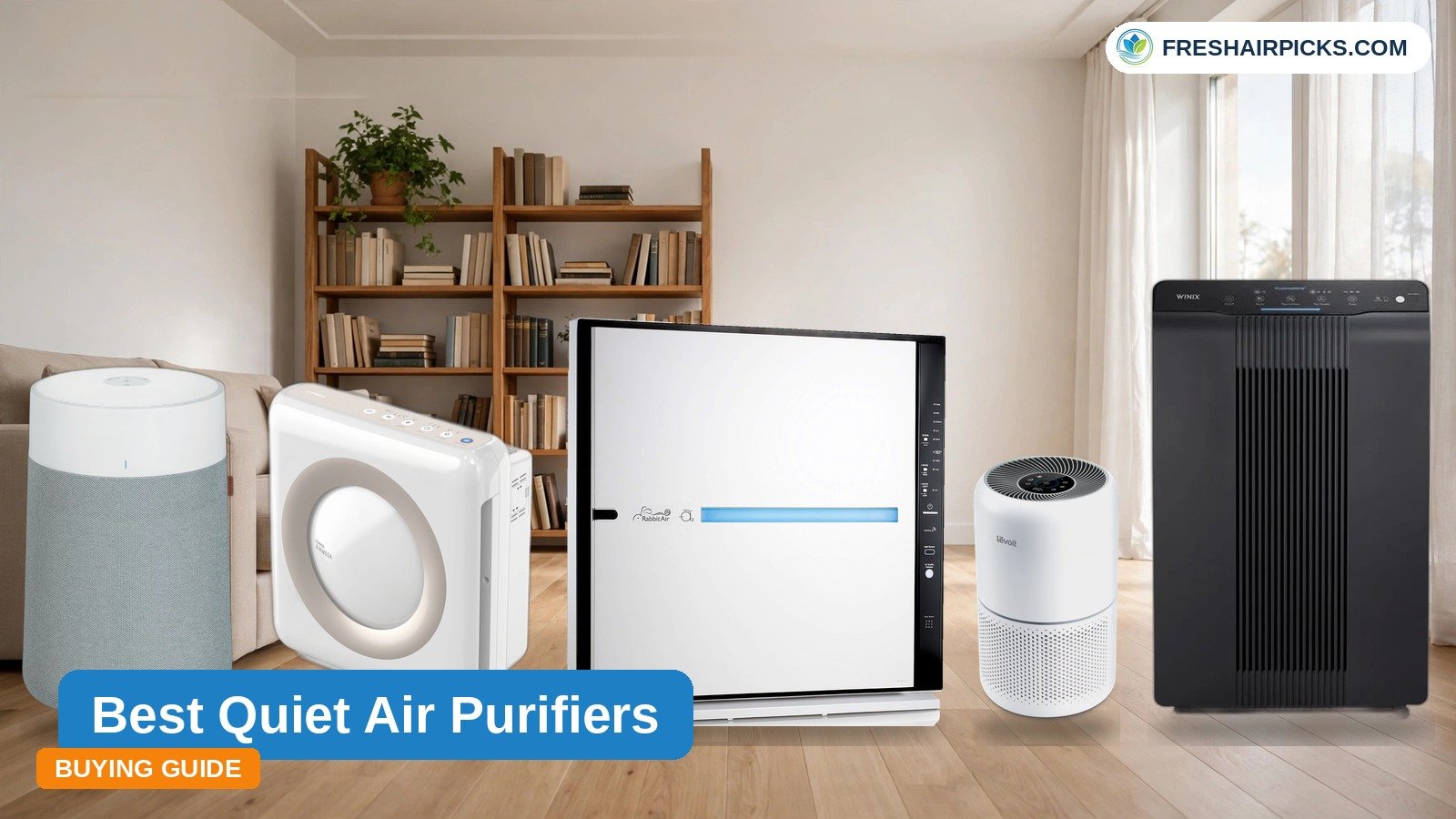
Dust is the particle problem every home has, and the one air purifier marketing understands least honestly. So here is the limit up front: a purifier only captures dust that is still floating in the air. The film already settled on your shelves is beyond any fan’s reach — that still takes a damp cloth and a vacuum. What a good purifier does is pull dust out of the air before it settles, which slows the build-up and, more importantly, keeps it out of your lungs in the meantime. (Our explainer on whether air purifiers help with dust walks through that airborne-versus-settled split in detail.)
That is why this guide ranks machines by dust CADR — the middle of the three CADR numbers, measured specifically on dust — and by how well each machine copes with a heavy dust load over months of use. Dust is coarse, plentiful and relentless: it clogs filters faster than smoke or pollen do, so a washable pre-filter and an honest filter bill matter here more than app features. Every pick below has verified ratings behind it, and every running cost is printed next to the price.
Quick Answer
- Top pick: Levoit Vital 200S-P — $159.99. The strongest AHAM-verified dust CADR (254) anywhere near its price, a washable pre-filter, and the cheapest filters in this guide at $49.99 a year.
- Best for large rooms: Blueair Blue Pure 211i Max — $349.99. Dust CADR of 452 and enough verified coverage (674 sq ft) for big living rooms, with washable fabric pre-filters.
- Budget pick: Levoit Core 300S — $99.99. The right buy for a small bedroom, provided you accept its one dust-specific weakness: its pre-filter can’t be washed.
How these picks were chosen
FreshAirPicks doesn’t run a testing lab, and this page contains no first-person test claims. (An earlier version of this guide claimed garage-lab testing and performance scores; that was wrong, and it’s gone.) The rankings rest on the US Association of Home Appliance Manufacturers’ CADR ratings — independently tested figures reported through AHAM‘s Verifide directory and the US ENERGY STAR program — manufacturer specifications, and the measured results published by reviewers who do test, chiefly HouseFresh. Prices and filter costs were checked in October 2026 against the sources named in our research notes. Where a manufacturer rates its own machine without independent verification, the table says so — and for a dust guide, that distinction is the whole ballgame, because dust CADR is the number doing the ranking.
The 5 best air purifiers for dust at a glance
| Product | Price | CADR (smoke/dust/pollen) | Coverage @ 4.8 ACH | Filter cost/yr | 3-year cost* | Noise | Best for |
|---|---|---|---|---|---|---|---|
| Levoit Vital 200S-P | $159.99 | 250 / 254 / 289 (AHAM) | 388 sq ft | ~$50 | ~$310 | 24–54 dB | Most homes & bedrooms |
| Blueair Blue Pure 211i Max | $349.99 | 435 / 452 / 450 (Blueair) | 674 sq ft | ~$93–140 | ~$630–770 | 23–53 dB | Large living rooms |
| Coway Airmega ProX | $999 list | 577 / 586 / 450 (AHAM via ENERGY STAR) | 894 sq ft | $199 | $1,596 | 37–54 dBA (measured) | Open-plan & very large spaces |
| Winix 5510 | $179.99 | 253 / 252 / 247 (AHAM) | 392 sq ft | ~$80 | ~$420 | 35–67 dBA (measured) | Dusty homes; washable pre-filter routine |
| Levoit Core 300S | $99.99 | 141 / 156 / 175 (AHAM smoke; see note) | 219 sq ft | ~$45–60 | ~$235–280 | 22–55 dB | Small bedrooms on a budget |
* 3-year cost = unit price + three years of replacement filters; electricity excluded (it typically adds a few dollars a month, depending on speed and your rate). Coverage assumes 8-foot ceilings. CADR note: four of these five carry AHAM-verified ratings; the Blueair figures are Blueair’s own, updated under the current US Department of Energy test procedure, and the Core 300S’s firmly verified figure is its AHAM smoke CADR of 141 — its dust/pollen split comes from secondary sources, which is why the budget pick is sized by smoke like everything else here.
1. Levoit Vital 200S-P — Best Overall
The Vital 200S-P is what a dust pick should look like on paper, and the paper is verified: an AHAM dust CADR of 254 — the highest independently verified dust rating in its price class — behind a washable pre-filter that takes the coarse load before it reaches the HEPA. For dusty homes, that washable first stage is the difference between a filter that lasts its rated year and one that chokes in seven months.
It is also unusually usable at the speeds people actually live with. HouseFresh measured it delivering roughly 128 CFM on speed 2 at 41.9 dBA — conversation-level noise — which means it keeps scrubbing dust on a medium setting all day instead of only when you can tolerate turbo. Pet Mode cycles the fan up to deal with shedding, auto mode responds to its particle sensor, and it’s AHAM Verifide, ENERGY STAR certified and CARB listed, with no ionizer to think about.
The honest weaknesses: the carbon stage is modest (better on litter and cooking smells than on serious VOCs), and in a home with heavy shedding the filter interval can halve — budget ~$100 a year instead of $50 if your pets shed year-round. At $159.99 with $49.99 filters, though, it remains the cheapest serious dust machine to buy and to run.
| Spec | Vital 200S-P |
|---|---|
| Price | $159.99 (Amazon) |
| CADR (smoke/dust/pollen) | 250 / 254 / 289 (AHAM Verifide) |
| Room coverage @ 4.8 ACH | 388 sq ft |
| Filters | $49.99, ~12 months (less with heavy shedding) |
| Noise | 24–54 dB (rated) |
| Dimensions | 15.6 × 8.5 × 19.8 in |
| Weight | 13.2 lb |
| Ionizer | No |
Best for: most homes and bedrooms up to ~390 sq ft — the default recommendation.
2. Blueair Blue Pure 211i Max — Best for Large Rooms
If the dusty room is a big one, the 211i Max is the practical step up: a dust CADR of 452 on Blueair’s DOE-updated figures, covering 674 sq ft at 4.8 air changes an hour — nearly double the Vital’s reach — for $349.99. Its design suits dust specifically: washable fabric pre-filters wrap the outside of the unit and intercept the coarse load (and the pet hair, and the lint) before the main filter ever sees it, and they come in several colors, so the machine reads as furniture rather than appliance.
Two qualifications, stated plainly. Blueair’s CADR figures are the manufacturer’s own, and an AHAM-directory figure for its dust CADR (410, via PurifierBeast’s directory tables) runs lower than Blueair’s 452 — size it by its smoke CADR of 435 and the coverage claim still holds. And its HEPASilent stage charges particles electrostatically and cannot be switched off; buyers who want strictly mechanical filtration should look at the Vital, the ProX or the Core 300S instead. Running costs are the other watch-out: the filter is $69.99 every 6–9 months, annualizing to roughly $93–140 a year.
| Spec | Blue Pure 211i Max |
|---|---|
| Price | $349.99 (Blueair) |
| CADR (smoke/dust/pollen) | 435 / 452 / 450 (Blueair, DOE-updated) |
| Room coverage @ 4.8 ACH | 674 sq ft |
| Filters | $69.99 every 6–9 months (~$93–140/yr) |
| Noise | 23–53 dB (rated) |
| Dimensions | 22.7 × 14.4 × 14.4 in |
| Weight | 16.2 lb |
| Ionizer | HEPASilent electrostatic stage — cannot be switched off |
Best for: large living rooms and open family spaces up to ~670 sq ft.
3. Coway Airmega ProX — Most Powerful
The ProX is the heavyweight of this guide in every sense: an AHAM dust CADR of 586 (verified in ENERGY STAR’s official product record, alongside smoke 577 and pollen 450) — more than double the Vital’s rating — delivered through two intakes, one on each side, each with its own washable pre-filter and Max2 filter set. At 4.8 air changes an hour it covers 894 sq ft, which is open-plan territory: a combined living/dining space, a finished basement, a small office.
What surprises, given that power, is the noise — or lack of it. HouseFresh measured 37.4 dBA on speed 1 and just 53.6 dBA at full speed from 3 feet, quieter at maximum than several smaller units here, and Coway dropped the ionizer entirely: ENERGY STAR lists its ozone emissions at 0.0 ppb, and the cleaning is purely mechanical. It carries a 3-year warranty and ENERGY STAR’s “Most Efficient” designation, and it rolls on four wheels — useful, because at 51 lb and 36.6 inches tall you will not be carrying it between rooms.
The costs are as large as the machine. List price is $999 (it is frequently discounted toward $800), and the bonded Max2 filter sets run $199 a year — when the carbon side is spent, you replace the HEPA with it, ready or not. There is no app or Wi-Fi; control is on the unit. Buy it only if your space genuinely needs CADR in the high 500s; for a normal room it is expensive overkill with an expensive filter habit.
| Spec | Airmega ProX |
|---|---|
| Price | $999 list (often discounted to ~$800) |
| CADR (smoke/dust/pollen) | 577 / 586 / 450 (AHAM via ENERGY STAR) |
| Room coverage @ 4.8 ACH | 894 sq ft |
| Filters | $199 set, 12 months |
| Noise | 37.4–53.6 dBA (measured at 3 ft, HouseFresh) |
| Dimensions | 18.9 × 36.6 × 24.3 in |
| Weight | 51 lb |
| Ionizer | No (0.0 ppb ozone, ENERGY STAR) |
Best for: open-plan homes, large basements and small offices up to ~890 sq ft.
4. Winix 5510 — Best Pre-Filter Routine
The earlier version of this guide recommended the Winix 5500-2. That model has been discontinued, and the 5510 is its successor: AHAM-verified CADRs of 253 smoke / 252 dust / 247 pollen, a 392 sq ft verified room rating, and the most dust-conscious maintenance design in this guide. Winix’s manual tells you to vacuum or brush the removable pre-filter every 14 days (and rinse it if it’s badly soiled) — exactly the habit dusty homes need — in front of a pelleted-carbon stage and a True HEPA filter, replaced together annually as the Filter Q set ($79.99).
Its PlasmaWave bipolar ionizer deserves a straight answer rather than a scare: it is CARB-listed (EO G-24-234, within the 0.050 ppm ozone limit), and unlike the Blueair’s electrostatic stage, it can be switched off and left off. If you prefer zero ionization, buy the Vital or the ProX; if you want the option, the Winix handles it more honestly than most.
The trade-off is noise at the top end. HouseFresh measured 67.2 dBA on turbo at 3 feet — loud, and the reason that reviewer didn’t shortlist it for dust despite the numbers. Its headline CADR is therefore a daytime/boost figure; on quiet speeds expect roughly half the airflow. The app is also basic, and the warranty is a short 2 years. But if your home’s problem is a relentless dust load — pets, carpets, a busy street — the 5510’s cleanable pre-filter and low $80-a-year filter bill make it the easiest machine here to keep performing at its rated numbers.
| Spec | Winix 5510 |
|---|---|
| Price | $179.99 (Amazon) |
| CADR (smoke/dust/pollen) | 253 / 252 / 247 (AHAM Verifide) |
| Room coverage @ 4.8 ACH | 392 sq ft |
| Filters | Filter Q set $79.99, 12 months (~$80/yr) |
| Noise | From 23.5 dB (rated); 35.2–67.2 dBA measured at 3 ft (HouseFresh) |
| Dimensions | 15.9 × 11 × 25.2 in |
| Weight | 13.03 lb |
| Ionizer | PlasmaWave — yes, but can be switched off (CARB-listed) |
Best for: dusty, pet-heavy or carpeted homes up to ~390 sq ft where filter upkeep is the priority.
5. Levoit Core 300S — Best Budget
The Core 300S is the budget pick with one honest asterisk. The verified anchor is its AHAM smoke CADR of 141 — enough for 219 sq ft at 4.8 ACH, which means small bedrooms, nurseries and home offices, not living rooms. (Its published dust/pollen split of 156/175 comes from secondary sources rather than a headline AHAM listing, which is why this guide sizes it by smoke, like everything else here.) It is genuinely quiet in sleep mode (22 dB rated), the VeSync app and auto mode are things budget rivals often skip, and at $99.99 it’s the cheapest way into this guide.
The asterisk is the pre-filter: on the Core 300S it’s bonded to the 3-in-1 filter and cannot be removed or washed. In a dusty home that matters — you’ll vacuum its surface gently, watch the filter indicator, and expect the 6–8-month replacement interval to land at the short end. Filters run roughly $45–60 a year, so the 3-year cost (~$235–280) stays low; just don’t buy it for a big or very dusty room and expect the numbers on the box. Note also that the 300S itself has no ionizer — avoid the similarly named PlasmaPro variant if that’s a concern.
| Spec | Core 300S |
|---|---|
| Price | $99.99 (Amazon) |
| CADR (smoke/dust/pollen) | 141 / 156 / 175 (AHAM smoke; split from secondary sources) |
| Room coverage @ 4.8 ACH | 219 sq ft |
| Filters | ~$45–60/yr (every 6–8 months) |
| Noise | 22 dB sleep (rated) to ~54.5 dBA at top speed (measured) |
| Dimensions | 8.7 × 8.7 × 14.2 in |
| Weight | ~7.5 lb |
| Ionizer | No |
Best for: bedrooms, nurseries and small offices up to ~220 sq ft on a tight budget.
How to choose an air purifier for dust
Dust CADR is the number that matters here
CADR comes in threes — smoke, dust, pollen — and for this job the middle number is the honest headline. Dust particles are among the largest things a purifier is asked to catch (the visible household fraction runs roughly 2.5–10 microns, per the American Lung Association), so dust CADR is usually a machine’s highest or joint-highest score, and it’s the rating that tracks how fast the machine clears a dusty room. One discipline still applies: size the room by the smoke CADR, the smallest and most conservative figure — it’s also the basis of AHAM’s own room-size ratings. If a brand advertises a single combined “CADR” or a room size four times the AHAM figure, it’s marketing, not measurement.
The 4.8 ACH rule, with a worked example
For allergy- and dust-grade cleaning, aim for 4.8 air changes per hour: the purifier’s smoke CADR × 1.55 gives the largest room (in sq ft, 8-foot ceilings) it can serve at that rate — the same math behind AHAM’s 2/3 rule, which our dust explainer covers in full.
Worked example — a 20 × 18 ft living room (360 sq ft): you need a smoke CADR of at least 360 ÷ 1.55 ≈ 232. The Vital 200S-P (250) and Winix 5510 (253) both clear it. The Core 300S (141) tops out at 219 sq ft at 4.8 ACH; in that 360 sq ft room it would manage under 3 air changes an hour — fine for overnight dust control in a bedroom, weak as a living room’s only machine. When in doubt, buy one size up: a bigger unit on a quiet medium speed out-cleans and out-quietens a small unit screaming on turbo.
Pre-filters do the heavy lifting
Dust is a volume problem before it’s a filtration problem. The coarse fraction — lint, hair, skin flakes, fabric fibers — is what cakes onto filters and strangles airflow, and the pre-filter is the stage designed to take that hit. In a dusty home, a washable pre-filter is close to a requirement: the Winix manual’s every-14-days cleaning rhythm and the washable screens on the Vital, 211i Max and ProX exist precisely so the expensive HEPA behind them survives to its rated interval. A bonded pre-filter you can’t clean (the Core 300S) isn’t a deal-breaker at $99.99, but it converts dust load directly into filter replacements.
The dust mite truth
About 20 million Americans are allergic to dust mites (AAFA), so this needs saying clearly: if your “dust problem” is waking up congested, the mites are mostly not in the air — they’re in your bed. Mites live in mattresses, bedding, upholstery and carpets, feeding on shed skin; their allergen particles are relatively heavy and settle quickly, so the airborne share a purifier can catch is small. Mayo Clinic’s guidance for dust mite allergy barely mentions air cleaning: encase the mattress and pillows in allergen-proof covers, wash bedding weekly in water of at least 130°F, keep indoor humidity below 50%, dust with a damp (never dry) cloth, and vacuum with a HEPA-filter machine. Do those first. A purifier in the bedroom — sized from our allergies guide, where this is the primary use case — is the supporting player that catches what cleaning stirs up, not the treatment itself.
Placement and running habits
- Run it continuously or on auto. Dust resuspends every time you walk across a carpet, make a bed or sit down on a sofa; a purifier that only runs for an hour after cleaning misses most of the cycle.
- Give it air. Keep the intake and outlet clear of walls, curtains and furniture — a unit jammed into a corner cleans the corner.
- One room, door closed. Especially the bedroom: eight hours of clean air where you sleep beats a whole house of slightly-less-dusty air.
- Clean while it runs. Dust and vacuum with the purifier on a higher speed, then leave it running for an hour after — that’s when the airborne load peaks.
The filter bill is the real running cost
Electricity for a purifier is a few dollars a month; filters are where ownership gets expensive, and dust accelerates them. Before buying, price the replacement and its interval — the spread in this guide runs from $49.99 a year (Vital) to $199 a year (ProX) — and assume a dusty or pet-heavy home lands at the short end of every interval. Our guide to whether air purifiers are worth it works through full 3-year ownership costs, electricity included.
Do air purifiers actually remove dust?
Yes — the airborne fraction. A true-HEPA purifier continuously pulls floating dust (including the fine particles that carry dust mite allergens, pollen and dander) out of the air. What it cannot do is lift dust that has already settled on surfaces; that still requires dusting and vacuuming. The visible result is slower re-settling and cleaner breathing air, not dust-free furniture.
Will an air purifier stop dust from settling on my furniture?
No — and any brand implying otherwise is overselling. Capturing dust while it’s airborne reduces how much new dust settles and how fast, but gravity always wins some of it. Expect to dust and vacuum less desperately, not never. Pairing the purifier with damp-cloth dusting (dry dusting just relaunches particles) is what actually moves the needle.
Do air purifiers help with dust mite allergy?
Only a little, and indirectly. Dust mites live in bedding and soft furnishings, and their allergen particles settle quickly, so most exposure happens at the mattress, not in mid-air. The measures that work are allergen-proof encasings, weekly bedding washes at 130°F+, humidity below 50%, and HEPA vacuuming (Mayo Clinic). A purifier helps at the margins — catching allergen debris stirred up by cleaning and bed-making — which is why it’s a supporting measure, not the headline one.
What size air purifier do I need for dust?
Use the smoke CADR and the 4.8 ACH rule: room size (sq ft) × 0.65, roughly, gives the minimum smoke CADR for 4.8 air changes an hour with 8-foot ceilings. A 200 sq ft bedroom needs a smoke CADR of about 129+; a 360 sq ft living room needs about 232+. Then sanity-check the dust CADR — for this job it should be at or above the smoke figure, as it is on every pick in this guide.
How often should I run an air purifier for dust?
Continuously, or on auto mode around the clock. Dust is generated and resuspended all day — by movement, HVAC airflow, pets and bedding — so intermittent running keeps missing the load. A correctly sized unit on a quiet medium speed costs only a few dollars a month in electricity; that’s the speed to live on, with turbo reserved for cleaning days and high-pollen weeks.
How often do filters need replacing in a dusty home?
The washable pre-filter: every 2–4 weeks of cleaning (Winix specifies 14 days for the 5510). The main HEPA/carbon filter: at the manufacturer’s interval — 12 months on the Vital, Winix and ProX, 6–9 months on the Blueair — but treat those as best-case. In a genuinely dusty or pet-heavy home, check at two-thirds of the interval; a grey, matted pre-filter or a persistent musty smell at the outlet means the filter is done early. Never wash a HEPA or carbon filter unless the manufacturer explicitly says you can (none of the five here allows it).
Is a washable pre-filter really worth it for dust?
Yes — for dust, it’s arguably worth more than app control or a fancy display. Dust load is what kills filters, and a pre-filter you can rinse or vacuum keeps the expensive HEPA behind it breathing for its full rated life. It’s no coincidence that four of the five picks here have washable pre-filters, and that the one that doesn’t — the $99.99 Core 300S — has its limitation flagged in its review above.
Prices checked October 2026 against the manufacturer stores, Amazon, and AHAM and ENERGY STAR records cited above. Prices, discounts and filter costs change; verify before you buy — a purifier is a multi-year filter commitment, not a one-off purchase.
When you buy through links on our site, we may earn an affiliate commission at no extra cost to you. That income is what keeps FreshAirPicks independent and lets us do this research. We don’t run sponsored placements or paid rankings: products are selected and ranked on the verified data shown in this article, and where the data was weak or conflicted, the article says so instead of filling the gap with a confident guess.
FreshAirPicks has no lab and tests nothing; the performance claims here come from AHAM, ENERGY STAR, manufacturer specifications and named third-party measurements, not from hands-on testing. Specs and prices can change after publication; if you spot an error, write to us and we’ll correct it.