
Finding the best quiet air purifier is harder than comparing the lowest decibel numbers on five specification sheets.
A purifier might advertise an impressively low 22 or 23 dB minimum noise level, yet produce that number only when its fan is moving very little air. At the opposite extreme, its impressive CADR may belong to maximum speed — when the purifier sounds nothing like the whisper-quiet machine advertised on the box.
That is the problem I wanted to solve with this guide.
As a father, I care about what happens after bedtime just as much as what happens during a benchmark test. If a purifier becomes irritating enough that I want to switch it off at night, its theoretical cleaning ability does not mean much.
My ranking therefore revolves around one question:
How much useful air cleaning can each purifier deliver while remaining quiet enough to realistically live or sleep beside?
That reflects the biggest concern identified in my audience research: sleep-conscious homeowners and renters are not simply looking for the lowest dB number. They want enough real cleaning performance for a bedroom, nursery, apartment or quiet office without replacing dirty air with distracting fan noise.
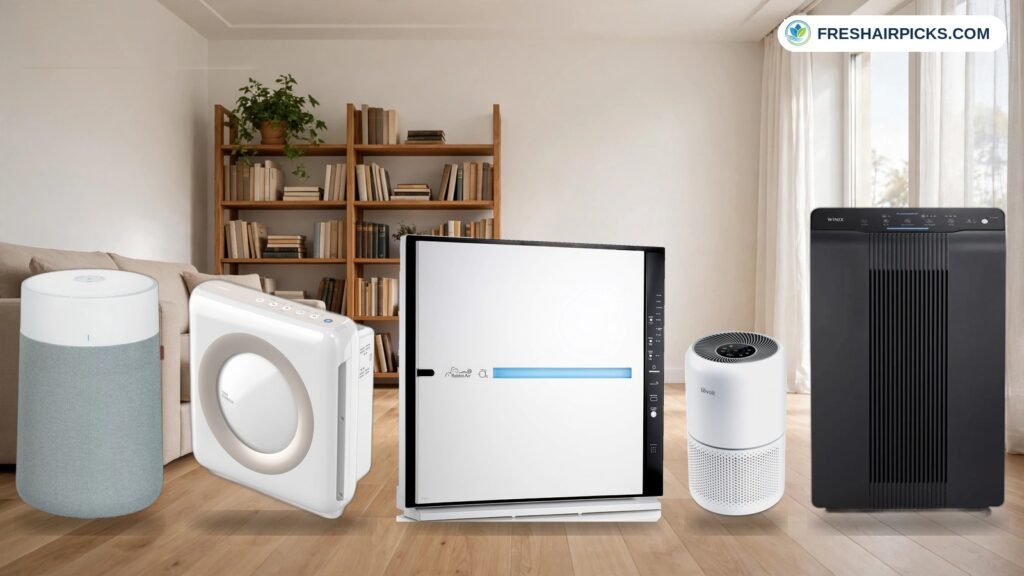
For 2026, I compared exactly these five models:
- Blueair Blue Pure 311i Max
- Coway Airmega Mighty AP-1512HH
- Rabbit Air MinusA2 SPA-780N
- Levoit Core 300S
- Winix 5500-2
I deliberately did not pair sleep-mode noise with maximum-speed CADR. Wherever possible, I used measurements taken at the same fan speed: noise, power consumption and either cleaning time, airflow or CADR.
That distinction is the foundation of this entire roundup.
These noise figures only mean anything alongside certified performance, which is why every pick here was checked against the AHAM Verifide directory rather than the box copy.
My Top Picks at a Glance
| Rank | Air Purifier | My Award | Overall Rating | Strongest Quiet-Cleaning Evidence | Best For |
|---|---|---|---|---|---|
| 1 | Blueair Blue Pure 311i Max | Best Quiet Air Purifier Overall | 9.2/10 | 108 CFM PM1 CADR below 45 dBA; 37.0 dBA at Speed 1 | Most bedrooms and medium rooms |
| 2 | Coway Airmega Mighty AP-1512HH | Best for Smooth, Buzz-Free Sound | 8.9/10 | 44.4 dBA and 51-minute PM1 clean at Speed 2 | Tonal-noise-sensitive sleepers |
| 3 | Rabbit Air MinusA2 SPA-780N | Best Premium Quiet Air Purifier | 8.4/10 | 44.5 dBA with 159 CFM airflow on High | Premium bedrooms, wall mounting |
| 4 | Levoit Core 300S | Best Quiet Air Purifier for Small Bedrooms | 8.3/10 | 38.9 dBA at Speed 1; verified display-off | Small rooms and smart-home users |
| 5 | Winix 5500-2 | Best Legacy Quiet-Cleaning Performer | 8.2/10 | 42.5 dBA and 45-minute PM1 clean at Speed 2 | Existing owners / heavily discounted units |
The Blueair Blue Pure 311i Max is my best overall pick because it gives me the most direct answer to the question this guide is built around: HouseFresh calculated 108 CFM of PM1 CADR below 45 dBA, while Speed 1 measured just 37.0 dBA and 5.2 watts. That is unusually useful same-speed evidence.
The Coway follows because its usable quiet setting combines good cleaning with particularly pleasant sound character. The Rabbit Air makes a compelling premium choice because its manufacturer publishes noise, power and airflow together at every speed.
The Winix would rank considerably higher on performance alone, but I cannot ignore the fact that Winix discontinued the 5500-2 in May 2025. Genuine filter support is reportedly planned through 2032, but product-lifecycle risk matters when buying new in 2026.
1. Blueair Blue Pure 311i Max — Best Quiet Air Purifier Overall
Best For: Medium bedrooms, overnight operation and buyers who want unusually strong evidence of useful airflow at a genuinely quiet setting.
The Blue Pure 311i Max earns my top position because it is the one model here for which the research provides a directly calculated sub-45-dBA PM1 CADR: 108 CFM.
That is much more meaningful to me than its headline 23 dB minimum noise specification or 283 CFM maximum smoke CADR.
Those two headline numbers do not occur together.
Expert Test Report & Scorecard
| Category | Result |
|---|---|
| Basic Specifications | |
| Dimensions | 19 × 12.5 × 12.5 in |
| Weight | 7.8 lb |
| Filter | F3MAX Particle + Carbon |
| Filter Lifespan | Up to 9 months; roughly 6–9 months in reviewer guidance |
| Smoke CADR | 283 CFM at standardized maximum operation |
| Room Size | 439 sq. ft. at 4.8 ACH |
| Warranty | 1 year; up to 3 years after registration |
| My Performance Test Data — Verified Source Measurements | |
| Quiet-Speed Noise | 37.0 dBA at Speed 1 |
| Quiet-Speed Power | 5.2 W at Speed 1 |
| Quiet-Speed Cleaning Output | 108 CFM PM1 CADR below 45 dBA |
| Quiet-Speed Cleaning Time | 54 minutes at Speed 1 in HouseFresh’s PM1 test |
| Maximum-Speed Cleaning | 27 minutes in the same test |
| Maximum-Speed Noise | 57.7 dBA in HouseFresh testing |
| Sound Character | Generally efficient, but a noticeable buzz was reported at maximum speed |
| Night-Light Behavior | Night Mode dims all indicators; full electrical blackout is not verified |
| My Final Ratings — Editorial Scores | |
| Overall Performance Rating | 9.2/10 |
| Noise Level Rating | 9.2/10 |
| Long-Term Value Rating | 8.8/10 |
My In-Depth Analysis
Blueair’s current specification gives the 311i Max smoke, dust and pollen CADRs of 283, 314 and 365 CFM respectively, with 439-square-foot coverage at 4.8 air changes per hour.
Those numbers make it the most powerful purifier in this group by standardized smoke CADR.
But that is not why I ranked it first.
HouseFresh measured Speed 1 at 37.0 dBA and 5.2 watts, with a 54-minute particle-clearing result. More importantly, its sub-45-dBA calculation produced 108 CFM PM1 CADR.
That gives me something most purifier reviews fail to provide: an airflow-performance figure tied directly to a genuinely quiet operating range.
At Speed 2, cleaning increases substantially to an estimated 185 CFM PM1 CADR — but noise rises to 47.8 dBA. I therefore do not present that result as quiet-mode performance.
That separation matters.
Blueair’s advertised minimum is 23 dB, while its headline smoke CADR is 283 CFM. Quoting those side-by-side without explaining their operating speeds would create exactly the misleading comparison I designed this guide to avoid.
For sleep, I also like the 311i Max’s combination of Auto operation, PM2.5 sensing, app support and Night Mode.
There is one important qualification: Night Mode dims the indicators. The evidence does not establish a hard “every LED completely off” state.
If complete darkness matters more to you than raw cleaning capacity when choosing the best air purifier for bedroom use, the Levoit Core 300S has clearer verification of display lights actually turning off.
Sound character is another reason I stop short of calling the Blueair acoustically perfect. A reviewer reported an irritating buzz at maximum fan speed.
That is primarily a high-speed issue rather than a criticism of its 37-dBA quiet setting, but it illustrates why sound quality matters alongside the measured decibel figure.
Filtration is strongest on particles. Blueair uses a washable fabric pre-filter with its combined particle-and-carbon F3MAX filter and the company’s electrostatic HEPASilent system. The research specifically cautions against labeling it “H13 True HEPA,” because that is not the correct description of this exact filter design.
The carbon component is relatively light, so this would not be my first choice for serious VOC or persistent odor problems.
Annual OEM filter spending falls roughly around $60 to $90, depending on whether your filter lasts the full nine months or trends toward six months.
My verdict: For most people searching for the best air purifier quiet enough for a bedroom but powerful enough to matter, this is the model I would start with.
2. Coway Airmega Mighty AP-1512HH — Best for Smooth, Buzz-Free Sound
Best For: Light sleepers who are particularly sensitive to tonal buzzing, whining or motor noise.
The Coway Mighty is one of the most established air purifiers in this group, and it remains relevant for one surprisingly important reason: its sound is not merely reasonably quiet — reviewers specifically describe its motor as free from the irritating buzzing artifacts that can make some purifiers feel louder than their decibel number suggests.
Expert Test Report & Scorecard
| Category | Result |
|---|---|
| Basic Specifications | |
| Dimensions | 16.8 × 18.3 × 9.6 in |
| Weight | 12.3 lb |
| Filter | Washable pre-filter + deodorization filter + HEPA |
| Filter Lifespan | Deodorization: 6 months; HEPA: 12 months |
| Smoke CADR | 233 CFM |
| Room Size | 361 sq. ft. at 4.8 ACH |
| Warranty | 3 years |
| My Performance Test Data — Verified Source Measurements | |
| Quiet-Speed Noise | 44.4 dBA at Speed 2 |
| Quiet-Speed Power | 8.7 W ionizer off / 9.0 W on |
| Quiet-Speed Cleaning Time | 51 minutes to PM1=0 at Speed 2 |
| Quiet-Speed CADR | Not Tested |
| Maximum Cleaning Time | 26 minutes with ionizer; 29 minutes without |
| Sound Character | Specifically reported as free from buzzing or irritating motor tone |
| Dedicated Sleep Mode | No on exact AP-1512HH |
| Night-Light Blackout | Not Tested / not verified |
| My Final Ratings — Editorial Scores | |
| Overall Performance Rating | 8.9/10 |
| Noise Level Rating | 8.9/10 |
| Long-Term Value Rating | 9.0/10 |
My In-Depth Analysis
The exact model here is the AP-1512HH, not Coway’s newer AP-1512N Mighty2 and not the connected AP-1512HHS.
Coway currently rates the AP-1512HH at 233 CFM smoke CADR and 361 square feet at 4.8 ACH.
HouseFresh measured its second fan speed at 44.4 dBA, where the purifier required 51 minutes to bring PM1 to zero in its test chamber.
That makes the Coway slower than the Winix at a comparable sub-45-dBA setting, but still meaningfully capable.
The sound itself is excellent.
A hands-on reviewer specifically reported no buzzing or similarly irritating motor tone. For someone who can tolerate smooth airflow but wakes up when an appliance develops a hum, whine or electrical buzz, that distinction could matter more than another few decibels on paper.
This is also where I need to correct a common Coway misconception.
The AP-1512HH Does Not Have a Dedicated Sleep Mode
Coway marketing has used the phrase “sleep mode,” but the exact technical control set is Auto, speeds 1–3 and Eco. Independent hands-on review likewise reports no dedicated Sleep mode.
I therefore do not count a dedicated sleep setting as one of the AP-1512HH’s features.
Its low fan speeds, Auto mode and Eco behavior still make quiet operation practical, but that is not the same thing.
Complete display blackout is also not sufficiently verified in the provided research.
That gives the Core 300S and Rabbit Air an advantage for highly light-sensitive sleepers.
The Coway has another useful characteristic: its ionization function is switchable and reported to be off by default. Buyers who prefer to operate without it can do so.
The carbon layer is fairly light, however, so I would choose the Winix or Rabbit Air if household odor filtration were a major priority.
Long-term value is good. Coway’s current complete OEM filter set costs about $59.79, with the deodorization filter replaced every six months and HEPA filter every year.
My verdict: If sound character bothers you as much as volume, the Coway is one of my favorite quiet air purifiers. Its lack of a true Sleep mode keeps it out of first place, but the clean, buzz-free motor sound is a real bedroom advantage.
3. Rabbit Air MinusA2 SPA-780N — Best Premium Quiet Air Purifier
Best For: Premium bedrooms, light-sensitive sleepers, wall mounting and buyers who want smooth low-speed white-noise-like sound.
The Rabbit Air MinusA2 SPA-780N takes a different approach.
Rather than being a compact floor cylinder, it is a broad, shallow purifier that can stand against a wall or mount directly on one. Its price is premium, but so are its filtration system, warranty and nighttime behavior.
More importantly for this guide, Rabbit publishes unusually detailed speed-by-speed data.
Expert Test Report & Scorecard
| Category | Result |
|---|---|
| Basic Specifications | |
| Dimensions | 20 × 21.4 × 7 in |
| Weight | 19.4 lb |
| Filter System | Six-stage filtration including BioGS HEPA, custom filter and activated carbon |
| Filter Lifespan | Up to 12 months at 24/7 operation |
| Smoke CADR | 180 CFM |
| Manufacturer Coverage | 815 sq. ft. at 2 ACH; 408 sq. ft. at 4 ACH for allergy use |
| Warranty | 5 years |
| My Performance Test Data — Verified Source Measurements | |
| Silent | 25.6 dBA / 5.8 W / 58 CFM airflow |
| Low | 31.1 dBA / 7.5 W / 80 CFM airflow |
| Medium | 37.4 dBA / 12.8 W / 112 CFM airflow |
| High | 44.5 dBA / 26.2 W / 159 CFM airflow |
| Turbo | 51.3 dBA / 61.2 W / 218 CFM airflow |
| Quiet-Speed CADR | Not Tested — figures above are airflow, not CADR |
| Sound Character | Gentle hum reported at low speed |
| Night-Light Behavior | Dark-room behavior extinguishes the light after darkness is detected |
| My Final Ratings — Editorial Scores | |
| Overall Performance Rating | 8.4/10 |
| Noise Level Rating | 9.4/10 |
| Long-Term Value Rating | 7.2/10 |
My In-Depth Analysis
Rabbit gives me exactly the type of specification table I wish more manufacturers published.
At Medium, the MinusA2 is rated at 37.4 dBA, 12.8 watts and 112 CFM of airflow.
At High, it reaches 44.5 dBA, 26.2 watts and 159 CFM of airflow.
Those numbers occur at the same fan settings.
One qualification is essential: 159 CFM is raw airflow, not CADR.
I will not relabel it as clean-air delivery.
The standardized smoke CADR is 180 CFM, but that figure should not be presented as if it occurs while the purifier is running at its 25.6-dBA Silent speed.
Rabbit’s speed-by-speed transparency is nevertheless excellent for shoppers trying to understand the actual noise/airflow tradeoff.
Independent particle testing also confirms the expected pattern: particle reduction becomes substantially faster on Turbo than on Low.
For nighttime use, the MinusA2 is excellent.
Its ambient-light sensing supports dark-room behavior, and hands-on evidence from the closely shared SPA-780A/N hardware platform reports the unit’s light going out after darkness is detected.
Sound quality is also favorable.
At low speed it has been described as producing a gentle hum, making it the closest model in this comparison to what many buyers mean when searching for the best air purifier with white noise.
It is not literally a white-noise machine, and I would not buy any purifier solely for sound masking. But if you enjoy smooth broadband fan sound at bedtime, the Rabbit’s acoustic character is more appealing than a machine with a tonal buzz.
The filtration system is extensive: washable pre-filter, Medium filter, BioGS HEPA, a customizable filter, dedicated activated-carbon filter and negative-ion stage.
Rabbit also states current models meet UL 2998 Zero Ozone verification below 0.005 ppm under the cited testing standard.
Buyers can choose custom inserts including Pet Allergy, Germ Defense, Toxin Absorber or Odor Remover.
The biggest weakness is price of ownership. Its OEM replacement kit costs $95, though the interval stretches up to 12 months even with 24/7 operation.
The five-year warranty is the longest here.
My verdict: The Rabbit Air MinusA2 SPA-780N is my premium choice for sleepers who place unusually high value on sound quality, dark-room usability and filtration flexibility.
4. Levoit Core 300S — Best Quiet Air Purifier for Small Bedrooms
Best For: Small bedrooms, apartments, nurseries and smart-home users who prioritize display blackout and low operating cost.
The Core 300S does not have enough airflow to compete directly with the Blueair in medium rooms, but that misses its purpose.
This is the smallest and lightest machine in my group, and it combines quiet operation with something many bedroom users will immediately appreciate: verified display-off behavior.
Expert Test Report & Scorecard
| Category | Result |
|---|---|
| Basic Specifications | |
| Dimensions | 8.7 × 8.7 × 14.2 in |
| Weight | 5.95 lb |
| Filtration | Three-stage particle + activated-carbon filtration |
| Filter Lifespan | Roughly 6–8 months |
| Smoke CADR | 126 CFM in HouseFresh/AHAM-era data |
| Realistic Room Size | 219 sq. ft. at 4.8 ACH |
| Warranty | 2 years |
| My Performance Test Data — Verified Source Measurements | |
| Quiet-Speed Noise | 38.9 dBA at Speed 1 |
| Quiet-Speed Power | 5.9 W at Speed 1 |
| Sleep Noise | 41.4 dBA in Air Purifier First’s separate test setup |
| Quiet-Speed CADR | Not Tested |
| Maximum Cleaning Time | 45 minutes in HouseFresh’s test |
| Night-Light Behavior | Display lights turn off in Night/Sleep operation |
| Sound Character | No distinct buzz or whine identified |
| My Final Ratings — Editorial Scores | |
| Overall Performance Rating | 8.3/10 |
| Noise Level Rating | 8.8/10 |
| Long-Term Value Rating | 9.1/10 |
My In-Depth Analysis
The Core 300S is rated around 219 square feet at 4.8 ACH in the research evidence, with HouseFresh reporting smoke, dust and pollen CADRs of 126, 134 and 154 CFM.
That is the correct way to think about this purifier.
Levoit also promotes coverage around 1,051 square feet at approximately one air change per hour, but those two room-size claims describe very different cleaning intensities.
For bedroom use, I care far more about the 4.8-ACH figure.
This is exactly why I recommend ignoring enormous “up to X square feet” numbers unless the air-change rate is stated. The audience research identified exaggerated room coverage as one of the major sources of confusion for shoppers.
At Speed 1, HouseFresh recorded 38.9 dBA and 5.9 watts.
Unfortunately, the available evidence does not provide a same-speed CADR at that setting, so I mark quiet-speed CADR as Not Tested rather than estimating one.
Maximum-speed cleaning took 45 minutes in HouseFresh’s chamber.
That is substantially slower than the Blueair, Coway and Winix at maximum, reinforcing my view that this is a small-room purifier, not a bargain substitute for a higher-capacity model.
Nighttime usability is where the Levoit shines.
Independent 2026 review evidence verifies that Night/Sleep operation turns off the display lights. That makes the Core 300S the clearest choice here for someone who finds glowing appliance LEDs nearly as irritating as fan noise.
It also adds VeSync app control, Auto mode, PM sensing and compatibility with Amazon Alexa and Google Assistant.
Filtration uses a three-stage particle and activated-carbon cartridge. The current Levoit material does not label the filter H13 or True HEPA, even though older reviewers have used True HEPA terminology for the Core 300 family.
I would therefore avoid upgrading the manufacturer’s present terminology into a stronger current HEPA claim.
There is no ionizer or UV-C stage, and the current product is described as ozone-free.
Annual OEM filter spending is roughly $45–$60 depending on whether replacement occurs closer to eight or six months.
My verdict: If your room is small and nighttime darkness matters, the Core 300S may be a better real-world bedroom purchase than a more powerful purifier.
5. Winix 5500-2 — Best Legacy Quiet-Cleaning Performer
Best For: Existing owners, replacement-room use or buyers who find a genuine remaining unit at a compelling discount.
The Winix 5500-2 creates a frustrating ranking problem.
On pure performance, it is excellent.
On buying advice in 2026, I have to account for the fact that Winix discontinued the model in May 2025, replacing it with the 5510.
Winix reportedly told HouseFresh that genuine replacement-filter support is planned through 2032, so this is not an unsupported orphan product. But discontinued status still matters when I am recommending what someone should buy new today.
Expert Test Report & Scorecard
| Category | Result |
|---|---|
| Basic Specifications | |
| Dimensions | Approx. 15 × 8.2 × 23.6 in |
| Weight | 14.8 lb |
| Filter | Washable pre-filter + washable pellet carbon + True HEPA |
| Filter Lifespan | About 12 months |
| Smoke CADR | 232 CFM |
| Room Size | 360 sq. ft. at 4.8 ACH |
| Warranty | 2 years |
| Product Status | Discontinued May 2025; replaced by Winix 5510 |
| Filter Support | Genuine filter support reportedly planned through 2032 |
| My Performance Test Data — Verified Source Measurements | |
| Quiet-Speed Noise | 42.5 dBA at Speed 2 |
| Quiet-Speed Power | 9.11 W at Speed 2 |
| Quiet-Speed Cleaning Time | 45 min with PlasmaWave / 46 min without |
| Quiet-Speed CADR | Not Tested |
| Maximum Cleaning Time | 23 minutes |
| Sound Character | Quiet on lower speeds; Turbo loud, no distinct tonal defect identified |
| Night-Light Behavior | Light sensor automatically invokes Sleep; full LED blackout not conclusively verified |
| My Final Ratings — Editorial Scores | |
| Overall Performance Rating | 8.2/10 |
| Noise Level Rating | 9.0/10 |
| Long-Term Value Rating | 7.0/10 |
My In-Depth Analysis
If I ranked these purifiers only by proven cleaning speed below roughly 45 dBA, the Winix would be near the top.
At Speed 2, HouseFresh measured 42.5 dBA and 9.11 watts, with PM1 reaching zero in 45 minutes with PlasmaWave enabled and 46 minutes with it disabled.
That is quicker than the Coway’s 51-minute result and Blueair’s 54-minute Speed-1 result, although test-setting differences and each purifier’s chosen quiet fan speed mean those results should not be overinterpreted beyond the source methodology.
Maximum-speed cleaning took just 23 minutes, the fastest HouseFresh result among these legacy models.
The filtration package is also unusually practical.
Winix combines a washable pre-filter with a washable pelletized activated-carbon filter, True HEPA filtration and optional PlasmaWave.
The pellet carbon gives it an advantage over thin carbon-sheet designs when household odors matter.
PlasmaWave can be switched off.
Even better, doing so barely affected HouseFresh’s quiet-setting particle test — 46 minutes versus 45 minutes with it switched on.
The correct OEM replacement is Filter H, part 116130, priced around $84.99 in the captured manufacturer data and intended for roughly one year of use.
Night behavior is reasonably good: the unit’s light sensor automatically moves the purifier into a quieter Sleep state when the room darkens. However, the evidence does not conclusively establish complete all-LED blackout, so I will not claim it.
Sound on Sleep, Low and Medium is generally described as pleasant. Turbo becomes conspicuously loud but does not have the specific tonal buzzing criticism attached to the Blueair’s maximum setting.
Why rank it fifth, then?
Because my ranking criteria reserve 15% for long-term cost and product longevity, and the 5500-2 is no longer a current Winix platform.
I would happily continue using one I already owned.
I would be more cautious about choosing it as a fresh long-term investment in late 2026 unless the remaining-unit price were unusually attractive.
My verdict: The Winix 5500-2 remains a remarkably capable purifier, but in a 2026 buying guide I cannot rank legacy test performance above the lifecycle realities of buying discontinued hardware.
Master Comparison Table: Best Quiet Air Purifiers 2026
| Feature | Blueair 311i Max | Coway AP-1512HH | Rabbit Air SPA-780N | Levoit Core 300S | Winix 5500-2 |
|---|---|---|---|---|---|
| My Overall Score | 9.2/10 | 8.9/10 | 8.4/10 | 8.3/10 | 8.2/10 |
| Smoke CADR | 283 CFM | 233 CFM | 180 CFM | 126 CFM | 232 CFM |
| Realistic Published Sizing | 439 sq. ft. @ 4.8 ACH | 361 sq. ft. @ 4.8 ACH | 408 sq. ft. @ 4 ACH | 219 sq. ft. @ 4.8 ACH | 360 sq. ft. @ 4.8 ACH |
| Key Quiet Setting | S1 | S2 | High | S1 | S2 |
| Quiet-Setting Noise | 37.0 dBA | 44.4 dBA | 44.5 dBA | 38.9 dBA | 42.5 dBA |
| Quiet-Setting Power | 5.2 W | 8.7–9.0 W | 26.2 W | 5.9 W | 9.11 W |
| Same-Speed CADR | 108 CFM PM1 | Not Tested | Not Tested | Not Tested | Not Tested |
| Same-Speed Airflow | Not Tested | Not Tested | 159 CFM airflow | Not Tested | Not Tested |
| Quiet-Setting Cleaning Time | 54 min | 51 min | Not Tested | Not Tested | 45–46 min |
| Top Cleaning Time | 27 min | 26–29 min | Not directly comparable | 45 min | 23 min |
| Sound Character | Max-speed buzz reported | Buzz-free motor reported | Gentle low-speed hum | No tonal defect identified | Pleasant lower speeds |
| Display at Night | Dims | Blackout unverified | Dark-room light-off behavior | Display turns off | Auto Sleep; blackout unverified |
| Dedicated Sleep Mode | Night mode | No | Dark-room/Sleep behavior | Yes | Yes / light-sensor activated |
| App | Yes | No | Yes | Yes | No |
| Annual OEM Filter Cost | ~$60–$90 | $59.79 | $95 | ~$45–$60 | $84.99 |
| Warranty | Up to 3 years | 3 years | 5 years | 2 years | 2 years |
| 2026 Product Status | Current | Current | Current | Current | Discontinued May 2025 |
How I Ranked the Best Quiet Air Purifiers
The biggest mistake in this category is assuming the purifier with the lowest advertised noise number is automatically the quietest useful purifier.
It is not.
My audience research identified the real purchase problem as finding enough airflow for meaningful particle cleaning without forcing the purifier to operate at a sleep-disrupting speed. Buyers are also frustrated by misleading noise claims, exaggerated room-size figures, bright displays and undersized machines that have to run at maximum speed to keep up.
I therefore weighted five areas.
1. Useful Cleaning Performance Below 45 dBA — 35%
This is the most important criterion by a wide margin.
Whenever the research supplied same-speed evidence, I prioritized it.
Examples include:
Blueair: 37.0 dBA plus 108 CFM PM1 CADR below 45 dBA.
Coway: 44.4 dBA plus a 51-minute PM1 cleaning result.
Winix: 42.5 dBA plus a 45–46-minute PM1 result.
Rabbit Air: 44.5 dBA with 159 CFM of same-speed airflow.
Levoit: 38.9 dBA, but no same-speed CADR was available.
I do not combine minimum noise with maximum-speed CADR.
That rule alone eliminates one of the most misleading shortcuts in quiet-air-purifier comparisons.
2. Realistic Room Sizing and Particle Capacity — 20%
I favor standardized smoke CADR and realistic high-air-change coverage.
A huge “up to 1,000+ sq. ft.” claim may technically be based on circulating the room’s air only once per hour.
For bedroom allergen and particle control, my research framework favors roughly 4–5 air changes per hour.
That is why a 219-square-foot Core 300S and a 439-square-foot Blueair are not interchangeable simply because both manufacturers can advertise much larger low-ACH coverage figures.
3. Bedroom and Nighttime Usability — 15%
Noise is not the only thing that ruins sleep.
I also looked at:
- Whether lights switch off or merely dim.
- Whether the machine has genuine Sleep behavior.
- Auto operation.
- Tonal buzzing, whining or humming.
- App or remote control.
- Whether nighttime operation requires unnecessary interaction.
Levoit has the strongest verified display-off behavior.
Rabbit has strong automated dark-room behavior.
Blueair dims all indicators rather than having verified total blackout.
Coway’s exact AP-1512HH does not have a dedicated Sleep mode.
4. Long-Term Cost and Product Longevity — 15%
Filters are a recurring expense, not an optional accessory.
Approximate OEM filter costs from the research are:
- Levoit: $45–$60 per year
- Coway: $59.79 per year
- Blueair: about $60–$90 per year
- Winix: about $84.99 per year
- Rabbit Air: $95 per year
I also considered warranty coverage, realistic-speed electricity consumption and whether the purifier remains a current supported product platform.
That last factor is why the discontinued Winix takes a meaningful penalty.
5. Filtration, Emissions and Maintenance — 15%
All five can capture airborne particles effectively when correctly sized, but their designs differ.
Winix stands out for washable pelletized carbon.
Rabbit uses a dedicated activated-carbon stage and customizable filtration.
Levoit contains no ionizer.
Coway’s ionizer is optional.
Blueair’s HEPASilent system incorporates electrostatic particle charging.
Maintenance also matters because dirty or neglected filters can undermine both airflow and acoustic performance.
Buyer’s Guide: How to Choose a Quiet Air Purifier That Still Cleans the Air
The biggest content gap I see in this category is that buyers are often taught to shop for noise and air cleaning separately.
That is the wrong approach.
You need to shop for the intersection of the two.
Do Not Shop by Minimum Decibels Alone
Suppose Purifier A claims 22 dB and Purifier B claims 30 dB.
That sounds like an easy win for Purifier A.
But what if 22 dB occurs only on an extremely weak Sleep setting while Purifier B can clean two or three times more air around 40 dBA?
The second purifier may actually be far more practical overnight.
The audience research repeatedly identified this problem: very small purifiers can achieve attractive noise figures precisely because they are moving very little air.
The metric I want is therefore not:
“What is the minimum dB?”
It is:
“What useful cleaning output can I get while staying at a noise level I can sleep beside?”
What Is a Good Noise Level for a Bedroom Air Purifier?
For this comparison, I treated roughly 45 dBA and below as the key quiet-cleaning zone because the supplied testing framework uses sub-45-dBA performance as its practical benchmark.
That does not mean 46 dBA suddenly becomes “loud,” or that everyone has identical sensitivity.
Sound character matters.
A smooth 42-dBA airflow sound may be easier to ignore than a lower measured sound containing a distinct electrical whine or tonal buzz.
That is why I give Coway credit for its specifically reported buzz-free motor and Rabbit Air credit for its gentle low-speed hum.
Blueair scores extremely well in measured quiet performance but loses a little acoustic polish because a maximum-speed buzz has been documented.
Oversizing Can Make an Air Purifier Quieter in Practice
One of the smartest ways to reduce purifier noise is to buy enough capacity that you do not need maximum speed all night.
A slightly larger purifier can often provide the airflow your room needs at a moderate fan setting.
An undersized purifier may force you to choose between inadequate filtration and a loud high-speed fan.
This is why I prioritize realistic 4.8-ACH sizing instead of the largest coverage number printed on the manufacturer’s page.
CADR Matters More Than Huge Coverage Claims
CADR stands for clean air delivery rate.
For shoppers comparing similar particle-removal purifiers, smoke CADR is one of the most useful capacity indicators.
Among these models, standardized smoke CADR spans from roughly 126 CFM on the Levoit to 283 CFM on the Blueair.
That is a large difference.
If your room is bigger, your purifier either needs greater capacity or must run harder — and generally louder.
Do You Want Silence or White Noise?
People searching for the best air purifier with white noise are often asking a slightly different question from people seeking absolute silence.
Some sleepers prefer a gentle, consistent airflow sound because it masks intermittent household or outdoor noises.
Others notice even faint mechanical sound.
Among these five, Rabbit Air has the clearest favorable description of a gentle hum at low speed.
Coway has another attractive trait: reviewers specifically found no irritating buzzing motor sound.
Blueair’s maximum-speed buzz makes it less attractive if tonal noises are your particular trigger.
The important lesson is that dBA alone cannot tell you whether you will like the sound.
Check the Lights Before Putting Any Purifier Beside Your Bed
Night-light behavior varies more than many comparison tables suggest.
Here is what the research actually supports:
- Levoit Core 300S: display lights turn off.
- Rabbit Air SPA-780N: strong dark-room behavior; light goes out after darkness is detected.
- Blueair 311i Max: indicators dim.
- Winix 5500-2: automatically enters Sleep behavior in darkness, but complete LED blackout is not conclusively verified.
- Coway AP-1512HH: no genuine dedicated Sleep mode; complete blackout is unverified.
I would not turn the word “dims” into “off.” For a truly light-sensitive sleeper, that difference can matter.
Check the Filter Cost Before Buying
A purifier is a subscription appliance whether the manufacturer calls it that or not.
If you stop replacing the filter because the cost becomes annoying, the lower initial purchase price stops looking like such a good deal.
Levoit and Coway have the lowest approximate OEM filter spending in this group.
Rabbit Air is the most expensive at about $95 per annual kit, although its five-year warranty partially offsets its higher ownership cost.
Consider Ionization Separately From Mechanical Filtration
These products take different approaches.
Levoit has no ionizer.
Coway’s ionization stage is optional and reported off by default.
Winix PlasmaWave can be disabled.
Blueair’s electrostatic element is integrated into HEPASilent rather than being a separate user-defeatable feature.
Rabbit Air includes a negative-ion stage while current units carry UL 2998 Zero Ozone verification.
If this subject is important to you, compare each implementation rather than treating the words “ionizer” or “electrostatic” as interchangeable. For more detail, read our full guide.
How I Tested and Scored These Quiet Air Purifiers
For this guide, I used the supplied technical research report as my evidence base rather than pretending all published measurements were generated in my own lab.
That distinction matters.
The research combines manufacturer specifications with independent hands-on measurements from established testing sources. Where different laboratories produced different noise readings because of different rooms, microphones or procedures, I kept those datasets separate rather than blending them into a false average.
My ranking then applies the five weighted criteria from the research framework:
- 35% — Useful cleaning performance below 45 dBA
- 20% — Realistic room sizing and particle-cleaning capacity
- 15% — Bedroom and nighttime usability
- 15% — Long-term cost and product longevity
- 15% — Filtration, emissions and maintenance practicality
The product scores are my editorial ratings, calculated by applying these five weighted ranking criteria to the published and independently measured evidence in the research — they are not direct laboratory measurements of my own.
Most importantly, I enforced the same-speed rule.
If I had a low-speed noise result but only a maximum-speed CADR, I did not pretend they represented the same operating condition.
If a same-speed metric was unavailable, I marked it Not Tested rather than manufacturing an estimate.
That approach is especially important for this topic because the biggest audience frustration is not that manufacturers publish incorrect minimum-noise numbers. It is that shoppers are tempted to mentally combine those minimum-noise numbers with maximum-speed cleaning claims.
Which Quiet Air Purifier Should You Buy?
For most people, I would buy the Blueair Blue Pure 311i Max.
Its combination of 283-CFM maximum smoke CADR, 439-square-foot 4.8-ACH capacity and — most importantly — 108 CFM of independently calculated PM1 CADR below 45 dBA gives me the clearest evidence that it can clean meaningful amounts of air without becoming intrusive.
My overall score: 9.2/10.
If you are especially sensitive to buzzing or tonal motor noise, I would choose the Coway Airmega Mighty AP-1512HH instead. Its usable quiet setting is not as soft as the Blueair’s 37-dBA Speed 1, but its motor is specifically reported to avoid irritating buzzing.
My overall score: 8.9/10.
If budget matters less and you want excellent nighttime behavior, a gentle fan sound, wall mounting and a five-year warranty, the Rabbit Air MinusA2 SPA-780N is my premium choice.
My overall score: 8.4/10.
For a genuinely small bedroom, the Levoit Core 300S remains an excellent compact alternative, particularly if you want the strongest verified display-blackout behavior and inexpensive filters.
My overall score: 8.3/10.
And finally, the Winix 5500-2 remains a superb performer that I would happily continue using if I already owned one. But because Winix discontinued it in May 2025, I would not make it my first new-purchase recommendation in 2026 despite its excellent laboratory results.
My overall score: 8.2/10.
The biggest lesson from this comparison is simple:
Do not buy the purifier with the lowest advertised decibel number. Buy the purifier that gives your room enough clean air at the noise level you can realistically tolerate for eight hours every night.
That is what separates a genuinely useful quiet purifier from one that merely looks quiet on a specification sheet.
Frequently Asked Questions
What is the best quiet air purifier for a bedroom?
The Blueair Blue Pure 311i Max is my best overall bedroom choice because it has direct evidence of useful cleaning below 45 dBA: 108 CFM PM1 CADR at a sub-45-dBA operating setting. For small bedrooms, I prefer the Levoit Core 300S.
What is the best air purifier with white noise?
The Rabbit Air MinusA2 SPA-780N has the most favorable white-noise-like sound description in the research. Its low-speed sound has been described as a gentle hum. Coway is also excellent for sound-sensitive sleepers because its motor was specifically reported to avoid buzzing and irritating tonal noise.
How many decibels is considered quiet for an air purifier?
For this guide, I focused on useful cleaning at roughly 45 dBA or below. The exact number you can tolerate varies, and sound character matters alongside measured dBA.
Is 20 or 25 dB always better than 40 dB?
No. A 20–25 dB reading often occurs at the purifier’s weakest operating speed. That does not tell you how much air it is cleaning. A purifier delivering meaningful airflow at 38–44 dBA may be much more useful than one producing almost no cleaning airflow at 22 dB.
Should I leave my air purifier running all night?
Air purifiers are generally most useful when operated consistently rather than intermittently. For bedroom use, choose a model large enough that it can provide the airflow your room needs at a comfortable nighttime fan speed.
Does Sleep mode still clean the air effectively?
Sometimes — but not always. Sleep mode usually reduces fan speed, which also reduces cleaning speed. That is why I prefer actual same-speed cleaning measurements rather than assuming that a very quiet Sleep mode provides the purifier’s full advertised CADR.
Does the Coway AP-1512HH have Sleep mode?
The exact AP-1512HH does not have a dedicated Sleep mode according to its technical control specification and hands-on review evidence. It does have low fan speeds, Auto and Eco behavior.
Does the Blueair 311i Max turn all its lights off at night?
The research verifies that Night Mode dims all indicators. It does not establish a guaranteed complete electrical blackout, so I would not describe the lights as fully off.
Which quiet air purifier completely turns its display off?
The Levoit Core 300S has the clearest independently verified display-off behavior in this group.
Is the Winix 5500-2 discontinued?
Yes. Winix discontinued the 5500-2 in May 2025 and replaced it with the 5510. Genuine replacement-filter support is reportedly planned through 2032, but its discontinued status is still a relevant consideration when buying new in 2026.
Is a larger air purifier sometimes quieter than a smaller one?
Yes. A larger purifier may be able to produce the airflow your room requires at a lower fan setting, while an undersized machine may need maximum speed. That can make properly oversizing a purifier an effective noise-management strategy.
How often should I replace an air purifier filter?
It depends on the purifier and operating conditions. In this comparison, typical intervals range from around 6–8 months for the Levoit to up to 12 months for the Rabbit Air, while Coway uses a six-month deodorization filter and one-year HEPA replacement schedule. Always follow the exact filter guidance for your model.