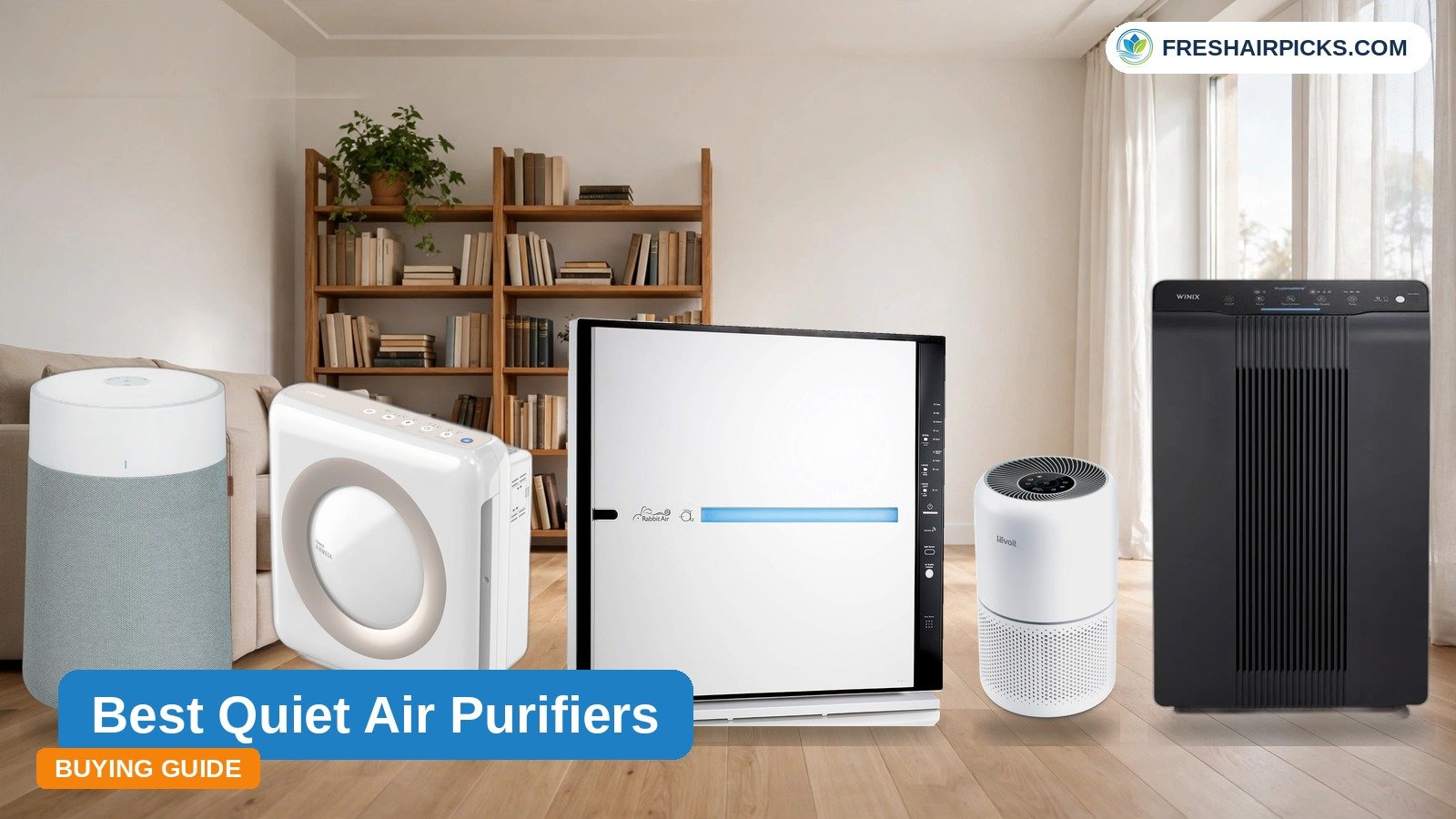
An office purifier has a different job from a living-room one: it must clean a space full of people, printers and meeting-room air without becoming the loudest thing on a Zoom call, without blasting a cold draft across a desk, and without adding ozone to the air you breathe eight hours a day. The right pick depends on the space — a desk corner, a shared office, an open plan, or an odor-heavy workspace — and this guide ranks one machine for each, on verified numbers only.
This guide contains no test results. FreshAirPicks does not lab-test air purifiers. Every number below traces to a manufacturer specification or a labelled independent measurement, and where a figure could not be verified, the guide says so. One general point first, because it frames everything else: a portable purifier supplements ventilation, it does not replace it. In an office it earns its place on the pollutants the building system misses — dust, printer particles, meeting-room stuffiness — not as a substitute for fresh air.
Quick answer: For an open-plan office, the Blueair 211i Max ($349.99 list, seen at $227.99) covers 674 sq ft on AHAM-verified CADR. For a shared or medium office, the Levoit Vital 200S-P ($159.99) covers 388 sq ft with no ionizer. For a small office or quiet room, the Blueair 511i Max (~$113–140) pairs 237 sq ft with a 19 dB night mode. For an odor-heavy workspace like a salon or studio, the Winix 5510 ($179.99) brings a real carbon stage to 392 sq ft. For a desk-adjacent budget pick, the Levoit Core 300S (~$99.99) covers 219 sq ft with no ionizer and a 22 dB sleep floor.
My Top Picks at a Glance
| Product | Best for | Verified coverage | Working noise | Price | Score |
|---|---|---|---|---|---|
| Blueair 211i Max | Open-plan office | 674 sq ft (AHAM) | 23–53 dB | $349.99 list / $227.99 seen | 8.7 |
| Levoit Vital 200S-P | Shared / medium office | 388 sq ft (AHAM) | Not published | $159.99 | 8.2 |
| Blueair 511i Max | Small office / quiet room | 237 sq ft (AHAM) | 19 dB night | ~$113–140 | 8.4 |
| Winix 5510 | Odor-heavy workspace | 392 sq ft (AHAM) | Not stated in manual | $179.99 | 8.0 |
| Levoit Core 300S | Budget desk-adjacent | 219 sq ft (AHAM) | 22 dB sleep | ~$99.99 | 7.8 |
How We Chose These Five
Office ranking weights space first, because the wrong size is the most common office mistake:
- Verified CADR for the space (35%). AHAM or labelled measurements only — a box claim for 1,500 sq ft at one air change per hour is not coverage.
- Noise at working speeds (25%). Top-speed figures are irrelevant; what matters is the sound on the speeds the machine actually runs at during calls.
- Running costs (20%). Filter price divided by filter life, at office hours.
- Footprint and office features (20%). Floor space, weight, app and auto mode, and whether the machine needs babysitting.
1. Blueair 211i Max — Best Open-Plan Office
Score: 8.7/10 · $349.99 list, seen at $227.99
| Spec | Detail |
|---|---|
| CADR (smoke / dust / pollen) | 435 / 452 / 450 CFM (AHAM) |
| Coverage @4.8 ACH | 674 sq ft |
| Filtration | HEPASilent + carbon layer; washable fabric pre-filter sleeve |
| Filter cost | F2MAX $69.99, 6–9 months → ~$93–140/yr |
| Power | 46 W max |
| Noise | 23–53 dB |
| Size / weight | 13 × 13 × 21.9 in; 14.8 lb |
| Extras | App, auto mode, air quality sensor |
The 211i Max is the open-plan pick because it is the only machine here whose verified coverage matches an open-plan room: AHAM-listed 435 smoke CADR covering 674 sq ft at 4.8 air changes per hour. One machine covers a studio, a large shared office, or a meeting-heavy floor that would take three small machines — and three small machines cost more in filters and floor space than one big one. At 46 W max it is efficient for its size, and its washable fabric pre-filter sleeve stretches the main filter in dusty, high-traffic air.
The disclosure that must travel with it: HEPASilent is a mechanical plus electrostatic stage, not a True HEPA filter in the conventional sense, and it cannot be switched off. Blueair markets the stage as ozone-free, and this guide does not claim otherwise; but an office buying for a health-conscious team should know the stage is always part of the cleaning, and the two Levoit picks below are fully mechanical alternatives.
Who it’s for: An open-plan office, a studio, or any room over ~400 sq ft where one machine must do the work of several.
2. Levoit Vital 200S-P — Best Shared / Medium Office
Score: 8.2/10 · $159.99
| Spec | Detail |
|---|---|
| CADR (smoke / dust / pollen) | 250 / 254 / 289 CFM (AHAM) |
| Coverage @4.8 ACH | 388 sq ft |
| Filtration | True HEPA + carbon pre-filter; washable pre-filter |
| Filter cost | ~$50/yr |
| Power | 50 W rated |
| Noise | Noise floor not published in the sources used |
| Size / weight | 15.6 × 8.5 × 19.8 in; 13.2 lb |
| Extras | Pet Mode; app and auto mode; no ionizer |
The Vital 200S-P is the shared-office pick: AHAM-verified 250 smoke CADR covering 388 sq ft — a two-to-four-desk office, a large private office, or a meeting room — at $159.99 with ~$50 annual filters, a washable pre-filter, and no ionizer at all. (The “-P” here is not a plasma variant; this machine has no ionizer, full stop.) For a team that wants a mechanical-only machine without paying open-plan prices, this is the middle of the guide.
Its honest limit: its noise floor is not published in the sources used, so for a call-heavy room the quiet figures of the Blueair picks are the known quantities. And its carbon is a pre-filter, not a stage — light smells only, not a salon or print-shop machine.
Who it’s for: A shared office, a large private office, or a meeting room where a mechanical-only machine matters.
3. Blueair 511i Max — Best Small Office / Quiet Room
Score: 8.4/10 · ~$113–140
| Spec | Detail |
|---|---|
| CADR (smoke) | 153 CFM (AHAM-listed) |
| Coverage @4.8 ACH | 237 sq ft |
| Filtration | HEPASilent + carbon layer; washable fabric pre-filter sleeve |
| Filter cost | ~$40/yr (Particle + Carbon filter ~$30–36, up to 9 months) |
| Power | 17 W max |
| Noise | 19 dB night mode — quietest verified figure here |
| Size / weight | 10.6 × 10.6 × 18.9 in; 4.2 lb |
| Extras | App, auto mode, air quality sensor |
The 511i Max is the small-office pick because it wins the constraint that decides small rooms: quiet. Nineteen decibels on its night setting is the quietest verified figure in this guide, and it comes in a 4.2 lb machine that moves between rooms with one hand. Its AHAM-listed 153 smoke CADR covers 237 sq ft — a private office, a consultation room, a home office — at 17 W max and ~$40 annual filters, the cheapest running cost here.
The same HEPASilent disclosure as the 211i Max applies: the electrostatic stage cannot be switched off, so teams that want a fully mechanical machine should choose a Levoit above or below.
Who it’s for: A private office, a consultation room, or any small room where calls and quiet matter most.
4. Winix 5510 — Best Odor-Heavy Workspace
Score: 8.0/10 · $179.99
| Spec | Detail |
|---|---|
| CADR (smoke) | 253 CFM (AHAM) |
| Coverage @4.8 ACH | ~392 sq ft |
| Filtration | True HEPA + AOC carbon filter; vacuum-cleanable pre-filter |
| Filter cost | Filter Q $79.99 list (often $50–65 street), 12 months → ~$50–80/yr |
| Power | 65 W rated |
| Noise | Not stated in the Winix manual |
| Size / weight | 13.59 × 8.27 × 22.17 in; 13.3 lb |
| Extras | Auto mode with air quality sensor; PlasmaWave advised OFF |
The 5510 is the odor-heavy workspace pick — salons, studios, workshops with an office corner, print rooms — because it is the only machine here with a real carbon stage rather than a carbon pre-filter: its AOC carbon filter is a small stage (about half a pound of pellet carbon by third-party figures), which is modest next to a dedicated carbon machine but real next to a pre-filter. Its AHAM 253 smoke CADR covers ~392 sq ft at $179.99 with ~$50–80 annual filters, and it replaces the discontinued 5500-2.
Two disclosures: its noise is not stated in the Winix manual (third-party reviews cite roughly 35 dB at sleep to 67 dB at turbo), so for a call-heavy room the Blueair figures are the known quantities. And PlasmaWave is advised OFF — in a workspace full of people, an ionizer adds a question nobody needs.
Who it’s for: A salon, studio, or workshop-adjacent office where smells are the problem, not just dust.
5. Levoit Core 300S — Best Budget Desk-Adjacent Pick
Score: 7.8/10 · ~$99.99
| Spec | Detail |
|---|---|
| CADR (smoke / dust / pollen) | 141 / 156 / 175 CFM (AHAM) |
| Coverage @4.8 ACH | 219 sq ft |
| Filtration | True HEPA + carbon pre-filter |
| Filter cost | ~$45–60/yr |
| Power | 26 W max |
| Noise | 22 dB sleep floor |
| Size / weight | 8.7 × 8.7 × 14.2 in; 7.5 lb |
| Extras | VeSync app, auto mode, sleep mode, display-off |
The Core 300S is the budget desk-adjacent pick: AHAM-verified 141 smoke CADR covering 219 sq ft, a 22 dB sleep floor, app control and auto mode, at ~$99.99 with $45–60 annual filters — and the standard model has no ionizer at all. It suits a desk corner in a small office, a cubicle-adjacent floor spot, or a home office on a budget, where the machine sits near one person rather than serving a whole floor.
The standing warning: buy the standard Core 300S, never the Core 300S-P “PlasmaPro” variant — the names are nearly identical and the -P adds a plasma ionizer function an office does not need. Check the suffix on the box.
Who it’s for: A desk corner, a cubicle-adjacent spot, or a home office where budget and quiet both matter.
Buying Guide: Size the Room, Then Judge the Noise
Measure the room, not the box claim. A machine advertised for 1,500 sq ft delivers roughly one air change per hour there, far below the 4.8–5 ACH benchmark used in this guide. Open plan over 400 sq ft: the 211i Max. Shared office to ~390 sq ft: the Vital. Private office to ~240 sq ft: the 511i Max. Desk corner to ~220 sq ft: the Core 300S.
Judge a workspace machine by its quiet speeds. Top-speed figures never run during calls. The Blueair’s 19 dB and the Core 300S’s 22 dB are known-quiet numbers; the Vital’s unpublished floor and the 5510’s manual silence are the honest unknowns. A machine switched off during meetings cleans nothing.
Odors need carbon weight, not just carbon presence. A carbon pre-filter (the Levoits, the Blueairs) handles light smells. A carbon stage (the 5510) handles a salon or studio. Neither replaces ventilation, and neither touches the deep-VOC problem — that needs pounds of carbon, which no machine in this guide holds.
What the old post got wrong, plainly. Its intro claimed “rigorous empirical testing” of aerodynamics, acoustic engineering and filtration chemistry, and a “verified, clinical-grade bubble of clean air” — testing this site does not do. Its desk pick (Coway Airmega 100) and its tiny-cubicle pick (Levoit Core mini-P) could not be verified to this guide’s standard and are not ranked. Its demanding-environment pick (Coway Mighty) is verified, but its ionizer and its size suit a home more than a workspace; the 5510’s carbon stage is the better workspace answer.
Frequently Asked Questions
What size air purifier does an office need?
Measure the room and match it to verified coverage at 4.8–5 air changes per hour: up to ~220 sq ft, the Core 300S; up to ~240 sq ft, the 511i Max; up to ~390 sq ft, the Vital 200S-P or the 5510; over 400 sq ft, the 211i Max. A box claim for 1,500 sq ft means roughly one air change per hour there — too slow for a room full of people.
Will an air purifier be too loud for Zoom calls?
Not if it is sized right and judged by its quiet speeds: the Blueair’s 19 dB night mode and the Core 300S’s 22 dB sleep floor are known-quiet numbers. An undersized machine forced onto top speed during calls is the loud one — size up, and the machine stays on its quiet speeds.
Should an office air purifier have an ionizer?
No — this guide recommends against it for workspaces. The safest picks have no ionizer at all (Vital 200S-P, Core 300S). If a machine has a switchable ionizer (Winix 5510), keep it OFF and check it after any power cut. Electrostatic stages that cannot be switched off (both Blueairs) are disclosed in this guide so the choice is the team’s, not the marketing’s.
Do air purifiers replace office ventilation?
No. A portable purifier supplements ventilation; it does not replace fresh air. In an office it earns its place on the pollutants the building system misses — dust, printer particles, meeting-room stuffiness — while ventilation handles the air exchange. If the office air feels stale, the ventilation answer comes first.
What is the best air purifier for a salon or studio?
The Winix 5510, because it is the only machine here with a real carbon stage rather than a carbon pre-filter — and smells are a gas problem, which needs carbon weight. Its stage is still small (~0.5 lb pellet carbon), so for heavy chemical use, ventilation and source control matter more than any portable machine.
Is the Coway Airmega 100 still a good desk pick?
Not ranked here — its cleaning rate could not be verified to this guide’s standard in the sources used. The old post ranked it best for office desks on claims (sub-45 dBA cleaning, zero ozone) that this guide could not cite from a CADR listing or a labelled measurement. Until its numbers are citable, the verified picks above are the answer.
Is the Levoit Core mini-P good for a tiny cubicle?
Not ranked here — its cleaning rate could not be verified to this guide’s standard in the sources used, and a micro-format machine is unlikely to cover even a cubicle at a real air-change rate. A small verified machine (Core 300S, 219 sq ft) on the floor beside the desk is the honest answer for a cubicle.
Conclusion
Office air is decided by size, quiet and verified numbers: the Blueair 211i Max for the open plan, the Levoit Vital 200S-P for the shared office, the Blueair 511i Max for the small quiet room, the Winix 5510 for the odor-heavy workspace, and the Levoit Core 300S for the desk corner — each with its coverage verified, its noise stated, and its ionizer question answered. Measure the room, size up rather than down, keep ionizers off, and let ventilation do the air exchange.
Prices checked October 2026 and will drift; specifications are drawn from AHAM Verifide listings, manufacturer publications and labelled independent measurements, as noted throughout. This guide contains no hands-on test results.