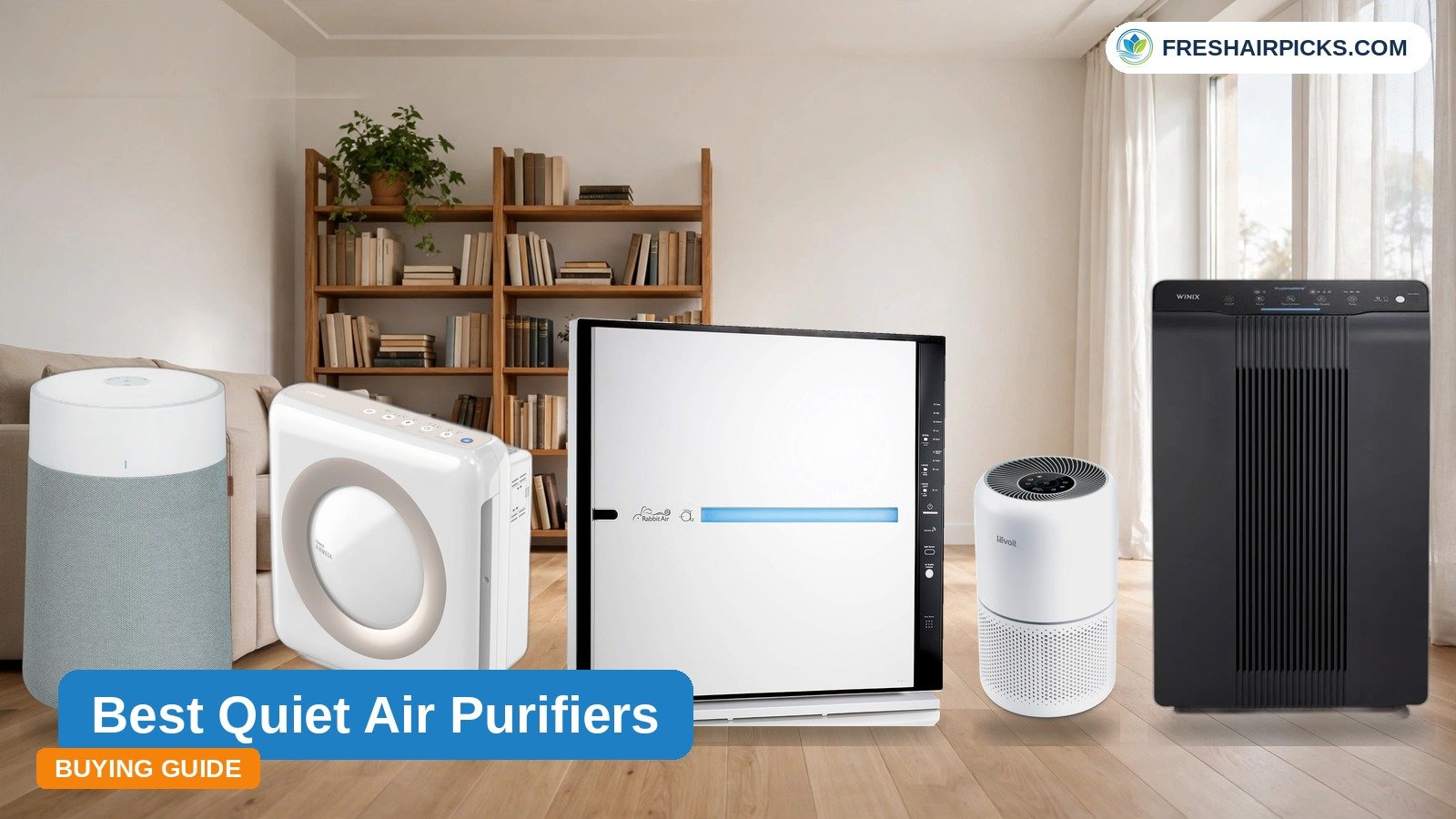
A nursery is the one room where the usual buying logic reverses: power takes a backseat to quiet, and every extra feature is a question, not a selling point. New cribs, mattresses and paint off-gas VOCs, dust and diaper odors fill the air, and the baby sleeping ten feet away needs the room clean without noise, without ozone, and without a machine that becomes one more thing to manage at 3 a.m. This guide ranks nursery machines on what actually matters here: ionizer and ozone safety, sleep noise, verified CADR for a nursery-sized room, and running costs.
This guide contains no test results. FreshAirPicks does not lab-test air purifiers. Every number below traces to a manufacturer specification or a labelled independent measurement, and where a figure could not be verified, the guide says so. It also makes no medical claims: a purifier reduces airborne particles — it does not protect hearing, prevent illness, or inhibit pathogens, and no machine here claims otherwise.
Quick answer: For the quietest nursery, buy the Blueair 511i Max (~$113–140) — 19 dB on its night setting, the quietest verified figure here. For the safest default, the Levoit Core 300S (~$99.99) has no ionizer at all, a 22 dB sleep floor, and AHAM-verified 219 sq ft. For a larger or open-plan nursery, the Levoit Vital 200S-P ($159.99) covers 388 sq ft with no ionizer. For the strongest small-room numbers, the Winix A231 (~$99.99) brings AHAM ~159 smoke CADR — with its PlasmaWave switched OFF, always. For a tiny nursery or a nightstand, the Blueair Blue Pure Mini Max (check current price) brings AHAM-verified 60 CFM in a 2.8 lb machine.
My Top Picks at a Glance
| Product | Best for | Verified coverage | Sleep noise | Ionizer question | Price | Score |
|---|---|---|---|---|---|---|
| Blueair 511i Max | Quietest nursery | 237 sq ft (AHAM) | 19 dB night | HEPASilent electrostatic, always on | ~$113–140 | 8.5 |
| Levoit Core 300S | Safest default | 219 sq ft (AHAM) | 22 dB sleep | None on standard model | ~$99.99 | 8.3 |
| Levoit Vital 200S-P | Larger nursery | 388 sq ft (AHAM) | Not published | None | $159.99 | 8.0 |
| Winix A231 | Strongest small numbers | 246 sq ft (AHAM) | 35.2 dB speed 1 | Switchable — keep OFF | ~$99.99 | 7.7 |
| Blueair Blue Pure Mini Max | Tiny nursery | 93 sq ft (AHAM) | 20 dB floor | HEPASilent electrostatic, always on | Check price | 7.0 |
How We Chose These Five
Nursery ranking needs different weights from a living-room guide:
- Ozone and ionizer safety (30%). The safest defaults are machines with no ionizer at all, or a switchable ionizer kept off. Electrostatic stages that cannot be switched off are disclosed, not hidden.
- Sleep noise (30%). A nursery machine lives feet from a crib. Night-mode and sleep-floor figures decide this, not top-speed numbers.
- Verified CADR for nursery size (25%). Nurseries are typically 100–250 sq ft. AHAM or labelled measurements only.
- Running costs (15%). Filter price divided by filter life — a nursery machine runs all day, every day.
1. Blueair 511i Max — Best Quietest Nursery
Score: 8.5/10 · ~$113–140
| Spec | Detail |
|---|---|
| CADR (smoke) | 153 CFM (AHAM-listed) |
| Coverage @4.8 ACH | 237 sq ft |
| Filtration | HEPASilent + carbon layer; washable fabric pre-filter sleeve |
| Filter cost | ~$40/yr (Particle + Carbon filter ~$30–36, up to 9 months) |
| Power | 17 W max |
| Noise | 19 dB night mode — quietest verified figure here |
| Size / weight | 10.6 × 10.6 × 18.9 in; 4.2 lb |
| Extras | App, auto mode, air quality sensor |
The 511i Max is the nursery pick because it wins the constraint that matters most: sleep. Nineteen decibels on its night setting is the quietest verified figure in this guide, and it comes in a 4.2 lb machine that moves room to room with one hand. Its AHAM-listed 153 smoke CADR covers 237 sq ft — more than most nurseries — and at 17 W max it costs almost nothing to run around the clock. Its washable fabric pre-filter sleeve is a nursery feature too: pull it off, wash it, and the dust never reaches the main filter.
The disclosure that must travel with it: HEPASilent is a mechanical plus electrostatic stage, not a True HEPA filter in the conventional sense, and it cannot be switched off — the electrostatic stage is always part of the cleaning. Blueair markets the stage as ozone-free, and this guide does not claim otherwise; but if you want no electrostatic stage in the nursery at all, the two Levoit picks below are pure-mechanical machines with nothing of the kind.
Who it’s for: Parents whose first priority is the quietest verified sleep setting, in a standard-size nursery.
2. Levoit Core 300S — Best Safest Default
Score: 8.3/10 · ~$99.99
| Spec | Detail |
|---|---|
| CADR (smoke / dust / pollen) | 141 / 156 / 175 CFM (AHAM) |
| Coverage @4.8 ACH | 219 sq ft |
| Filtration | True HEPA + carbon pre-filter |
| Filter cost | ~$45–60/yr |
| Power | 26 W max |
| Noise | 22 dB sleep floor |
| Size / weight | 8.7 × 8.7 × 14.2 in; 7.5 lb |
| Extras | VeSync app, auto mode, sleep mode, display-off |
The Core 300S is the safest nursery default because its safety case is the simplest: the standard model has no ionizer at all — nothing to switch off, nothing to forget, nothing to explain to a babysitter. It pairs that with a 22 dB sleep floor and a display-off sleep mode for a dark room, AHAM-verified 141 smoke CADR covering 219 sq ft, and app control and auto mode at ~$99.99 with $45–60 annual filters.
The standing warning, and it matters more here than anywhere: buy the standard Core 300S, never the Core 300S-P “PlasmaPro” variant — the names are nearly identical and the -P adds a plasma ionizer function a nursery does not need. Check the suffix on the box before it enters the baby’s room.
Who it’s for: The default nursery pick — no ionizer, quiet sleep, verified coverage, fair price.
3. Levoit Vital 200S-P — Best Larger / Open-Plan Nursery
Score: 8.0/10 · $159.99
| Spec | Detail |
|---|---|
| CADR (smoke / dust / pollen) | 250 / 254 / 289 CFM (AHAM) |
| Coverage @4.8 ACH | 388 sq ft |
| Filtration | True HEPA + carbon pre-filter; washable pre-filter |
| Filter cost | ~$50/yr |
| Power | 50 W rated |
| Noise | Noise floor not published in the sources used |
| Size / weight | 15.6 × 8.5 × 19.8 in; 13.2 lb |
| Extras | Pet Mode; app and auto mode; no ionizer |
The Vital 200S-P is the larger-nursery pick: AHAM-verified 250 smoke CADR covering 388 sq ft — enough for an open-plan nursery, a nursery that flows into a playroom, or a room shared with a toddler bed — at $159.99 with ~$50 annual filters, a washable pre-filter, and no ionizer at all. (The “-P” here is not a plasma variant; this machine has no ionizer, full stop.)
Its limits: a carbon pre-filter, not a carbon stage — light smells only, not new-furniture VOCs. And its noise floor is not published in the sources used, so if the nursery must be silent at night, that unknown matters; the Blueair’s 19 dB and the Core 300S’s 22 dB are the known-quiet figures.
Who it’s for: A larger nursery, an open-plan nursery, or a room that will grow with the child.
4. Winix A231 — Best Strongest Small-Room Numbers
Score: 7.7/10 · ~$99.99
| Spec | Detail |
|---|---|
| CADR (smoke) | ~159 CFM (AHAM) |
| Coverage @4.8 ACH | 246 sq ft (manual Verified Room Size) |
| Filtration | True HEPA + carbon filter; vacuum-cleanable pre-filter |
| Filter cost | Filter O ~$50/yr (12 months, often discounted into the $30s) |
| Power | 55 W rated |
| Noise | 35.2 dB at speed 1 (HouseFresh measured) |
| Size / weight | 9.5 × 9.5 × 14.6 in; ~7 lb |
| Extras | Auto mode with air quality sensor; PlasmaWave switchable — MUST be OFF in a nursery |
The A231 is the strongest small machine on this site by verified numbers: AHAM smoke CADR near 159 CFM and a HouseFresh-measured 148 CFM PM1 at top speed, covering 246 sq ft, with a vacuum-cleanable pre-filter and auto mode, at ~$99.99 street with ~$50 annual filters. For a dusty nursery — pets in the house, a street-facing window — its extra CADR is real.
Its nursery condition is non-negotiable and is stated as a rule, not a footnote: PlasmaWave MUST be OFF in a nursery, always, and the button should be checked after any power cut or move. Its 35.2 dB at its lowest measured speed is also louder at the bottom end than the Blueair or the Levoit — if sleep quiet is the first priority, those win; if verified cleaning power is, this does.
Who it’s for: A dusty or pet-filled home where verified CADR matters most — with PlasmaWave OFF, always.
5. Blueair Blue Pure Mini Max — Best Tiny Nursery / Nightstand
Score: 7.0/10 · Check current price
| Spec | Detail |
|---|---|
| CADR | 60 CFM (AHAM, ANSI/AHAM AC-1-2020) |
| Coverage @4.8 ACH | 93 sq ft |
| Filtration | HEPASilent + carbon layer; washable fabric pre-filter |
| Filter cost | FMINI filter every 6 months — check current filter price |
| Power | 2–10 W |
| Noise | 20–44 dB(A) |
| Size / weight | 6.8 × 6.8 × 11.4 in; ~2.8 lb |
| Extras | Two-button control; no app, no sensor |
The Mini Max is the tiny-nursery pick: AHAM-verified 60 CFM covering 93 sq ft, 2–10 W power draw, a 20 dB floor, and 2.8 lb — small enough for a nightstand, quiet enough for a crib corner, simple enough for a sleep-deprived parent (two buttons is the whole interface). Its washable fabric pre-filter is a real Blueair feature at this size.
Its limits: 93 sq ft is a crib corner or a tiny nursery, not a room; its filter changes every 6 months, twice the rhythm of the other picks; and its US price and filter price could not be verified in the October 2026 sources used — check both before buying. The same HEPASilent disclosure as the 511i Max applies: the electrostatic stage cannot be switched off, so buyers who want a fully mechanical machine should choose a Levoit above.
Who it’s for: A tiny nursery, a crib corner, or a nightstand — bought only after checking it is actually in stock.
Buying Guide: Quiet, No Ionizer, Then Ventilation for VOCs
Choose the ionizer answer first, then the machine. The safest nursery defaults are machines with no ionizer (Core 300S, Vital 200S-P) or a switchable ionizer kept off (A231, checked after every power cut). Electrostatic stages that cannot be switched off (both Blueairs) are disclosed above — Blueair markets them as ozone-free, and this guide does not claim otherwise — but the choice belongs to the parent, not the marketing.
Judge a nursery machine by its quiet speeds. A nursery machine lives feet from a crib. The Blueair’s 19 dB and the Core 300S’s 22 dB are known-quiet figures; the Vital’s unpublished floor and the A231’s 35.2 dB are the honest unknowns and trade-offs. A machine switched off at night cleans nothing.
VOCs from new furniture need ventilation first. New cribs, mattresses and paint off-gas gases, and gases need carbon weight — none of these small picks holds pounds of it. The practical nursery answer is ventilation (open windows, time, low-VOC finishes) plus a mechanical HEPA pick for particles. The deep-carbon machine (Austin HealthMate, 15 lb) is loud, heavy and $844.99 — wrong for a nursery except as a noted alternative, not a rank.
What the old post got wrong, plainly. Its title promised “Lab-Tested” results and its intro claimed lab testing against the AHAM protocol with laser particle meters and acoustic testing against pediatric guidelines — testing this site does not do. Its “pathogen inhibition” and hearing-protection framing claimed medical benefits no purifier claims in this guide. Its best-overall pick (Momcozy CozyBreath) and its large-nursery pick (Core 600S-P) could not be verified to this guide’s standard and are not ranked. The AROEVE avoid-warning survives: the MK01 has no verified CADR and is not ranked here.
Frequently Asked Questions
Is an air purifier safe for a baby’s room?
Yes, with the right machine and the right settings: no ionizer (or a switchable ionizer kept off), a quiet night mode, and a machine sized to the room. Avoid ionizer-first machines and any machine whose ozone output is not clearly stated. If your pediatrician has specific guidance for your child, that guidance wins over any guide.
Should a nursery air purifier have an ionizer?
No — this guide recommends against it for nurseries. The safest picks have no ionizer at all (Core 300S, Vital 200S-P). If a machine has a switchable ionizer (Winix A231), keep it OFF and check it after any power cut. Electrostatic stages that cannot be switched off (both Blueairs) are disclosed in this guide so the choice is yours, not the marketing’s.
How quiet should a nursery air purifier be?
As quiet as verified figures allow: the Blueair’s 19 dB night mode and the Core 300S’s 22 dB sleep floor are the known-quiet numbers here. A machine that hums at 35+ dB on its lowest setting risks the very sleep it is bought to protect — and a machine switched off at night cleans nothing.
Do air purifiers remove VOCs from new furniture and paint?
Only the carbon stage does — HEPA removes particles, not gases — and small nursery machines carry thin carbon layers, not pounds of it. Ventilation removes more VOCs than any small machine: open windows, give the room time, and choose low-VOC finishes. A purifier is the second stage, not the first.
What size air purifier does a nursery need?
Most nurseries are 100–250 sq ft, and every pick here except the Mini Max covers that range at a real air-change rate. Measure the room, not the box claim: a machine advertised for 1,000+ sq ft delivers roughly one air change per hour there, far below the 4.8–5 ACH benchmark used in this guide.
Is the Momcozy CozyBreath still a good nursery pick?
Not ranked here — its cleaning rate could not be verified to this guide’s standard in the sources used. The old post ranked it best overall on claims (zero ozone, silver-ion control, 21 dB sleep) that this guide could not cite from a CADR listing or a labelled measurement. Until its numbers are citable, the verified picks above are the answer.
Is the AROEVE MK01 really a bad nursery pick?
Yes — as an avoid, not a rank. The MK01 has no verified CADR in the sources used, so its cleaning rate cannot be compared with any pick here, and its tiny size suits a desk, not a nursery. A nursery budget is better spent on the Core 200S’s verified numbers or the Mini Max’s verified 60 CFM than on an unverified desk gadget.
Conclusion
Nursery air is decided by safety, sleep and verified numbers: the Blueair 511i Max is the quietest answer, the Levoit Core 300S the safest-default answer, the Levoit Vital 200S-P the larger-nursery answer, the Winix A231 the strongest-numbers answer (PlasmaWave OFF, always), and the Blueair Mini Max the tiny-nursery answer — each with its ionizer question answered, its sleep noise stated, and its coverage verified. Check the suffix, keep ionizers off, ventilate for VOCs, and let the machine run quietly.
Prices checked October 2026 and will drift; specifications are drawn from AHAM Verifide listings, manufacturer publications and labelled independent measurements, as noted throughout. This guide contains no hands-on test results.