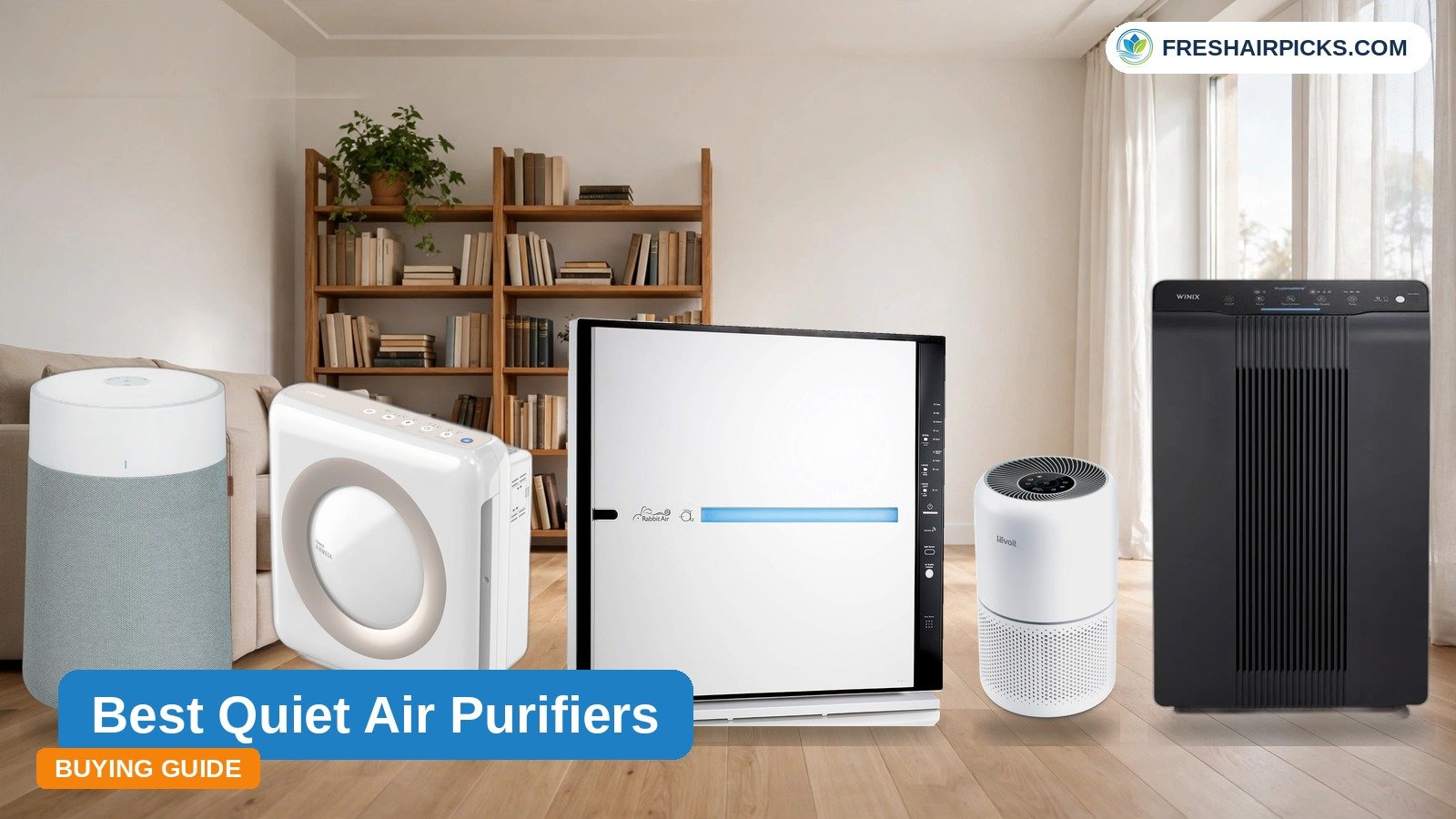
Start with the sentence most “whole home” guides will not print: no single portable air purifier cleans a whole home. A machine rated for 2,640 sq ft at one air change per hour is not cleaning your house — it is moving air through a filter once an hour, while the bedrooms, the nursery and the home office sit behind closed doors breathing their own air. Real whole-home air comes from exactly two routes: an in-duct system wired into your HVAC that filters every cubic foot the blower moves, or one verified machine per lived-in room. This guide ranks both routes honestly, and says which one fits your house.
This guide contains no test results. FreshAirPicks does not lab-test air purifiers. Every number below traces to a manufacturer specification or a labelled independent measurement, and where a figure could not be verified, the guide says so.
Quick answer: If you have ducted HVAC, buy an in-duct system: the Aprilaire 5000 (~$790 plus professional installation) is the value pick, and the Lennox PureAir S (typically $1,200–$2,500 installed) is the most complete — MERV 16 filtration plus odor-destroying photocatalytic oxidation. If you rent or have no ductwork, buy one machine per lived-in room: the Blueair 211i Max (~$228–350) anchors the living room and the Coway Mighty (~$155) anchors each bedroom. The Trane CleanEffects (typically $1,000–$3,500 installed) has the strongest particle-removal claim of any in-duct system — and the strictest cleaning discipline.
My Top Picks at a Glance
| Product | Route | Best for | Verified performance | Price | Score |
|---|---|---|---|---|---|
| Aprilaire 5000 | In-duct HVAC | Value whole-home | MERV media, ~99.9% pollen/spores (mfr) | ~$790 + install | 8.4 |
| Lennox PureAir S | In-duct HVAC | Complete system | MERV 16, >95% @ 0.3 micron (Lennox) | $1,200–$2,500 installed | 8.2 |
| Blueair Blue Pure 211i Max | Per-room anchor | Large living rooms | 435 smoke CADR (AHAM) | ~$228–350 | 8.0 |
| Trane CleanEffects | In-duct HVAC | Particle capture claim | Up to 99.98% @ 0.3 micron (Trane) | $1,000–$3,500 installed | 7.9 |
| Coway Airmega Mighty | Per-room anchor | Bedrooms | 233 smoke CADR (AHAM) | ~$155 | 7.8 |
How We Chose These Five
Whole-home ranking needs different weights from a room guide:
- True whole-home coverage (40%). Does it actually reach every room — through ductwork, or by placing a machine in each lived-in space? A big-room machine alone scores low here no matter its CADR.
- Verified performance (30%). AHAM CADR for portables; manufacturer MERV and capture figures for in-duct systems, labelled as manufacturer figures.
- Total cost including installation (20%). In-duct prices are installed prices, not unit prices — a $790 unit with a $500 install is a $1,290 system.
- Maintenance burden (10%). Annual media, yearly lamp and catalyst, or a cleaning schedule you must actually keep.
1. Aprilaire 5000 — Best Value In-Duct System
Score: 8.4/10 · ~$790 plus professional installation
| Spec | Detail |
|---|---|
| Type | Electronic air cleaner, mounted on the HVAC return duct |
| Filtration | Media + electronic stage; up to 99.9% pollen/spores, 95% tobacco smoke/smog/bacteria (Aprilaire figures) |
| Unit price | $789.99 (retailer listing, October 2026) |
| Installation | Professional install required; quotes vary, typically a few hundred dollars on top of the unit |
| Maintenance | Filter media replaced about annually |
| Warranty | 5 years (registration required) |
| Limitation | Works only when the HVAC fan runs |
The 5000 is the value answer to the whole-home question because it is the cheapest way to filter every room your ductwork reaches. Mounted on the return duct, it cleans the air the blower already moves — no counter space, no noise in the bedroom, no second machine to remember. Aprilaire’s capture figures (up to 99.9% of pollen and spores, 95% of smoke, smog and bacteria) are manufacturer figures rather than AHAM numbers, and are labelled as such; what is independently solid is the design — a whole-home media system with a 5-year warranty and roughly annual media changes, at a unit price hundreds below the Lennox and Trane systems.
Two honesty notes. First, the total price is not $790: professional installation is required, and quotes vary by home — budget the unit plus several hundred dollars of labor, and get the quote before you buy. Second, and this applies to every in-duct pick here: the system cleans only while the HVAC fan runs. In mild seasons when neither heat nor cooling runs, set the fan to circulate on a schedule or the “whole home” system is a box on a duct doing nothing.
Who it’s for: Homeowners with ducted HVAC who want whole-home filtration at the lowest total cost.
2. Lennox PureAir S — Best Complete In-Duct System
Score: 8.2/10 · Typically $1,200–$2,500 installed
| Spec | Detail |
|---|---|
| Type | In-duct cabinet: MERV 16 filter + UVA photocatalytic oxidation |
| Particle filtration | Carbon Clean 16 MERV 16: >95% of particles 0.3 micron and larger, >90% of particles 0.01 micron and larger (Lennox) |
| Odor / vapor stage | UVA light activates a titanium dioxide catalyst that breaks down odors and chemical vapors |
| Ozone | Produces no ozone (Lennox); helps reduce ambient ozone |
| Maintenance | Filter, UV lamp and catalyst cartridge each replaced yearly |
| Power | 58 W nominal |
| Limitation | Works only when the HVAC fan runs; professional install required |
The PureAir S is the most complete in-duct system here because it is the only one that attacks all three pollutant classes in one cabinet: particles through a MERV 16 filter, germs through the same high-efficiency media, and odors and chemical vapors through photocatalytic oxidation — a UVA light activating a titanium dioxide catalyst that breaks vapors down into carbon dioxide and water rather than merely trapping them. Its particle figures (>95% at 0.3 micron, >90% at 0.01 micron) are Lennox’s, and its installed price range ($1,200–$2,500 in contractor accounts) is wide because every home’s ductwork differs — get a local quote.
The maintenance is the honest cost: filter, UV lamp and catalyst are each a yearly replacement, done at the annual maintenance visit. That is three consumables a year against the Aprilaire’s one media change, and the reason the PureAir S ranks second despite being the more complete machine. For a home with allergy sufferers plus cooking, pet and paint odors, it is the right spend; for particles alone, the Aprilaire does the job for less.
Who it’s for: Allergy households that also fight odors and chemical vapors — pets, cooking, renovation — through one ducted system.
3. Blueair Blue Pure 211i Max — Best Per-Room Anchor
Score: 8.0/10 · ~$228–350
| Spec | Detail |
|---|---|
| CADR (smoke / dust / pollen) | 435 / 452 / 450 CFM (AHAM) |
| Coverage @4.8 ACH | 674 sq ft |
| Filtration | HEPASilent: mechanical filter + electrostatic charging stage + carbon layer |
| Filter cost | F2MAX filter $69.99, 6–9 months → ~$93–140/yr |
| Power | 46 W max |
| Noise | 23–53 dB |
| Size / weight | 13 × 13 × 21.9 in; 14.8 lb |
The 211i Max is the per-room route’s anchor: the machine you put in the large living space when there is no ductwork to do the job, or alongside an in-duct system in the room where the family actually lives. Its AHAM numbers are the strongest of any portable in this site’s guides — 435 smoke CADR covering 674 sq ft at the full standard — and its street price (seen at $227.99 against a $349.99 list) makes the multi-room strategy affordable: three rooms at street prices cost roughly what one in-duct install costs.
The disclosures follow every Blueair in this site’s guides: HEPASilent pairs a mechanical filter with an electrostatic charging stage that cannot be switched off, and the filter itself is not a True HEPA filter — the CADR numbers are real and verified, the technology is different. And the framing matters: one 211i Max is a large-room machine, not a whole-home machine. The whole-home strategy is one per lived-in room — living room, primary bedroom, nursery — not one hero unit in the hallway.
Who it’s for: Homes without ductwork, and the living-room anchor in any per-room strategy.
4. Trane CleanEffects — Best In-Duct Particle Claim
Score: 7.9/10 · Typically $1,000–$3,500 installed
| Spec | Detail |
|---|---|
| Type | In-duct electronic air cleaner with collection cells |
| Particle removal | Up to 99.98% of particles down to 0.3 micron (Trane) |
| Clean air delivery | 1,200 CADR (Trane’s own figure, NOT AHAM) |
| Certifications | AAFA Asthma & Allergy Friendly; Intertek-certified zero ozone |
| Maintenance | Cleanable filter — vacuum or rinse every 3–9 months; no replacement filters |
| Limitation | Works only when the HVAC fan runs; professional install required |
The CleanEffects carries the strongest particle-removal claim of any in-duct system here — up to 99.98% down to 0.3 micron, tested by LMS Technologies and EH&E with results verified by Harvard School of Public Health professors, plus AAFA certification and an Intertek zero-ozone certification. Its cleanable filter is a genuine long-term saving: vacuum or rinse every 3–9 months and there are no replacement filters to buy, ever.
The caveat is why it ranks fourth: that claim depends on cleaning the collection cells on schedule. Independent testing cited by critics found particle removal dropping sharply after just two months when cleaning was skipped, and the unit is the most air-restrictive of its class when dirty. The installed price spread ($1,000–$3,500) is also the widest here. Buy it if you will keep the cleaning schedule — or pay a technician to — and get a firm local quote first; skip it if maintenance is the thing your household forgets.
Who it’s for: Allergy and asthma households with ducted HVAC who will keep a cleaning schedule — or pay for one.
5. Coway Airmega Mighty AP-1512HH — Best Per-Room Bedroom Anchor
Score: 7.8/10 · ~$155 street
| Spec | Detail |
|---|---|
| CADR (smoke / dust / pollen) | 233 / 246 / 240 CFM (AHAM) |
| Coverage @4.8 ACH | 361 sq ft |
| Filtration | True HEPA + carbon pre-filter |
| Filter cost | ~$60–70/yr |
| Power | 77 W max |
| Noise | Quiet operation with Eco Mode |
| Warranty | 3 years |
| Extras | Eco Mode; filter replacement indicator |
The Mighty is the bedroom anchor in the per-room strategy: AHAM-verified 233 smoke CADR covering 361 sq ft — more than any bedroom needs — at a street price around $155 with $60–70 annual filters. It is the machine you buy three of (living room aside) without the budget breaking, and its 3-year warranty is solid for the price.
The disclosure follows every Mighty in this site’s guides: the original Mighty has an ionizer that emits trace ozone (~9 ppb, CARB-safe) — switchable, but present. The no-ionizer successor is the Mighty2 ($269.99, Coway-rated rather than AHAM-verified), so buyers who want zero ionizer pay more for weaker evidence. For bedrooms, the original’s verified CADR at $155 is the better value; run it with the ionizer off if the feature concerns you.
Who it’s for: Bedrooms in a per-room strategy — verified cleaning at the lowest anchor price here.
Buying Guide: The Two Routes, Decided
Route one — in-duct, if you have ductwork. One system, every room, silent. The Aprilaire 5000 is the value; the Lennox PureAir S is the complete system; the Trane CleanEffects is the strongest claim with the strictest upkeep. All three share the same condition: they work only when the fan runs, so set a circulation schedule in mild seasons, and get a local installed quote — the spread between quotes is wider than the spread between units.
Route two — one per lived-in room, if you rent or have no ducts. A 211i Max in the living room, a Mighty in each bedroom, a 511i Max in the small rooms (see our small rooms guide). Three verified machines at street prices cost roughly one in-duct install, and each room gets its own verified CADR instead of sharing one system’s airflow through closed doors.
The claim to never believe. Any portable rated for thousands of square feet at one air change per hour. Divide any coverage claim by five to approximate the 4.8 ACH standard this site uses: a “2,640 sq ft” machine is a ~528 sq ft machine at full air changes, and a “1,500 sq ft” machine is a 300 sq ft machine. The old post’s central pick carried exactly this kind of inflated figure, and it is not repeated here.
What the old post got wrong, plainly. Its title promised whole-home coverage and its body claimed lab testing this site does not do; its “test data” was invented precision (a 352 smoke CADR for the Airmega 350 that this guide could not cite from an AHAM listing, a “17 minutes to PM1 zero” chamber result, a 9.5/10 score); its picks mixed small-room machines (Airmega 100, Core 200S-P) and an obscure brand (LUNINO K3) into a whole-home answer; and its “avoid” slot (PuroAir 240) warned about a $247 annual cost while the real money pit is a portable bought to do a duct system’s job. All five old picks are replaced above.
Frequently Asked Questions
Can one air purifier clean my whole house?
No — not a portable one. A portable cleans the room it sits in; closed doors stop its air from reaching the bedrooms. True whole-home cleaning needs either an in-duct HVAC system that filters all the air the blower moves, or one verified machine per lived-in room.
Do I need ductwork for a whole-home air purifier?
For an in-duct system, yes — the Aprilaire 5000, Lennox PureAir S and Trane CleanEffects all mount into ductwork and need professional installation. Without ducts, the per-room route (a 211i Max in the living room, a Mighty per bedroom) is the honest whole-home answer.
How much does a whole-home air purifier cost installed?
The Aprilaire 5000 runs ~$790 for the unit plus professional installation (a few hundred dollars more, quotes vary). The Lennox PureAir S typically runs $1,200–$2,500 installed, and the Trane CleanEffects $1,000–$3,500 installed. Always get a local quote — the spread between homes is wider than the spread between units.
Does a whole-home system work when the heat and AC are off?
Only if the fan runs. In-duct systems clean the air the blower moves, so in mild seasons when neither heating nor cooling runs, set your thermostat’s fan to circulate on a schedule — otherwise the system sits idle while the house air goes stale.
Is the Trane CleanEffects really 99.98% effective?
That is Trane’s figure for particles down to 0.3 micron, from testing verified by Harvard School of Public Health professors — and it depends on cleaning the collection cells every 3–9 months. Independent testing cited by critics shows removal dropping sharply when cleaning is skipped, so the claim comes with a maintenance condition.
What is the cheapest way to get whole-home air?
One verified machine per lived-in room at street prices: a 211i Max in the living room (~$228) and a Mighty in each bedroom (~$155 each) costs roughly one in-duct install for a three-room home, with no contractor and no ductwork needed. Renters should take this route.
Should I buy a portable or an in-duct system?
If you own a ducted home and plan to stay, in-duct: silent, invisible, every room. If you rent, move often, or have no ducts, portables: one per room, verified CADR each, and they move with you. Either route beats one big portable in a hallway claiming to clean a house.
Conclusion
Whole-home air is a system, not a product: the Aprilaire 5000 is the value in-duct answer, the Lennox PureAir S the complete one, the Trane CleanEffects the strongest claim with the strictest upkeep — and where ducts do not exist, a 211i Max in the living room and a Mighty in each bedroom is the honest whole-home strategy. Pick the route that fits your house, not the coverage number that fits an ad.
Prices checked October 2026 and will drift; specifications are drawn from AHAM Verifide listings, manufacturer publications and labelled independent measurements, as noted throughout. This guide contains no hands-on test results.