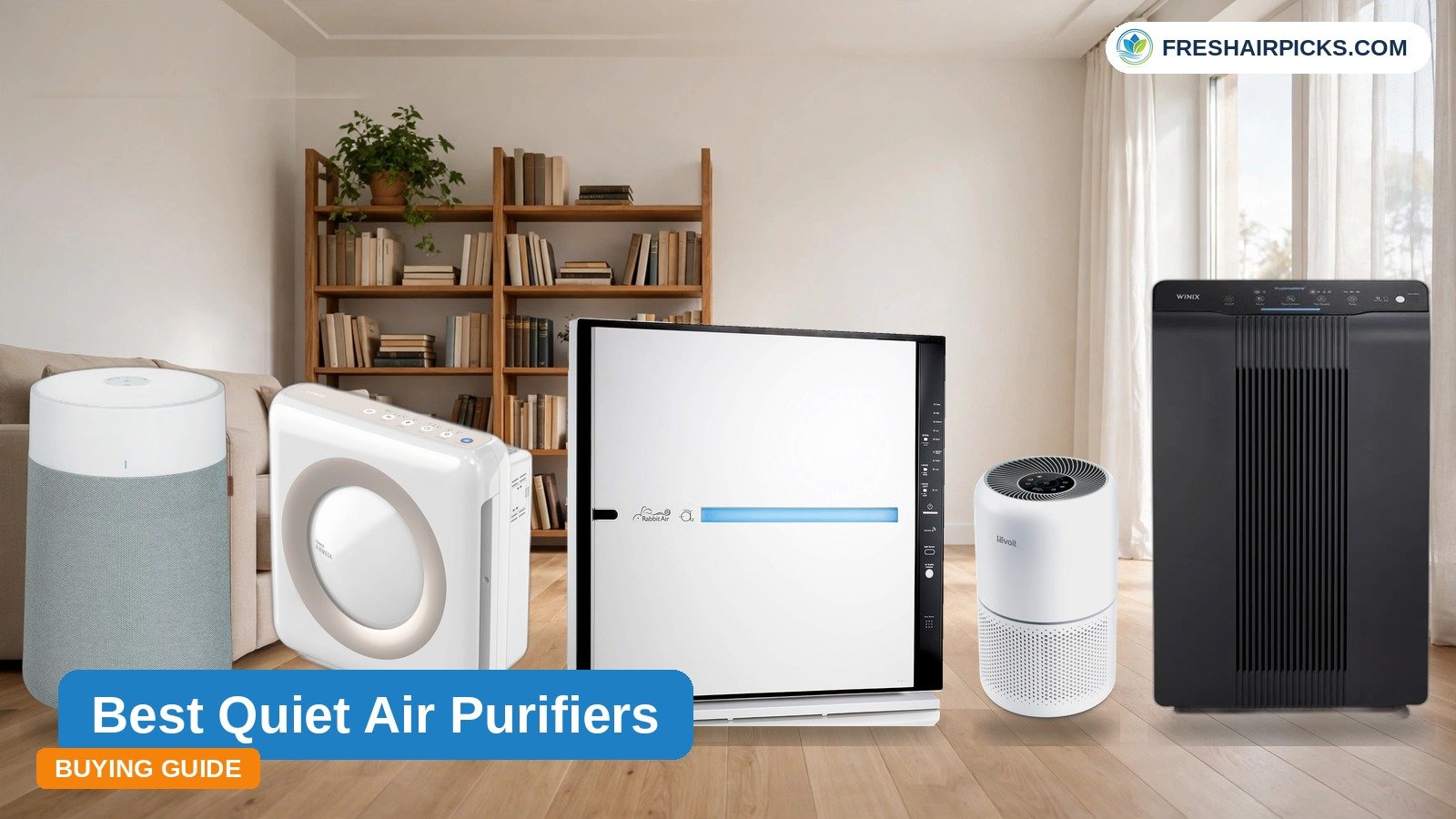
A purifier earns its place in a pet home on the invisible problem, not the visible one — so here is the honest split up front. The hair you can see is heavy: it floats briefly, settles on floors and furniture, and no purifier will lift it from either; that is a vacuum and grooming job, and our explainer on whether air purifiers help with pet hair walks through exactly where the machine’s role ends. What a good purifier genuinely does is the part you can’t see: it captures the microscopic dander that carries pet allergens — the fine fraction of cat allergen stays airborne for hours — and, if its carbon stage is substantial, it adsorbs litter and “wet dog” odors instead of masking them. It will not make a pet-allergic home allergen-free; allergists are clear that source control does that heavy lifting, and the purifier supports it. Within that honest job description, though, the right machine makes a shedding, smelling house measurably easier to live in.
That is why this guide ranks on three verified things: CADR, which decides how much of your room’s air actually passes through the filter each hour; pre-filter design, because hair that mats a HEPA filter strangles it, and a washable pre-filter is what stands between a pet home and a clogged machine; and activated carbon weight and form, which decides whether pet odor stands a chance. Every pick below has verified ratings behind it, and every running cost is printed next to the price — including what heavy shedding does to the filter bill.
Quick Answer
- Top pick: Levoit Vital 200S-P — $159.99. AHAM-verified CADR (250 smoke) with the highest pollen rating in this guide, a washable pre-filter and a U-shaped inlet built to pull in floating hair — plus the cheapest filters here.
- Best for large rooms and multi-pet homes: Coway Airmega 400 — $629.99. A smoke CADR of 376 (AHAM-tested, via ENERGY STAR) covering 583 sq ft, two washable pre-filters, and no ionizer at all.
- Budget pick: Levoit Core 300S — $99.99. The honest small-room buy, with its limits stated: an AHAM smoke CADR of 141, a thin carbon layer, and a pre-filter you can’t wash — the one real flaw in a shedding home.
How these picks were chosen
FreshAirPicks doesn’t run a testing lab, and this page contains no first-person test claims. (An earlier version of this guide claimed first-person lab testing — a decibel meter on a tripod, optical particle counters, per-product test scorecards and invented metrics; that was wrong, and it’s gone.) The rankings rest on the US Association of Home Appliance Manufacturers’ CADR ratings — independently tested figures reported through AHAM‘s Verifide directory and the US ENERGY STAR program — manufacturer specifications, and the measured results published by reviewers who do test, chiefly HouseFresh. Prices and filter costs were checked in October 2026 against the sources named in our research notes. Where a manufacturer rates its own machine without independent verification, the table says so — and for a pets guide there is a second place that distinction bites: carbon. Brands rarely publish carbon weight, so where a weight could not be verified, this guide says the stage is modest instead of guessing a number.
The 5 best air purifiers for pets at a glance
| Product | Price | CADR (smoke/dust/pollen) | Coverage @ 4.8 ACH | Filter cost/yr | 3-year cost* | Noise | Best for |
|---|---|---|---|---|---|---|---|
| Levoit Vital 200S-P | $159.99 | 250 / 254 / 289 (AHAM) | 388 sq ft | ~$50 (~$100 with heavy shedding) | ~$310 | 24–54 dB | Most pet homes; dander and everyday hair |
| Winix 5510 | $179.99 | 253 / 252 / 247 (AHAM) | 392 sq ft | ~$80 | ~$420 | 35–67 dBA (measured) | Shedding dogs and litter-box odor |
| Coway Airmega 400 | $629.99 | 376 / 384 / 409 (AHAM via ENERGY STAR) | 583 sq ft | ~$129 | ~$1,017 | 22–52 dB (Coway-rated) | Large rooms and multi-pet homes |
| Coway Airmega Mighty2 | $269.99 | 240 / 242 / 249 (Coway-rated) | 372 sq ft | $69.99 | ~$480 | 19–50 dB (Coway-rated) | Small spaces; zero ionization |
| Levoit Core 300S | $99.99 | 141 / 156 / 175 (AHAM smoke; see note) | 219 sq ft | ~$45–60 | ~$235–280 | 22–55 dB | Small bedrooms on a budget |
* 3-year cost = unit price + three years of replacement filters at typical (non-shedding-home) intervals; electricity excluded (it typically adds a few dollars a month, depending on speed and your rate). Coverage assumes 8-foot ceilings. CADR note: the Vital 200S-P, Winix 5510 and Core 300S carry AHAM-verified ratings, and the Airmega 400’s are AHAM-tested values reported to ENERGY STAR — Coway’s own store page lists a lower smoke figure (328) for that model; the ENERGY STAR record is used here, the same basis this site used for the Coway ProX. The Mighty2’s CADR is Coway-rated, not AHAM-verified, and is labelled as such wherever it appears. The Core 300S’s firmly verified figure is its AHAM smoke CADR of 141 — its dust/pollen split comes from secondary sources, which is why the budget pick is sized by smoke like everything else here.
1. Levoit Vital 200S-P — Best Overall for Pets
The Vital 200S-P is the pick the whole field keeps converging on for pet homes, and the verified numbers explain why. Its AHAM CADRs — 250 smoke / 254 dust / 289 pollen, the highest pollen figure in this guide — cover 388 sq ft at 4.8 air changes an hour through a true HEPA filter, and pollen CADR is the closest proxy here for the coarse end of the dander range. The pet-specific hardware is real rather than decorative: a washable pre-filter on its own panel, a U-shaped air inlet shaped to draw in floating hair before it settles, and a Pet Mode in the VeSync app. It is AHAM Verifide, ENERGY STAR certified and CARB listed — and there is no ionizer to think about.
It is also easy to live with around the clock, which is how pet duty works: HouseFresh measured it still delivering roughly 128 CFM on speed 2 at 41.9 dBA, conversation level, so it keeps scrubbing dander on a quiet medium speed instead of only when you can tolerate turbo. The running costs are the lowest of any full-size pick here: the filter is $49.99, rated about a year — a 3-year cost of roughly $310.
The honest caveats are two. In a heavy-shedding home the filter interval can halve, so budget ~$100 a year instead of $50 — still cheap, but not the headline figure. And its carbon stage, while pelleted rather than a token sheet, is modest (Levoit doesn’t publish a weight): fine for everyday pet smell, not a match for a serious litter-box problem. That is the Winix’s job, for $20 more.
| Spec | Vital 200S-P |
|---|---|
| Price | $159.99 (Amazon) |
| CADR (smoke/dust/pollen) | 250 / 254 / 289 (AHAM Verifide) |
| Room coverage @ 4.8 ACH | 388 sq ft |
| Filters | $49.99, ~12 months (~$50/yr; ~$100/yr with heavy shedding) |
| Noise | 24–54 dB (rated) |
| Dimensions | 15.6 × 8.5 × 19.8 in |
| Weight | 13.2 lb |
| Ionizer | No |
Best for: most pet homes — bedrooms and living rooms up to ~390 sq ft with cats or dogs, where dander and everyday hair are the problem.
2. Winix 5510 — Best for Shedding and Odor
The 5510 wins the shedding-and-smell brief because it is the only machine near its price that is strong on both halves of the pet problem. The particle half is verified: AHAM CADRs of 253 smoke / 252 dust / 247 pollen and a 392 sq ft verified room rating. The odor half is where it separates from the field: behind the HEPA sits 226 g of pelleted activated carbon as its own separate layer — a figure Winix confirmed to HouseFresh, and the kind of carbon quantity that can actually adsorb litter-box gases instead of perfuming them for a week. Because the carbon is a separate layer, it can also be removed on its own rather than forcing you to discard a still-good HEPA with it.
The maintenance design suits hair load. The removable pre-filter is washable, and Winix’s manual puts it on an every-14-days cleaning rhythm — and reviewers who test in shedding homes credit exactly that routine with extending the main filter’s life two to three times over. Its PlasmaWave bipolar ionizer deserves a straight answer rather than a scare: it is CARB-listed (EO G-24-234, within the 0.050 ppm ozone limit), and it can be switched off and left off — which is how homes with birds, or anyone who simply prefers zero ionization, should run it. The filtration doing the work here never needed the ionizer.
The trade-off is noise at the top end. HouseFresh measured 67.2 dBA on turbo at 3 feet — loud — so the headline CADR is a boost figure for after a litter change or a grooming session, not a speed you’ll live on; on quiet speeds expect roughly half the airflow. The app is basic and the warranty a short 2 years. But at $179.99 with an ~$80-a-year filter bill, nothing else verified comes close on hair-plus-carbon per dollar.
| Spec | Winix 5510 |
|---|---|
| Price | $179.99 (Amazon) |
| CADR (smoke/dust/pollen) | 253 / 252 / 247 (AHAM Verifide) |
| Room coverage @ 4.8 ACH | 392 sq ft |
| Filters | Filter Q set $79.99, 12 months (~$80/yr) |
| Noise | From 23.5 dB (rated); 35.2–67.2 dBA measured at 3 ft (HouseFresh) |
| Dimensions | 15.9 × 11 × 25.2 in |
| Weight | 13.03 lb |
| Ionizer | PlasmaWave — yes, but can be switched off (CARB-listed) |
Best for: shedding dogs and litter-box rooms up to ~390 sq ft, where odor is half the problem — the default recommendation when smell matters.
3. Coway Airmega 400 — Best for Large Rooms and Multi-Pet Homes
Multi-pet homes and open-plan spaces are where mid-size purifiers run out of air, and the Airmega 400 is built at that scale: a smoke CADR of 376 (with dust 384 and pollen 409), AHAM-tested values recorded in ENERGY STAR’s official product listing, covering 583 sq ft at 4.8 air changes an hour through two intakes, one on each side. Each side carries its own washable slide-out pre-filter and Max2 filter set (Green True HEPA plus activated carbon) — two hair traps to clean on a roughly two-week rhythm, which is the right architecture when several animals are shedding into one large room.
It is also the cleanest spec here for buyers wary of ionization: there is no ionizer at all, ENERGY STAR lists its ozone emissions at 0.0 ppb, and the cleaning is purely mechanical. It is ENERGY STAR, CARB and ETL certified, runs a Coway-rated 22–52 dB, and carries a 5-year limited warranty — the longest in this guide.
The costs match the scale. At $629.99 it is three and a half times the Winix’s price, and the two Max2 sets run ~$129 a year, for a 3-year cost around $1,017. The Max2 sets are bonded, so when the carbon side is spent you replace the HEPA with it, ready or not. And the base 400 has no app or Wi-Fi — the smart variant is the separate 400S. Buy it when the room genuinely needs CADR in the high 300s; for a normal bedroom it is expensive overkill, and the Vital or Winix will do the same job for a third of the money.
| Spec | Airmega 400 |
|---|---|
| Price | $629.99 (Amazon) |
| CADR (smoke/dust/pollen) | 376 / 384 / 409 (AHAM via ENERGY STAR) |
| Room coverage @ 4.8 ACH | 583 sq ft |
| Filters | Two Max2 sets, ~12 months (~$129/yr) |
| Noise | 22–52 dB (Coway-rated) |
| Dimensions | 14.8 × 14.8 × 22.8 in |
| Weight | 24.7 lb |
| Ionizer | No (0.0 ppb ozone, ENERGY STAR) |
Best for: open-plan living areas and multi-pet homes up to ~580 sq ft, where one mid-size machine would be running flat-out.
4. Coway Airmega Mighty2 — Best for Small Spaces
The Mighty2 is the small-space specialist the testing reviewers keep picking for pet homes, and its design shows why: a slidable washable pre-filter you can pull out, rinse and return without tools, in a compact footprint that fits a bedroom or apartment corner. Its CADRs — 240 smoke / 242 dust / 249 pollen — cover 372 sq ft at 4.8 ACH, and its filters are the second-cheapest in this guide at $69.99 a year, for a 3-year cost around $480. It is also the zero-ionization purist’s pick among the washable-pre-filter machines: Coway left the ionizer out entirely, so there is nothing to switch off and nothing to wonder about around birds or small animals.
One disclosure matters more here than anywhere else in the guide: those CADR figures are Coway-rated, not AHAM-verified. Coway does not appear in AHAM’s Verifide directory, so unlike the Vital, the Winix and the Airmega 400, this machine’s airflow has no independent rating behind it — the figure is printed and labelled as the manufacturer’s own wherever it appears in this guide. HouseFresh’s measurements are reassuring on the lived experience (35.9 dBA at the quiet end, up to 56.9 dBA at full speed, at 3 feet), but if independently verified CADR is a hard requirement for you, the Vital 200S-P is the pick.
The other caveat is the filter design. The Max2 set bonds the carbon to the HEPA, and HouseFresh notes the carbon side can saturate in roughly 6–9 months under load — in a pet home, budget on the shorter end of the rated year. There is no app (sensors drive its auto and sleep modes instead). At $269.99 it costs $110 more than the Vital with manufacturer-rated rather than AHAM-verified CADR; what the premium buys is the washable pre-filter in a smaller, quieter-running box with no ionizer at all.
| Spec | Airmega Mighty2 |
|---|---|
| Price | $269.99 |
| CADR (smoke/dust/pollen) | 240 / 242 / 249 (Coway-rated — not AHAM) |
| Room coverage @ 4.8 ACH | 372 sq ft |
| Filters | $69.99, up to 12 months |
| Noise | 19–50 dB (Coway-rated); 35.9–56.9 dBA measured at 3 ft (HouseFresh) |
| Dimensions | 16.9 × 17.9 × 9.3 in |
| Weight | 15.2 lb |
| Ionizer | No |
Best for: bedrooms, apartments and small living spaces up to ~370 sq ft, especially where zero ionization is a hard requirement.
5. Levoit Core 300S — Best Budget for Small Rooms
The Core 300S is the budget pick with two honest asterisks, and in a pet home both bite harder than usual. The verified anchor is its AHAM smoke CADR of 141 — enough for 219 sq ft at 4.8 ACH, which means a small bedroom, nursery or home office, not the living room where the dog actually lives. (Its published dust/pollen split of 156/175 comes from secondary sources rather than a headline AHAM listing, which is why this guide sizes it by smoke, like everything else here.) It is genuinely quiet in sleep mode (22 dB rated), the VeSync app and auto mode are things budget rivals often skip, and at $99.99 it is the cheapest way into this guide.
The first asterisk is the pre-filter. On the 300S it is bonded into the 3-in-1 cartridge and cannot be removed or washed — in a shedding home, the stage collecting your pet’s hair is one you can only replace, so expect the 6–8-month filter interval to land at the short end and keep a spare on hand. The second is carbon: a thin layer inside that same cartridge, which will take the edge off a faint pet smell and no more. Filters run roughly $45–60 a year, keeping the 3-year cost (~$235–280) low. Note also that the 300S itself has no ionizer — avoid the similarly named PlasmaPro variant if that’s a concern.
Bought with those limits understood — one cat, a small bedroom, light shedding — it is a sensible $100 machine. Bought as the whole home’s answer to two shedding dogs, it will clog, saturate and disappoint, and the Vital 200S-P at $60 more is the honest upgrade.
| Spec | Core 300S |
|---|---|
| Price | $99.99 (Amazon) |
| CADR (smoke/dust/pollen) | 141 / 156 / 175 (AHAM smoke; split from secondary sources) |
| Room coverage @ 4.8 ACH | 219 sq ft |
| Filters | ~$45–60/yr (every 6–8 months) |
| Noise | 22 dB sleep (rated) to ~54.5 dBA at top speed (measured) |
| Dimensions | 8.7 × 8.7 × 14.2 in |
| Weight | ~7.5 lb |
| Ionizer | No |
Best for: a small bedroom or nursery up to ~220 sq ft with one lightly shedding pet, on a tight budget.
How to choose an air purifier for pets
Dander vs hair: what actually floats
The thing you are allergic to is not the hair. Pet allergens are proteins in dander (skin flakes), saliva and urine, and the hair is mostly their transport. The size difference decides what a purifier can do. Hair is heavy — tens of microns wide and visible — so it floats briefly and settles; a purifier captures only the strands that happen to drift near its intake while still airborne, and everything already on the floor, sofa or bed is beyond its reach. Dander is the opposite problem: the cat allergen Fel d 1 rides on particles smaller than 4 microns that, per the American Academy of Family Physicians’ guidance on allergic disease, remain airborne for an extended time and spread through the whole home. That airborne persistence is precisely what a HEPA filter is built for — and it is also why allergen lingers: the same guidance puts cat allergen’s persistence in a home at an average of 20 weeks after the cat is gone. Our pet hair explainer lays out the full airborne-vs-settled split, and if allergies rather than hair are your main driver, our allergies guide ranks the same verified field for that use case.
Pre-filters under hair load
In a pet home the pre-filter is not an accessory; it is the component that decides whether the expensive filter behind it survives. Every strand of hair that reaches the HEPA mats into it, airflow falls, delivered CADR sags, and a filter rated for a year can be effectively spent in half that time. The defense is a pre-filter you can take off and wash: on the Winix and the Airmega 400 the manual’s rhythm is roughly every two weeks (vacuum or brush; rinse when badly soiled), the Vital’s panel and the Mighty2’s slide-out screen are the same idea, and keeping that rhythm is what reviewers credit with stretching HEPA life two to three times over in shedding homes. The failure mode is the bonded design: the Core 300S’s pre-filter is part of its cartridge, so hair load there converts directly into replacement cost. Whichever machine you buy, treat every filter interval in this guide as a best case in a shedding home and check the pre-filter at two weeks, not two months.
Carbon for litter and living-room odor
Pet odor is not a particle problem. Litter-box smell, “wet dog” and accident odors are gases — volatile organic compounds that pass straight through a HEPA filter untouched. Only activated carbon adsorbs them, and carbon capacity scales with how much carbon there is and how long air spends in it. That is why this guide makes such a point of the Winix 5510’s verified 226 g of pelleted carbon in its own layer, and why a whisper-thin carbon sheet bonded into a budget cartridge is near-useless against a real litter problem: it saturates in weeks to months, and the smell walks back in. Two practical rules follow. First, put the purifier in the room with the litter box or the dog’s bed, not down the hall — carbon can only adsorb the air that reaches it. Second, when the smell returns on a bonded-filter machine (the Mighty2, the Airmega 400, the Core 300S), the carbon side is usually spent even if the HEPA still has life; that replacement cost is priced into the tables above, and it is the honest reason the Winix’s separable carbon layer matters.
Sizing by smoke CADR, with a worked example
For dander- and allergy-grade cleaning, aim for 4.8 air changes per hour: the purifier’s smoke CADR × 1.55 gives the largest room (in sq ft, 8-foot ceilings) it can serve at that rate — the same math behind AHAM’s own room-size ratings. Why smoke, when dander is closer to pollen-sized? Because smoke CADR is almost always a machine’s lowest, most conservative rating: size by it and the dust and pollen numbers take care of themselves.
Worked example — a 20 × 18 ft living room (360 sq ft) shared with a shedding dog: you need a smoke CADR of at least 360 ÷ 1.55 ≈ 232. The Vital 200S-P (250) and Winix 5510 (253) both clear it. The Core 300S (141) tops out at 219 sq ft at 4.8 ACH; in that 360 sq ft room it would manage under 3 air changes an hour — acceptable overnight in a small bedroom, weak as a pet living room’s only machine. Scale up to a 550 sq ft open-plan space with three animals and the requirement jumps to ~355, which only the Airmega 400 (376) clears among these five. When in doubt, buy one size up: a bigger unit on a quiet medium speed out-cleans and out-quietens a small unit screaming on turbo. (Our guide to whether air purifiers are worth it works through what that headroom costs over three years.)
Ionizers and ozone around pets — birds especially
Pet homes are exactly where the ionizer question stops being abstract. The US EPA‘s position on ozone-generating air cleaners is unambiguous: ozone is a lung irritant, at concentrations safe to breathe it does little to indoor contaminants, and no federal agency approves ozone generators as residential air cleaners. For birds the evidence is sharper still: research cited by the Proceedings of the National Academy of Sciences and summarised by veterinary-facing sources finds ozone can damage birds’ respiratory systems — which are inherently more vulnerable to airborne pollutants than ours — raising physical stress and reducing immune function. Birds are the canary case, literally: if a device emits ozone, a bird room is the last place it belongs. The practical rules: prefer purely mechanical machines (four of this guide’s five have no ionizer at all); if a unit has an ionizer, choose one — like the Winix’s PlasmaWave — that switches off, is CARB-listed within California’s 0.050 ppm limit, and leave it off; and treat “ozone-free” claims as credible only when a CARB listing or an ENERGY STAR 0.0 ppb record backs them, as with the Airmega 400.
Running habits in a pet home
- Run it continuously or on auto. Dander resuspends every time the dog shakes, the cat jumps off the sofa or bedding is stripped — the same resuspension cycle our dust guide warns about. A purifier that runs for an hour after vacuuming misses most of it; on a quiet medium speed it costs only a few dollars a month in electricity.
- Keep it in the room the pets actually use. A purifier cleans the air that reaches it; a closed door is a wall to airflow. Litter room, main living room, or the bedroom — in that order of load.
- Keep the allergic person’s bedroom a pet-free zone. This is Mayo Clinic’s core advice, and it is source control, not defeat: the purifier then only has to hold a low-allergen room at low allergen, which is the job it is genuinely good at. Mayo’s companion measures — bathing the pet roughly weekly, vacuuming weekly with a HEPA-filter vacuum, washing bedding — are the other half of the system.
- Set expectations by the allergen clock. Because cat allergen persists for months in carpets and furnishings even with the animal gone (the AAFP’s ~20-week figure), no purifier makes a pet home allergen-free — and none of the marketing that implies otherwise should be believed. What the five machines above do, verifiably, is keep the airborne share of dander and odor down, every hour of the day, at a printed running cost.
Will an air purifier remove pet hair from my floors and furniture?
No. Hair is heavy and settles quickly; a purifier can only capture hair that is still airborne and drifts near its intake, which its pre-filter then traps. The hair already on your floors, sofa and bedding is a vacuuming and grooming job — and removing it there matters, because settled hair is a reservoir of the dander that causes allergies. Think of the purifier as handling the air between cleanings, not replacing them.
Do air purifiers really help with pet allergies?
They help with the airborne share, which is a real share. The fine fraction of cat allergen (Fel d 1, on particles under 4 microns) stays airborne for extended periods, and a true HEPA filter traps it — Mayo Clinic’s guidance is that HEPA purifiers may help reduce airborne pet allergens. But a purifier is support, not a cure: allergen also lives in carpets and bedding for months (an average of ~20 weeks after a cat is removed), so pair the machine with a pet-free bedroom, regular grooming and HEPA vacuuming — and if symptoms are significant, talk to an allergist rather than a product page.
What size air purifier do I need for a home with pets?
Use the smoke CADR and the 4.8 ACH rule: divide your room’s square footage by 1.55 (8-foot ceilings) to get the minimum smoke CADR. A 220 sq ft bedroom needs ~141+; a 360 sq ft living room needs ~232+; a 550 sq ft open-plan space needs ~355+. Manufacturers’ headline room sizes are usually calculated at one or two air changes an hour — at pet-grade air changes, the honest coverage is a fraction of the number on the box. In a shedding home, size one step up if you can: hair load costs airflow over time.
How often do filters need changing when you have pets?
More often than the box suggests. Washable pre-filters want cleaning roughly every two weeks in a shedding home — that single habit is what lets the main filter reach its rated life. The main HEPA/carbon filter runs 6–12 months depending on the model and the load; budget on the short end with heavy shedders (on the Vital 200S-P, that means ~$100 a year in filters instead of ~$50). Bonded designs like the Core 300S’s cartridge sit at the short end by construction, because the hair-clogged pre-filter can’t be washed — only replaced.
Will an air purifier get rid of litter box smell?
Yes, if its carbon stage is substantial. The smell is gas, and gases need activated carbon, in quantity — the Winix 5510’s verified 226 g of pelleted carbon is the benchmark in this guide. A thin carbon sheet will fade the smell briefly and saturate, and a HEPA-only machine does nothing for it at all. Placement matters as much as carbon: the purifier has to be in the litter room, pulling that air, not filtering a hallway. And if the smell keeps returning, either the carbon is spent or the box itself needs more frequent cleaning — no filter fixes the second one.
Are ionizers and ozone generators safe around pets, especially birds?
Mechanical filtration (HEPA + carbon) is the safe default — it adds nothing to the air. Ozone is the hazard: the EPA finds it a lung irritant that does little to contaminants at breathable concentrations, and birds are the most vulnerable animals in the house, with respiratory systems that ozone can damage outright. If a purifier has an ionizer, pick one that switches off and is CARB-listed — the Winix 5510’s PlasmaWave qualifies — and leave it off in a bird home. Four of this guide’s five picks have no ionizer at all.
Should I run my air purifier all the time?
Yes — continuously, or on auto if the model has a trustworthy particle sensor. Dander is shed and resuspended around the clock by ordinary pet activity, so a machine that runs an hour a day addresses a fraction of the load. On a quiet medium speed, most of these units still move meaningful air (the Vital 200S-P delivers ~128 CFM at 41.9 dBA on speed 2) for a few dollars a month in electricity. Turbo is for after grooming sessions, litter changes and vacuuming, when the air is briefly at its worst.
Prices checked October 2026 against the manufacturer stores, Amazon, and AHAM and ENERGY STAR records cited above. Prices, discounts and filter costs change; verify before you buy — a purifier is a multi-year filter commitment, not a one-off purchase.
When you buy through links on our site, we may earn an affiliate commission at no extra cost to you. That income is what keeps FreshAirPicks independent and lets us do this research. We don’t run sponsored placements or paid rankings: products are selected and ranked on the verified data shown in this article, and where the data was weak or conflicted, the article says so instead of filling the gap with a confident guess.
FreshAirPicks has no lab and tests nothing; the performance claims here come from AHAM, ENERGY STAR, manufacturer specifications and named third-party measurements, not from hands-on testing. Specs and prices can change after publication; if you spot an error, write to us and we’ll correct it.