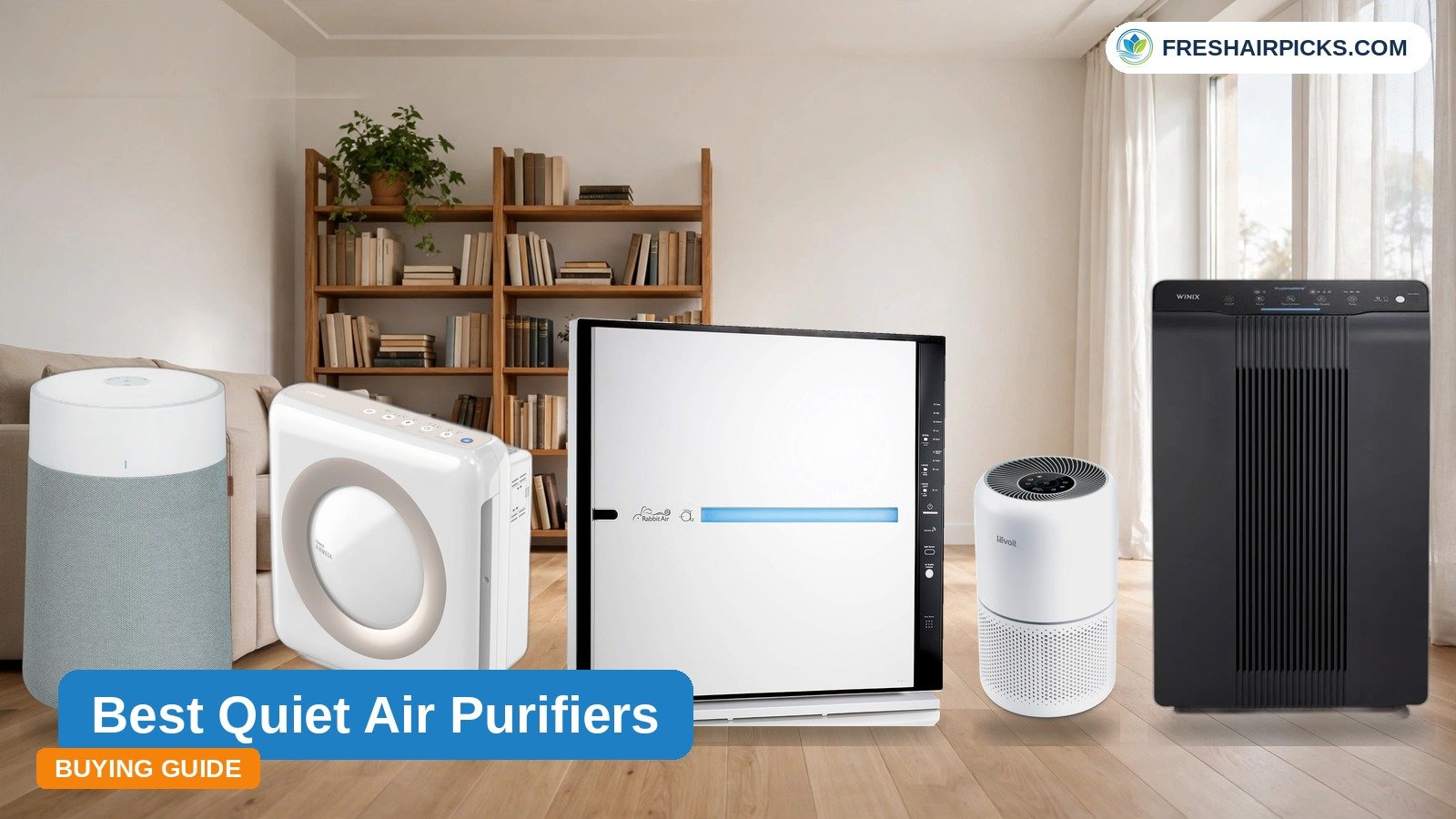
A vape cloud is two problems at once, and most purifiers only solve one. The visible cloud is fine aerosol — propylene glycol and vegetable glycerin droplets, small enough to hang in the air. The smell that lingers after the cloud clears is gas — flavor chemicals, nicotine, volatile organics — and gas passes straight through a particle filter. A purifier that only catches particles leaves the smell; a purifier with only a thin carbon pre-filter leaves most of the gas too. This guide ranks five machines on carbon weight first and verified CADR second, on verified numbers only.
This guide contains no test results. FreshAirPicks does not lab-test air purifiers. Every number below traces to a manufacturer specification or a labelled independent measurement, and where a figure could not be verified, the guide says so. One honesty note up front: no manufacturer publishes a “vape CADR,” and this site does not test, so this guide claims no vape-specific cleaning rate — it judges particles by AHAM or labelled CADR and gas by carbon weight, the two numbers that actually exist.
Quick answer: For heavy indoor vaping, the Austin Air HealthMate ($844.99) carries 15 lb of carbon — more gas-phase capacity than every other machine here combined — with medical-grade True HEPA and no ionizer. For a mid-price answer, the Alen BreatheSmart 45i VOC/Smoke ($449) pairs a TVOC sensor with a dedicated VOC/Smoke filter for ~300 sq ft. For the best value, the Winix 5510 ($179.99) adds a real AOC carbon stage to AHAM-verified 392 sq ft. For a bedroom or small room, the Levoit Vital 200S-P ($159.99) and Blueair 511i Max (~$113–140) handle light vaping with verified CADR — but their carbon is thin, so heavy clouds need a machine above them.
My Top Picks at a Glance
| Product | Best for | Carbon for vape gas | Verified coverage | Price | Score |
|---|---|---|---|---|---|
| Austin Air HealthMate | Heavy indoor vaping | 15 lb carbon + zeolite | No AHAM CADR | $844.99 | 8.6 |
| Alen BreatheSmart 45i VOC/Smoke | VOCs + sensor | VOC/Smoke filter (weight undisclosed) | ~300 sq ft | $449 | 8.3 |
| Winix 5510 | Best value | AOC carbon stage (~0.5 lb) | 392 sq ft (AHAM) | $179.99 | 8.2 |
| Levoit Vital 200S-P | Small room / light vaping | Carbon pre-filter only | 388 sq ft (AHAM) | $159.99 | 8.0 |
| Blueair 511i Max | Bedroom / light vaping | Thin carbon layer only | 237 sq ft (AHAM) | ~$113–140 | 7.9 |
How We Chose These Five
Vape ranking weights gas removal first, because the cloud clears on its own and the gas does not:
- Carbon weight / gas-phase stage (40%). Pounds of carbon, or a dedicated VOC filter — not a carbon pre-filter.
- Verified CADR for the space (30%). AHAM or labelled measurements only.
- Running costs (15%). Filter price divided by filter life, at daily-vape hours.
- Noise (15%). Quiet speeds for rooms people actually vape in.
1. Austin Air HealthMate — Best Heavy Indoor Vaping
Score: 8.6/10 · $844.99
| Spec | Detail |
|---|---|
| CADR | No AHAM CADR published |
| Coverage | Not AHAM-rated; sized by the manufacturer for large rooms |
| Filtration | Medical-grade True HEPA (60 sq ft media), 99.97% @ 0.3 micron; 15 lb carbon + zeolite |
| Filter cost | Up to 5 years (~$315–345 → ~$63–69/yr) |
| Power | 135 W |
| Noise | 50–66 dBA |
| Size / weight | 23 × 14.5 × 14.5 in; 45 lb, casters |
| Extras | CARB certified; ozone-free; made in USA |
The HealthMate is the heavy-vaping pick for one reason: 15 lb of carbon and zeolite. No other machine in this guide comes close on gas-phase capacity — the next-best carbon stage here is measured in ounces, and a vape room’s lingering smell is a gas problem. Its medical-grade True HEPA (60 sq ft of media, 99.97% at 0.3 micron) handles the aerosol half, its filter lasts up to 5 years at ~$63–69 a year, and it carries no ionizer at all.
Its honest limits: it has no AHAM CADR, so its room coverage cannot be stated the way the Winix’s or Levoit’s can — buy it for the carbon, not for a square-footage claim. It is 45 lb, 135 W, and 50–66 dBA: a floor machine with a real noise floor, not a bedroom machine.
Who it’s for: Someone who vapes indoors daily and wants the smell gone, not just the cloud.
2. Alen BreatheSmart 45i VOC/Smoke — Best VOCs + Sensor
Score: 8.3/10 · $449
| Spec | Detail |
|---|---|
| CADR (dust / smoke) | 208 (AHAM dust) / ~194 (manufacturer smoke) |
| Coverage @4.8 ACH | ~300 sq ft |
| Filtration | True HEPA + VOC/Smoke filter variant (required — the Pure filter is particle-only) |
| Filter cost | $69–99/yr |
| Power | ~64 W |
| Noise | 24–50 dB |
| Size / weight | 25 × 15 × 8.5 in; 15 lb |
| Extras | TVOC sensor; lifetime warranty requires filter subscription |
The 45i VOC/Smoke is the mid-price vape pick: a dedicated VOC/Smoke filter variant — the standard Pure filter is particle-only and must not be substituted — plus a TVOC sensor that actually shows when the room’s gas load rises, at $449 with $69–99 annual filters and ~300 sq ft of manufacturer-rated coverage. For a vaper who wants to see the machine respond to a cloud, this is the only pick here with a gas sensor.
Two disclosures: Alen publishes no carbon weight for this filter, so its gas capacity cannot be compared pound-for-pound with the Austin’s 15 lb — buy it for the sensor and the dedicated filter, not for a weight claim. And its lifetime warranty requires a filter subscription, so the $69–99 annual cost is effectively mandatory, not optional.
Who it’s for: A vaper who wants a gas sensor and a dedicated VOC filter at a mid-range price.
3. Winix 5510 — Best Value
Score: 8.2/10 · $179.99
| Spec | Detail |
|---|---|
| CADR (smoke) | 253 CFM (AHAM) |
| Coverage @4.8 ACH | ~392 sq ft |
| Filtration | True HEPA + AOC carbon filter; vacuum-cleanable pre-filter |
| Filter cost | Filter Q $79.99 list (often $50–65 street), 12 months → ~$50–80/yr |
| Power | 65 W rated |
| Noise | Not stated in the Winix manual |
| Size / weight | 13.59 × 8.27 × 22.17 in; 13.3 lb |
| Extras | Auto mode with air quality sensor; PlasmaWave advised OFF |
The 5510 is the value vape pick: the only genuine carbon stage in this price range (its AOC carbon filter is a small stage, about half a pound of pellet carbon by third-party figures) plus AHAM 253 smoke CADR covering ~392 sq ft, at $179.99 with ~$50–80 annual filters. It replaces the discontinued 5500-2, and its vacuum-cleanable pre-filter is a bonus in a room where aerosol residue settles on everything.
Its limits: half a pound of carbon is real but small — a heavy daily vaper will saturate it faster than the Austin’s 15 lb, and the filter’s 12-month life assumes normal use, not heavy vaping. Its noise is not stated in the Winix manual (third-party reviews cite roughly 35 dB at sleep to 67 dB at turbo). And PlasmaWave is advised OFF.
Who it’s for: A moderate vaper who wants a real carbon stage and verified CADR at a fair price.
4. Levoit Vital 200S-P — Best Small Room / Light Vaping
Score: 8.0/10 · $159.99
| Spec | Detail |
|---|---|
| CADR (smoke / dust / pollen) | 250 / 254 / 289 CFM (AHAM) |
| Coverage @4.8 ACH | 388 sq ft |
| Filtration | True HEPA + carbon pre-filter; washable pre-filter |
| Filter cost | ~$50/yr |
| Power | 50 W rated |
| Noise | Noise floor not published in the sources used |
| Size / weight | 15.6 × 8.5 × 19.8 in; 13.2 lb |
| Extras | Pet Mode; app and auto mode; no ionizer |
The Vital 200S-P is the light-vaping pick: AHAM-verified 250 smoke CADR covering 388 sq ft at $159.99 with ~$50 annual filters, a washable pre-filter, and no ionizer at all. For occasional vaping in a small room — a cloud now and then, not a daily habit — its particle numbers are excellent and its price is fair.
Its honest limit is the one that matters for vaping: its carbon is a pre-filter, not a stage. Light gas, light smell — yes. A daily habit’s lingering odor — no, and this guide does not pretend otherwise. Its noise floor is also not published in the sources used.
Who it’s for: Occasional vaping in a small room, where particle numbers matter more than gas capacity.
5. Blueair 511i Max — Best Bedroom / Light Vaping
Score: 7.9/10 · ~$113–140
| Spec | Detail |
|---|---|
| CADR (smoke) | 153 CFM (AHAM-listed) |
| Coverage @4.8 ACH | 237 sq ft |
| Filtration | HEPASilent + carbon layer; washable fabric pre-filter sleeve |
| Filter cost | ~$40/yr (Particle + Carbon filter ~$30–36, up to 9 months) |
| Power | 17 W max |
| Noise | 19 dB night mode — quietest verified figure here |
| Size / weight | 10.6 × 10.6 × 18.9 in; 4.2 lb |
| Extras | App, auto mode, air quality sensor |
The 511i Max is the bedroom vape pick: 19 dB on its night setting is the quietest verified figure in this guide, in a 4.2 lb machine that moves room to room with one hand, with an AHAM-listed 153 smoke CADR covering 237 sq ft at 17 W max and ~$40 annual filters, the cheapest running cost here. Its washable fabric pre-filter sleeve is a bonus where aerosol residue settles.
The same two disclosures as always: its carbon is a thin layer, not a stage — light gas only, not a heavy-vaping machine. And HEPASilent is a mechanical plus electrostatic stage, not a True HEPA filter in the conventional sense, and it cannot be switched off.
Who it’s for: A bedroom or small room with occasional vaping, where quiet matters most.
Buying Guide: Gas First, Particles Second, Then Honesty About Both
Carbon weight decides the gas half. A vape room’s lingering smell is gas, and gas removal scales with carbon: 15 lb (Austin) beats a dedicated VOC filter of undisclosed weight (Alen), which beats a half-pound stage (Winix), which beats a pre-filter or thin layer (Levoit, Blueair). Any guide that ranks a carbon pre-filter as a “vape odor” machine is selling the cloud, not the chemistry.
CADR decides the particle half. The cloud itself is aerosol, and aerosol removal is CADR: AHAM 253 (Winix), 250 (Vital), 153 (Blueair), or the Alen’s manufacturer-rated ~300 sq ft. The Austin has no AHAM CADR — buy it for the carbon, and accept the coverage claim on the manufacturer’s word, stated as such.
Do not buy a “vape CADR.” No manufacturer publishes one, and this site does not test. A number labelled as a vape cleaning rate is either a smoke CADR relabelled or a test result — and this guide contains neither.
What the old post got wrong, plainly. Its headline claimed the guide was “Tested for Heavy Clouds, Odors, and VOCs,” it carried a “How I Tested” section, and every product carried an “Expert Test Report & Scorecard” — testing this site does not do. Three of its picks are kept but reframed for gas and CADR (5510, Vital 200S-P, 511i Max). Its Coway Mighty pick is not ranked: it has no carbon stage for vape gas, and the original carries an ionizer. Its Core Mini-P pick could not be verified to this guide’s standard in the sources used and is not ranked.
Frequently Asked Questions
Do air purifiers really help with vape smoke?
They help with both halves, differently: a HEPA stage catches the aerosol droplets, and a real carbon stage adsorbs the gas-phase chemicals and odor. A particle-only machine leaves the smell; a thin-carbon machine leaves most of the gas. Judge a vape purifier on both numbers, not one.
What is the best air purifier for vaping?
The Austin Air HealthMate: 15 lb of carbon and zeolite is more gas-phase capacity than every other machine here combined, with medical-grade True HEPA for the aerosol half and no ionizer. For a mid-price answer, the Alen 45i VOC/Smoke pairs a TVOC sensor with a dedicated VOC filter.
How often should I replace the filter if I vape indoors frequently?
Faster than the box says. Heavy daily vaping saturates carbon well before a 12-month filter life — the Austin’s 5-year filter is the exception because it starts with 15 lb. The honest signal is smell: when the room’s vape odor returns after the machine runs, the carbon is spent, whatever the calendar says.
Can I use the same air purifier for vape smoke and cigarette smoke?
Yes, with the same ranking: carbon weight for the gas half (tar and tobacco VOCs are heavier gas loads than vape flavor chemicals) and CADR for the particle half. The Austin’s 15 lb carbon is the strongest answer for both; the cigarette-smoke guide ranks the same machines on the same logic.
Are ionizers safe to use with e-cigarette vapor?
This guide recommends against ionizers in vape rooms: they add ozone questions to a room already full of inhaled chemicals, and they do nothing for gas. The safest picks have no ionizer at all (Austin, Vital). If a machine has a switchable ionizer (Winix 5510), keep it OFF. Electrostatic stages that cannot be switched off (Blueair) are disclosed so the choice is yours.
Is the Coway Mighty still a good pick for vaping?
Not ranked here — it has no carbon stage for vape gas, and the original Mighty carries an ionizer. Its CADR is verified, but a vape pick without gas-phase capacity solves only half the problem. The Winix 5510’s AOC carbon stage is the value answer for the same room.
Is the Levoit Core Mini-P good for vaping?
Not ranked — its cleaning rate could not be verified to this guide’s standard in the sources used. The old post ranked it fifth on claims this guide could not cite from a CADR listing or a labelled measurement. The Blueair 511i Max’s AHAM 153 smoke CADR is the verified small-room answer.
Conclusion
Vape air is decided by carbon weight for the gas and verified CADR for the cloud: the Austin Air HealthMate for heavy indoor vaping, the Alen BreatheSmart 45i VOC/Smoke for VOCs with a sensor, the Winix 5510 for the best value, the Levoit Vital 200S-P for light vaping in a small room, and the Blueair 511i Max for the bedroom — each with its carbon stated, its coverage verified, and its ionizer question answered. Buy the carbon for the smell, the CADR for the cloud, and replace the filter when the smell returns.
Prices checked October 2026 and will drift; specifications are drawn from AHAM Verifide listings, manufacturer publications and labelled independent measurements, as noted throughout. This guide contains no hands-on test results.