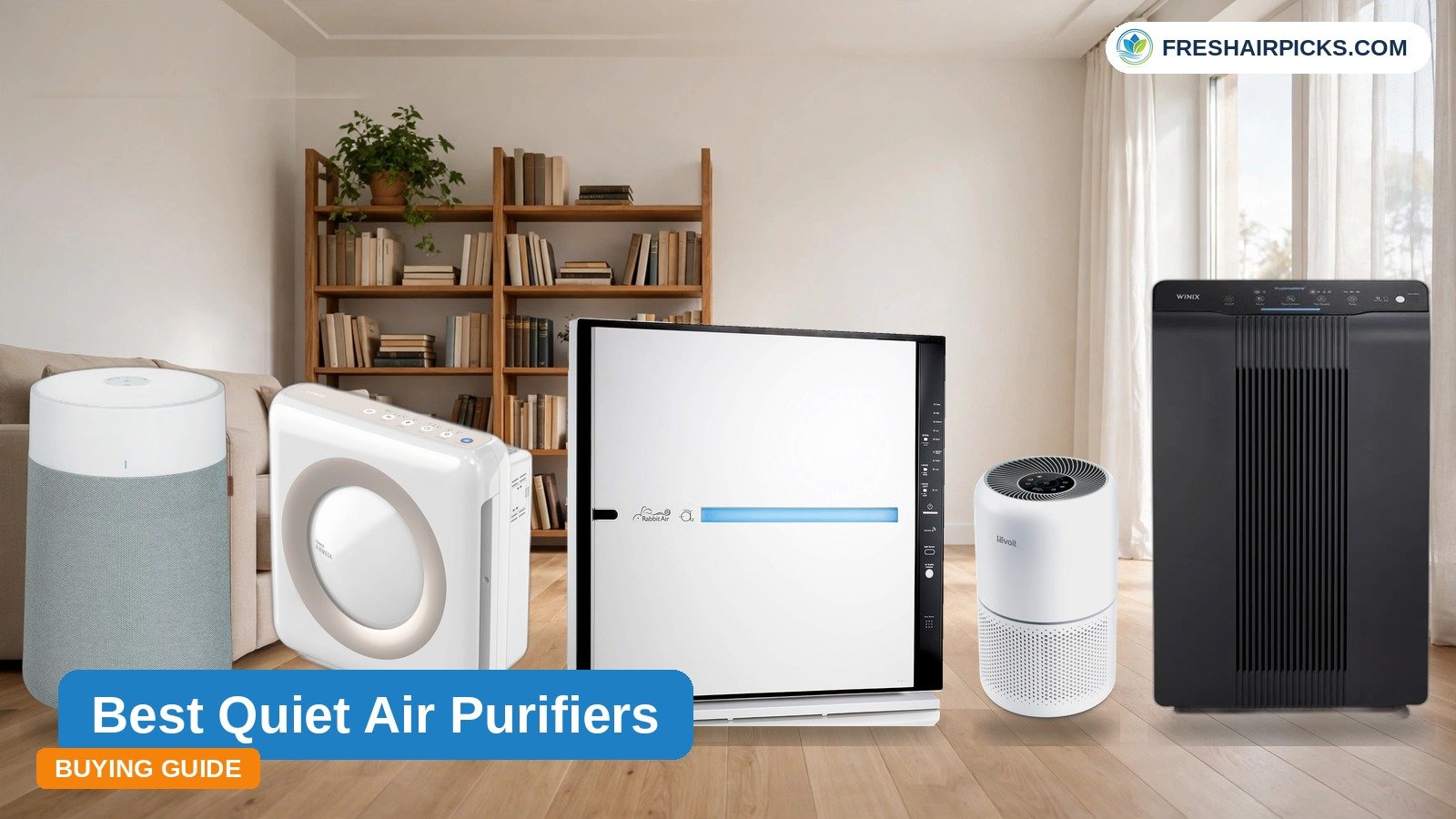
“Portable” is the most abused word in air purification. A 15-pound tower with no handle is not portable because the box says so; a cup-holder gadget with a battery is not a purifier because it runs for 12 hours. This guide defines portable honestly: a machine you can actually move — by a handle, into a suitcase, onto a car headrest — without dreading the trip, and whose cleaning power is stated in a CADR you can check. Where a machine has no verified CADR, the guide says so and caps its rank accordingly.
This guide contains no test results. FreshAirPicks does not lab-test air purifiers. Every number below traces to a manufacturer specification or a labelled independent measurement, and where a figure could not be verified, the guide says so.
Quick answer: For travel, buy the AirFanta 3Pro with HEPA + carbon filters (~$159.99) — it collapses into a suitcase, weighs ~5 lb, and has the highest estimated particle CADR here (353 CFM). For the car, the IQAir Atem Car ($399.99) runs on native 12V with a crash-tested headrest mount. For room-to-room carrying, the Blueair Blue Pure 511i Max (~$113–140) is a 4.2 lb full-room machine with AHAM-listed 153 smoke CADR. For an app-controlled portable, the PuroAir 100i ($109.99) has a handle and Wi-Fi — but no verified CADR. For a desk or dorm corner only, the Coway Airmega 50 ($79.99) is a 14-watt handle machine with a Coway-rated (not AHAM) 66.7 CADR.
My Top Picks at a Glance
| Product | Best for | Portability | Particle CADR | Price | Score |
|---|---|---|---|---|---|
| AirFanta 3Pro (HEPA + carbon) | Travel / suitcase | Collapses into suitcase; ~5 lb | 353 PM1 (HouseFresh est.) | ~$159.99 | 8.5 |
| IQAir Atem Car | Car / commute | Native 12V; headrest mount | No AHAM CADR | $399.99 | 8.2 |
| Blueair Blue Pure 511i Max | Room-to-room | 4.2 lb, one-hand carry | 153 smoke (AHAM-listed) | ~$113–140 | 8.0 |
| PuroAir 100i | App portable | Carry handle; 16 W | No verified CADR | $109.99 | 7.5 |
| Coway Airmega 50 | Desk / dorm corner | Carry handle; 14 W | 66.7 (Coway-rated) | $79.99 | 7.2 |
How We Chose These Five
Portability reorders the usual ranking, so the scoring here is specific to it:
- True portability (35%). Weight, a handle or a packing form, and a power source that fits the use — 12V for a car, a suitcase form for travel, one-hand weight for room-to-room.
- Verified CADR (35%). AHAM or labelled independent measurements first; an unverified figure is labelled and capped, never presented as equivalent.
- Power and battery (15%). Watts, car compatibility, and whether “battery” claims come with a CADR to match.
- Running costs (15%). Filter price divided by filter life.
1. AirFanta 3Pro (HEPA + Carbon) — Best Travel Pick
Score: 8.5/10 · ~$159.99
| Spec | Detail |
|---|---|
| CADR (particles / VOCs) | 353 CFM PM1 (HouseFresh-estimated); 68 CFM VOC (manufacturer listing) |
| Coverage | 529 sq ft at 5 ACH (HouseFresh, from particle CADR) |
| Filtration | H11 HEPA panels + optional pelleted carbon filter set |
| Filter cost | HEPA set ~$54; HEPA + carbon set ~$75; ~$67–100/yr |
| Power / noise | PC-fan powered; 25–56 dB range |
| Size / weight | 12.6 in cube; ~5 lb, collapsible into a suitcase |
| Certifications | CARB certified; UL 507 (SGS) |
The 3Pro is the only pick here that is genuinely built for travel: a cube of HEPA panels driven by four PC fans that packs down flat into a 20-inch suitcase, assembles by hand in a minute, and then out-cleans machines costing seven times as much on particles — HouseFresh’s estimated 353 PM1 CADR. For rentals, dorms, hotels and frequent movers, it is the portable pick by a wide margin, and its ~$159.99 price with $67–100 annual filters is unmatched value per CADR point.
Two honesty notes. First, the old post claimed 413 CFM for this machine; that figure is not repeated here, because the citable figure is HouseFresh’s 353 PM1 estimate — still the highest here, but not 413. Second, the carbon version is mandatory for odor: the HEPA-only version clears particles and does nothing for smell, and its VOC CADR of 68 CFM is modest against its particle power. It is also DIY assembly with no sensor and no app — a tool, not an appliance.
Who it’s for: Frequent travelers, renters and movers who need real cleaning power that packs into luggage.
2. IQAir Atem Car — Best Car Pick
Score: 8.2/10 · $399.99
| Spec | Detail |
|---|---|
| CADR | No AHAM CADR published (personal-zone device — see note) |
| Filtration | HyperHEPA Plus + gas-phase stage |
| Power | Native 12V — runs on car power, no inverter needed |
| Filter cost | $89.99/yr |
| Mount | ADAC crash-tested headrest mount |
| Size / weight | Compact car unit (headrest-mounted) |
| Extras | Designed for vehicle cabins; no app dependency |
The Atem Car is the only pick here designed for a vehicle rather than adapted to one: it runs on native 12V, so it plugs into the car without an inverter, and it mounts to a headrest with a bracket that ADAC crash-tested — a detail that matters when the alternative is a loose box becoming a projectile in a collision. Its HyperHEPA Plus filtration with a gas-phase stage addresses both exhaust particles and cabin odors, and its $89.99 annual filter is reasonable for the category.
The disclosure: IQAir’s “up to 150 sq ft” claim has no air-changes basis and is not used as a coverage claim here — a car cabin is ~100–150 cubic feet, not square feet, and this is a personal-zone device for the cabin, not a room machine. It has no AHAM CADR, and at $399.99 it is the priciest pick here per unit of space cleaned. Buy it for the car specifically; for a room, buy any other pick in this guide.
Who it’s for: Commuters and anyone who spends hours in a car and wants cabin air actually filtered, not fragranced.
3. Blueair Blue Pure 511i Max — Lightest Full-Room Portable
Score: 8.0/10 · ~$113–140
| Spec | Detail |
|---|---|
| CADR (smoke) | 153 CFM (AHAM-listed) |
| Coverage @4.8 ACH | 237 sq ft |
| Filtration | HEPASilent: mechanical filter + electrostatic charging stage + carbon layer |
| Filter cost | Particle + Carbon ~$30–36, up to 9 months → ~$40/yr |
| Power | 17 W max |
| Noise | 19 dB night mode floor |
| Size / weight | 10.6 × 10.6 × 18.9 in; 4.2 lb |
| Extras | Washable fabric pre-filter sleeve, app, auto mode, sensor |
The 511i Max earns its portable slot differently from the others: not by packing or by car power, but by being a genuine full-room machine you can carry in one hand. At 4.2 lb with an AHAM-listed 153 smoke CADR covering 237 sq ft, it is the machine you move from bedroom to office to nursery without thinking about it — and at 17 watts maximum with a 19 dB night mode, it is also the quietest and most efficient pick here. Its filter costs ~$40 a year, the cheapest in this guide.
The disclosure follows every Blueair in this site’s guides: HEPASilent pairs a mechanical filter with an electrostatic charging stage that cannot be switched off, and the filter itself is not a True HEPA filter. The CADR numbers are real and verified; the technology is different. And at 18.9 inches tall it is portable by weight, not by packing — it will not fit in a suitcase.
Who it’s for: Room-to-room carrying — bedroom to office to nursery — where verified full-room cleaning must travel light.
4. PuroAir 100i — Best App Portable
Score: 7.5/10 · $109.99
| Spec | Detail |
|---|---|
| CADR | No verified CADR (see note) |
| Filtration | HEPA + CarbonTech carbon |
| Power | 16 W |
| Filter cost | Subscription $31.50 shipped every 90 days |
| Size / weight | 11.0 × 8.9 × 4.9 in + carry handle |
| Extras | Wi-Fi/app control |
The 100i is the app portable: a slim machine with a real carry handle, 16 watts, Wi-Fi and app control, and a filter subscription ($31.50 shipped every 90 days) that removes the “when do I replace it” question entirely. At $109.99 it is the most convenient portable here for someone who wants schedules and remote control from their phone.
The disclosure is the reason it ranks fourth rather than first: PuroAir publishes no verified CADR for this machine, and its “550 sq ft” claim is a one-air-change marketing figure, not a 4.8 ACH coverage number. Without a CADR, its cleaning power cannot be compared with the verified picks above — buy it for the handle, the app and the convenience, not for a cleaning claim no independent body has measured.
Who it’s for: Buyers who want a handled, app-controlled portable and accept that its cleaning power is unmeasured rather than verified.
5. Coway Airmega 50 — Best Tiny-Space Portable
Score: 7.2/10 · $79.99
| Spec | Detail |
|---|---|
| CADR (smoke) | 66.7 CFM (Coway-rated, NOT AHAM) |
| Coverage @4.8 ACH | ~103 sq ft (from Coway’s figure) |
| Filtration | True HEPA + carbon layer; washable pre-filter |
| Power | 14 W max |
| Noise | Quiet operation (Coway does not publish a dB range in the sources used here) |
| Size / weight | 11.0 × 8.9 × 4.9 in + carry handle |
| Extras | The most portable Coway; fits a desk or a shelf |
The Airmega 50 is included with a warning label, not a recommendation for a room: its 66.7 smoke CADR is Coway-rated, not AHAM-verified, and even taken at face value it covers only ~103 sq ft at the full standard — a desk zone, a dorm corner, a nursery nook. Within that honest brief it is a good machine: 14 watts, a carry handle, a washable pre-filter, and the cheapest legitimate pick here at $79.99. Outside that brief it is undersized, and any listing that calls it a room purifier is selling the 1-air-change figure, not this one.
Who it’s for: Desks, dorm corners and nursery nooks under ~100 sq ft — and only those.
Buying Guide: What “Portable” Should Mean
Weight is the first spec. A portable machine you will not carry is a room machine with a marketing word. The 511i Max (4.2 lb), AirFanta (~5 lb) and Airmega 50 (handle, 14 W) pass this test; a 15 lb tower does not, whatever its listing says.
Power source decides the use. Car use needs 12V native (Atem Car) — an inverter-dependent machine is a workaround, not a car purifier. Travel use needs a packing form (AirFanta’s suitcase collapse) or it will stay home. Room-to-room use needs one-hand weight (511i Max). Match the power and the form to the trip, not just the CADR.
Battery life is not cleaning power. The old post’s cup-holder pick sold a 12-hour battery with no verified CADR — a machine can run all day and clean almost nothing. Ask for the CADR first; a battery without one is a fan with a timer.
The smart-ecosystem alternative. The old post’s Smartmi P1 is not ranked here, but its manual does verify real numbers: smoke CADR 120 CFM under ANSI/AHAM AC-1-2019, 30 W, ~6.6 lb with a handle, and HomeKit/Alexa/Google support. If your home runs on Apple HomeKit and you want a handled room machine with an app, it is a legitimate alternative to the 511i Max — its US pricing and availability are simply inconsistent enough (~$280 list in resale listings) that it does not earn a ranked slot here.
What the old post got wrong, plainly. Its title promised a “war” and its body claimed lab testing this site does not do; its “test data” was invented precision (a 413 CFM figure for the AirFanta, a “17 minutes to PM1 zero” chamber result, a 9.5/10 score); its budget pick (Core Mini, 34 CFM) covered ~53 sq ft at the full standard; its car pick (Westinghouse 1804) carried a “47 minute Tesla 3” figure no source supports; and its ultra-portable pick sold battery life in place of a CADR. All five old picks are replaced above.
Frequently Asked Questions
What is the best portable air purifier for travel?
The AirFanta 3Pro with carbon filters: it collapses into a suitcase, weighs ~5 lb, and has the highest estimated particle CADR here (353 CFM). For a hotel room or rental, it is the only pick that is both genuinely portable and genuinely powerful. Buy the carbon version — the HEPA-only version does nothing for odor.
Can a portable air purifier work in a car?
Only a car-designed one. The IQAir Atem Car runs on native 12V with a crash-tested headrest mount; a room machine loose in a car is both ineffective (wrong power, wrong placement) and unsafe in a collision. Do not buy a room purifier for car use.
Do battery-powered air purifiers actually clean the air?
Only if they have a CADR to match the battery. A cup-holder unit can run 12 hours and still clean almost nothing — battery life measures runtime, not cleaning. Check the smoke CADR first; under ~70 CFM, a machine is a personal-zone device, not a room purifier.
Is the AirFanta 3Pro really 413 CFM?
No — that figure came from the old post and is not repeated here. The citable figure is HouseFresh’s estimated 353 PM1 CADR, still the highest in this guide but not 413. Treat any CADR without a named source the same way: unverified until cited.
How much does a portable air purifier weigh?
From ~4.2 lb (Blueair 511i Max) and ~5 lb (AirFanta 3Pro) at the genuinely portable end, to handled machines like the PuroAir 100i and Coway Airmega 50 in the same small footprint. If a “portable” machine weighs over 10 lb and has no handle, it is a room machine with a marketing word.
Can one portable purifier cover my whole home?
No. Portables are single-room or single-zone machines by definition — the strongest here (AirFanta, 353 PM1) covers a large room at best, and the handled picks cover 100–240 sq ft. A home needs a machine per lived-in room, or a whole-home system.
Should I buy a portable or a regular air purifier?
Buy portable only if you will actually move it — travel, car, room-to-room. If the machine will sit in one room for a year, a regular machine gives more CADR per dollar: see our home guide for the verified full-size picks. Portability costs cleaning power; pay it only when you use it.
Conclusion
Portable means moved, not merely movable: the AirFanta 3Pro is the travel answer, the IQAir Atem Car the car answer, the Blueair 511i Max the room-to-room answer, the PuroAir 100i the app answer, and the Coway Airmega 50 the tiny-space answer — each with its CADR stated or its absence admitted. Check the weight, check the power source, check the CADR, and buy the machine that will actually travel with you.
Prices checked October 2026 and will drift; specifications are drawn from AHAM Verifide listings, manufacturer publications and labelled independent measurements, as noted throughout. This guide contains no hands-on test results.