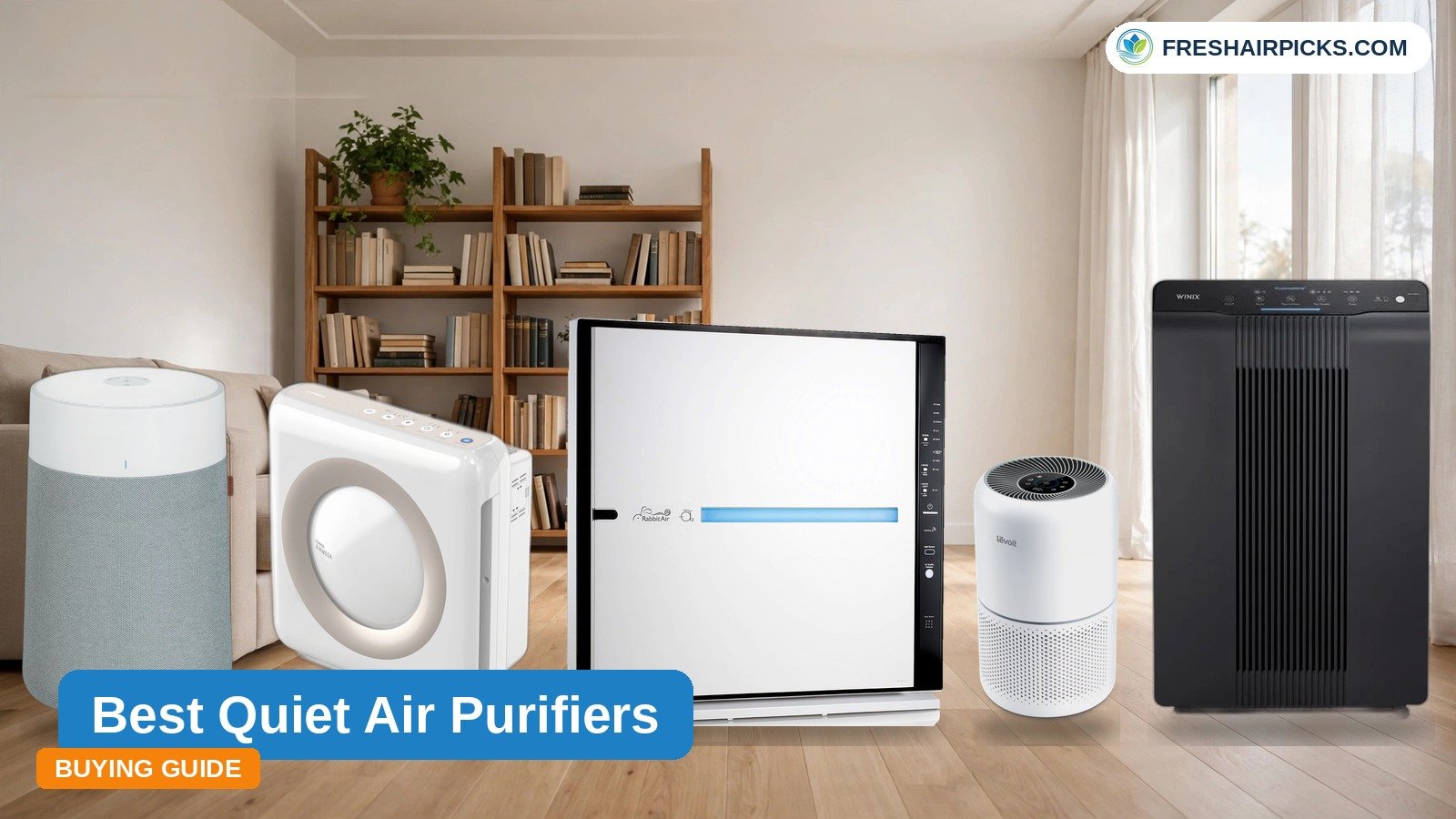
Cigarette smoke is two problems wearing one coat, and this guide starts with the honest split. The visible haze is particles — fine and ultrafine matter that a true HEPA filter genuinely traps, at a speed set by the machine’s smoke CADR. The smell that outlives the haze is gas: nicotine vapor, tar compounds and dozens of volatile chemicals that pass straight through a HEPA filter untouched and can only be adsorbed by activated carbon — in quantities measured in pounds, not in the token dusting most purifiers carry. A good smoke purifier does both jobs in the room it runs in, and it measurably cuts the particles and odor in that room’s air. What it cannot do matters just as much: the US Surgeon General’s finding is that there is no risk-free level of secondhand smoke exposure, and the EPA‘s position is that filtration and ventilation can reduce secondhand smoke indoors but never eliminate it. No purifier makes indoor smoking safe, none touches the residue that settles into furniture and walls, and none substitutes for the two steps that actually protect a household — smoking outside, and ventilating. Bought with that understood, the right machine is still the difference between a room that reeks for days and one that clears overnight.
That is why this guide ranks on two verified axes instead of one: smoke CADR, AHAM’s tobacco-smoke rating, which decides how fast particles are cleared; and activated carbon mass, which decides how long odor control survives before the carbon is spent. Every running cost is printed next to the price, including what a smoking home does to filter intervals — because with smoke, the filter bill is where the truth about a machine comes out.
Quick Answer
- Top pick: Austin Air HealthMate Plus — $895. Up to 15 lb of carbon-blend media behind 60 sq ft of medical-grade HEPA: several times the odor capacity of anything else in this guide, and the heavy-smoke pick — with its one real weakness, particle-clearing speed, stated plainly below.
- Best for large rooms: Coway Airmega 400 — $629.99. The highest verified smoke CADR here (376, AHAM-tested via ENERGY STAR), covering 583 sq ft, with no ionizer at all.
- Budget pick: Winix 5510 — $179.99. An AHAM smoke CADR of 253 and a real pelleted-carbon layer at a budget price; its honest limit is carbon mass — about half a pound — so heavy daily smoke will spend it months before the premium beds.
How these picks were chosen
FreshAirPicks doesn’t run a testing lab, and this page contains no first-person test claims. (An earlier version of this guide claimed first-person testing — a sealed smoke box, professional particle counters, weeks of placements in smokers’ homes and per-product test scorecards; that was wrong, and it’s gone.) The rankings rest on the US Association of Home Appliance Manufacturers’ CADR ratings — independently tested figures reported through AHAM‘s Verifide directory and the US ENERGY STAR program — manufacturer specifications, and the measured results published by reviewers who do test, chiefly HouseFresh. Prices and filter costs were checked in October 2026 against the sources named in our research notes. Where a manufacturer rates its own machine without independent verification, the table says so — and for a smoke guide there is a second place that distinction bites: carbon. Brands rarely publish carbon weight, so where a weight could not be verified, this guide says the stage is unpublished or modest instead of guessing a number.
The 5 best air purifiers for cigarette smoke at a glance
| Product | Price | CADR (smoke/dust/pollen) | Coverage @ 4.8 ACH | Filter cost/yr | 3-year cost* | Noise | Best for |
|---|---|---|---|---|---|---|---|
| Austin Air HealthMate Plus | $895 | None (no AHAM); ~160 CFM PM1 est. | ~248 sq ft (est.) | ~$89 (annualized) | ~$1,162 | 42.5–61.5 dBA (measured) | Heavy daily smoke and stubborn odor |
| IQAir HealthPro Plus XE | $1,199.99 | None (no AHAM); 300 CFM certified airflow | ~465 sq ft | ~$150 (annualized) | ~$1,650 | 27–59 dB(A) | Severe sensitivity; chemicals plus particles |
| Coway Airmega 400 | $629.99 | 376 / 384 / 409 (AHAM via ENERGY STAR) | 583 sq ft | ~$129 | ~$1,017 | 22–52 dB (Coway-rated) | Large rooms; strongest verified particle clearing |
| Alen BreatheSmart 75i (Fresh filter) | $799 | 350 / 355 / 400 (AHAM) | 543 sq ft | ~$185 (Fresh) | ~$1,354 | 25–51 dBA (Alen-rated) | Balanced smoke duty; quiet running |
| Winix 5510 | $179.99 | 253 / 252 / 247 (AHAM) | 392 sq ft | ~$80 | ~$420 | 35–67 dBA (measured) | Budget pick for small-to-medium rooms |
* 3-year cost = unit price + three years of replacement filters; electricity excluded (it typically adds a few dollars a month, depending on speed and your rate). Coverage assumes 8-foot ceilings. CADR notes: two of these machines carry no AHAM rating at all. Austin Air does not participate in AHAM’s program, so the HealthMate Plus’s particle figure is HouseFresh’s measured PM1 estimate (~160 CFM at top speed) and its coverage is estimate-based; the IQAir’s coverage is computed from its certified 300 CFM maximum airflow, the same basis used in our other guides. The Airmega 400’s CADRs are AHAM-tested values reported to ENERGY STAR — Coway’s own store page lists a lower smoke figure (328) for that model; the ENERGY STAR record is used here. The Alen’s filter cost annualizes its Fresh filter ($129, rated 7–10 months) at the midpoint; Alen’s own headline “CADR 375” is its turbo airflow figure, not the AHAM triple used here. The Austin’s filter cost annualizes its $445 filter over its 5-year rated life — a rating that assumes normal residential use, which a smoking home is not (see its section).
1. Austin Air HealthMate Plus — Best for Heavy Cigarette Smoke
For cigarette smoke specifically, the HealthMate Plus is built the way the problem demands, and the specification that decides it is a weight: up to 15 lb of adsorption media — activated carbon blended with potassium-iodide-impregnated carbon and granulated mineral (zeolite) filtration, over 780 cubic inches of it — sitting in front of 60 sq ft of true medical-grade HEPA. That is roughly thirty times the carbon in this guide’s budget pick and four times the Alen’s verified bed, and carbon capacity is what smoke odor consumes: in independent testing by HouseFresh, the standard HealthMate’s gas removal was beaten only by a DIY inline-fan build carrying 16 lb of carbon, and by nothing sold as a normal air purifier. The body around that filter is a steel shell with a 360° intake, three manual speeds, casters, and no electronics to speak of — no app, no sensors, no ionizer, nothing that emits ozone.
The ownership math is the other half of the case. The combined filter is rated to last five years under normal residential use and costs $445 to replace — about $89 a year annualized, the lowest filter bill among this guide’s premium machines, under a 5-year mechanical warranty and a 5-year pro-rated filter warranty. It is made in Buffalo, New York, and CSA approved.
The honest weakness is particle speed, and it is real. Austin Air does not participate in AHAM, so there is no verified CADR for this machine at all; HouseFresh’s measured estimate puts its top-speed particle delivery at roughly 160 CFM — it took about 52 minutes to clear their test room, where the Coway below clears comparable air in a fraction of the time. If your priority is knocking down a visible haze fast, this is the slowest machine in the guide. It is also loud at the top (61.5 dBA measured) and heavy at 47 lb. And the 5-year filter rating assumes normal use: under daily cigarette load the carbon will spend sooner, and the smell returning is your signal, whatever the calendar says. Buy it when odor and gas are the war you’re fighting — a pack-a-day living room, a cigar den, a home that has absorbed years of smoke — and accept slower particle clearing as the trade.
| Spec | HealthMate Plus |
|---|---|
| Price | $895 (Austin Air direct) |
| CADR (smoke/dust/pollen) | No AHAM rating — Austin does not participate; ~160 CFM PM1 measured estimate (HouseFresh) |
| Room coverage @ 4.8 ACH | ~248 sq ft (estimate-based) |
| Carbon | Up to 15 lb (carbon / KI-impregnated carbon / zeolite blend) |
| Filters | $445, rated 5 years under normal use (~$89/yr annualized) |
| Noise | 42.5–61.5 dBA measured at 3 ft (HouseFresh, standard HealthMate) |
| Dimensions | 14.5 × 14.5 × 23 in |
| Weight | 47 lb |
| Ionizer | No |
Best for: homes with a daily indoor smoker, cigar rooms and smoke-saturated rooms up to ~250 sq ft, where odor and gases — not raw particle speed — are the problem.
2. IQAir HealthPro Plus XE — Best for Severe Sensitivity
The HealthPro Plus XE is the premium answer when smoke is one item on a longer list of chemical concerns. Its gas stage is the V5-Cell — a granular activated-carbon and chemisorption cartridge, the same architecture we rank in our mold guide for gas-phase duty — and its particle stage is the finest in this guide: a HyperHEPA filter rated at 99.5% efficiency down to 0.003 microns, with every unit individually tested and shipped with its own signed test certificate. There is no ionizer, it is CARB-listed (EO G-10-059), and the warranty runs 10 years.
Like the Austin, it carries no AHAM CADR — IQAir does not submit to that program either — so its room figure here (~465 sq ft) is computed from its certified maximum airflow of 300 CFM rather than from an independently tested smoke rating. That is a workable basis for sizing, but it means neither premium machine in this guide can prove its particle speed the way the Coway and Alen can, and buyers for whom verified CADR is a hard requirement should weight that. Within those terms, the XE’s combination — granular gas media for the smell and chemical load, ultrafine particle filtration for what the smoke leaves airborne — is the most complete filtration stack here.
The costs are the highest in the guide and stay that way: $1,199.99 to buy, and three staggered filters (PreMax $79 roughly every 18 months, V5-Cell $99 every 24, HyperHEPA $199 every 48) annualizing to about $150 a year, for a 3-year cost around $1,650. IQAir does not publish the V5-Cell’s carbon weight, so this guide claims none — the stage is granular rather than a sheet, which is the meaningful distinction, but the Austin’s verified 15 lb remains the carbon benchmark. At 35 lb and 28 inches tall it is furniture, and at full speed (59 dB(A)) it is not quiet furniture.
| Spec | HealthPro Plus XE |
|---|---|
| Price | $1,199.99 (Amazon) |
| CADR (smoke/dust/pollen) | No AHAM rating; certified airflow 40–300 CFM |
| Room coverage @ 4.8 ACH | ~465 sq ft (computed from certified airflow) |
| Filters | ~$150/yr annualized (PreMax $79, V5-Cell $99, HyperHEPA $199, staggered intervals) |
| Noise | 27–59 dB(A) |
| Dimensions | 28 × 15 × 16 in |
| Weight | 35 lb |
| Ionizer | No |
Best for: chemically sensitive households and anyone combining cigarette smoke with broader VOC concerns, in rooms up to ~460 sq ft, with the budget for the premium tier.
3. Coway Airmega 400 — Best Verified Particle Power for Large Rooms
If the Austin is the odor specialist, the Airmega 400 is this guide’s particle champion, and unlike the two premium machines above it, the number is independently anchored: a smoke CADR of 376 (dust 384, pollen 409) — AHAM-tested values recorded in ENERGY STAR’s official product listing — covering 583 sq ft at 4.8 air changes an hour through two intakes, one on each side. (One disclosure, carried from our other guides: Coway’s own store page lists a lower smoke figure of 328 for this model. The ENERGY STAR record is the tested basis used here and in our pets guide.) Each side carries a washable slide-out pre-filter and a Max2 filter set, it is ENERGY STAR, CARB and ETL certified with ozone emissions listed at 0.0 ppb — there is no ionizer at all — and the warranty is 5 years.
For smoke, the caveat sits exactly where the Austin is strongest. The Max2 sets bond their activated carbon to the HEPA, and Coway does not publish the carbon’s weight; nothing about the construction suggests a deep granular bed, and bonded carbon is the layer that spends first under cigarette load. So the honest summary is asymmetric: this is the fastest verified clearer of smoke particles in the guide, in the biggest rooms, and a mid-pack machine for smoke odor stamina — in a heavy smoker’s living room, expect the smell to start winning months before the Austin’s or the Alen’s beds give up, and expect to replace both Max2 sets (~$129 a year) when it does, HEPA life remaining or not.
At $629.99 with a 3-year cost around $1,017, it sits between the Alen and the premium pair on price while out-clearing both on verified numbers. The base 400 has no app or Wi-Fi (that is the separate 400S), and at 24.7 lb with a 14.8-inch-square footprint it is a piece of furniture — but for an open-plan space where several people smoke and gather, verified airflow at this scale is the thing the premium machines can’t show you.
| Spec | Airmega 400 |
|---|---|
| Price | $629.99 (Amazon) |
| CADR (smoke/dust/pollen) | 376 / 384 / 409 (AHAM via ENERGY STAR) |
| Room coverage @ 4.8 ACH | 583 sq ft |
| Filters | Two Max2 sets, ~12 months (~$129/yr) |
| Noise | 22–52 dB (Coway-rated) |
| Dimensions | 14.8 × 14.8 × 22.8 in |
| Weight | 24.7 lb |
| Ionizer | No (0.0 ppb ozone, ENERGY STAR) |
Best for: large living rooms and open-plan spaces up to ~580 sq ft where smoke particles are the main complaint and more than one person smokes.
4. Alen BreatheSmart 75i (with Fresh filter) — Best Balanced Pick
The 75i is the only machine in this guide that is strong on both ranking axes at once, with receipts for each. The particle axis: an AHAM-verified CADR triple of 350 smoke / 355 dust / 400 pollen, covering 543 sq ft at 4.8 air changes an hour. The odor axis: choose the Fresh filter configuration and the carbon bed is a verified 3.6 lb (per HouseFresh’s teardown figures) — less than the Austin’s deep bed, but several times what any bonded cartridge carries, and enough to rank third in HouseFresh’s odor testing. Around those numbers it is the most livable machine here: a 25–51 dBA rated noise range with QuietMark certification, ENERGY STAR’s 2025 Most Efficient list, and a sensor suite (PM2.5 and TVOC among them) whose auto mode reacts to a smoking event without you touching anything.
Two of Alen’s own headline numbers need translating rather than repeating. The “CADR 375” on its product page is the machine’s turbo airflow in CFM, not the AHAM triple used here; and its “up to 2,800 sq ft” coverage works out to roughly one air change an hour — at smoke-grade air changes the honest figure is the 543 sq ft in the table. Neither changes the verdict, but both change the room you should put it in.
The costs are the catch. At $799 it is premium-priced, and the smoke-appropriate filters are its expensive ones: the Fresh filter is $129 (the Odor variant $139) and rated at 7–10 months where the particle-only Pure filter ($99) is rated 12–15 — Alen’s own intervals quietly confirm what this guide says about carbon under load. Annualized, budget ~$185 a year, the highest filter bill in this guide, for a 3-year cost around $1,354. The lifetime “Forever Guarantee” warranty is real but conditional on registration and an active filter subscription. The 75i also carries an ionizer — one Alen rates at 0 ppm ozone when disengaged, which is how it should stay: switched off, with the filtration doing the work.
| Spec | BreatheSmart 75i (Fresh) |
|---|---|
| Price | $799 (Alen) |
| CADR (smoke/dust/pollen) | 350 / 355 / 400 (AHAM-verified) |
| Room coverage @ 4.8 ACH | 543 sq ft |
| Carbon | 3.6 lb (Fresh filter) |
| Filters | Fresh $129, rated 7–10 months (~$185/yr annualized) |
| Noise | 25–51 dBA (Alen-rated); QuietMark certified |
| Dimensions | 27 × 18.5 × 11.5 in |
| Weight | 27 lb |
| Ionizer | Yes — can be switched off (0 ppm ozone disengaged, Alen) |
Best for: living rooms up to ~540 sq ft where someone smokes daily and the machine also has to be quiet, automatic and presentable — the balanced buy.
5. Winix 5510 — Best Budget Pick
The 5510 earns the budget slot the same way it earned its place in our dust, mold and pets guides: verified numbers where rivals print adjectives. Its AHAM CADRs — 253 smoke / 252 dust / 247 pollen — give it the highest verified smoke CADR under $200 and honest coverage of 392 sq ft, and behind the HEPA sits 226 g of pelleted activated carbon as its own separate layer, a figure Winix confirmed to HouseFresh. Because the carbon is a separate layer, it can be replaced on its own rather than forcing you to discard a still-good HEPA with it. The pre-filter is washable, on a manual-specified every-14-days rhythm that matters more under smoke load, when tar joins dust on the screen. Its PlasmaWave ionizer is CARB-listed (EO G-24-234) and — the part that matters — can be switched off and left off.
The honesty paragraph for this pick is about mass. 226 g is about half a pound of carbon: real, pelleted and separable, and in a room with an occasional or moderate daily smoker it will hold odor at bay for a good stretch — but set against the Alen’s 3.6 lb and the Austin’s 15 lb, it is the first carbon bed in this guide that heavy daily smoke will spend, likely within months, and the returning smell is the signal to budget the $79.99 Filter Q set. The second caveat is noise: HouseFresh measured 67.2 dBA on turbo at 3 feet, so the headline CADR is a clearing boost for after a smoking session, not a speed anyone lives at; on quiet speeds expect roughly half the airflow.
None of that overturns the value case. At $179.99 with ~$80-a-year filters — a 3-year cost around $420, a third of the next machine up — it is the only budget buy whose smoke figures are verified rather than asserted. Bought for a small-to-medium room with its carbon limit understood, it is the sensible entry point; bought as a whole home’s answer to a two-pack-a-day household, it will saturate and disappoint, and the Alen is the honest upgrade.
| Spec | Winix 5510 |
|---|---|
| Price | $179.99 (Amazon) |
| CADR (smoke/dust/pollen) | 253 / 252 / 247 (AHAM Verifide) |
| Room coverage @ 4.8 ACH | 392 sq ft |
| Carbon | 226 g pelleted, separate layer (Winix-confirmed) |
| Filters | Filter Q set $79.99, 12 months (~$80/yr) |
| Noise | From 23.5 dB (rated); 35.2–67.2 dBA measured at 3 ft (HouseFresh) |
| Dimensions | 15.9 × 11 × 25.2 in |
| Weight | 13.03 lb |
| Ionizer | PlasmaWave — yes, but can be switched off (CARB-listed) |
Best for: bedrooms, dens and small living rooms up to ~390 sq ft with a light-to-moderate smoking load, on a budget.
How to choose an air purifier for cigarette smoke
Smoke CADR: the particle number
Tobacco smoke is not a generic pollutant in the ratings world — it is literally one of AHAM’s three test particles. Smoke CADR measures how fast a machine removes tobacco-smoke particles, which run roughly 0.1–1 microns, largely submicron: small enough to stay airborne for hours and to penetrate deep into lungs. It is almost always a machine’s lowest and most conservative rating, which is why every guide on this site sizes by it. Two things CADR does not measure are just as important to know: it says nothing about odor or gases (a particle metric cannot), and it only exists where a manufacturer submits to testing — which is why two premium machines in this guide, the Austin and the IQAir, carry airflow-based figures instead, labelled as such wherever they appear. Our explainer on whether air purifiers help with smoke walks through the particle/gas split in full.
Carbon weight in pounds: the odor number
Smoke smell is gas — nicotine vapor, tar compounds, formaldehyde, benzene and dozens of other volatiles — and gases ignore HEPA filters entirely. Activated carbon adsorbs them, and its capacity scales with how much carbon there is and how long each pass of air spends inside it. That is why this category is honestly measured in pounds. This guide’s own lineup is the demonstration: the Austin carries up to 15 lb of carbon-blend media, the Alen’s Fresh filter a verified 3.6 lb, the Winix a verified 226 g (about half a pound) of pellets — and the Coway and IQAir stages are unpublished-weight constructions in between, described as such rather than assigned numbers. At the bottom of the market sit the carbon sheets: a light dusting of carbon bonded to a filter’s back, which under cigarette load can saturate within days to weeks and then does nothing at all while the machine’s marketing still says “carbon filter.” If a manufacturer won’t state a carbon weight for a machine sold for smoke, assume the sheet, not the bed.
Sizing by smoke CADR, with a worked example
For smoke-grade cleaning, aim for 4.8 air changes per hour: a purifier’s smoke CADR × 1.55 gives the largest room (in sq ft, 8-foot ceilings) it can serve at that rate. Worked example — a 20 × 15 ft living room (300 sq ft) where someone smokes daily: you need a smoke CADR of at least 300 ÷ 1.55 ≈ 194. The Winix 5510 (253), Alen 75i (350) and Coway Airmega 400 (376) all clear it with headroom; the Austin and IQAir have no CADR to check against, so they are sized by role and airflow — the IQAir’s certified 300 CFM computes to ~465 sq ft of coverage, while the Austin is bought for odor capacity in a defined smoking room rather than for whole-room air changes. Manufacturers’ headline room sizes are usually calculated at one or two air changes an hour, which is why they run two to five times larger than the figures in this guide’s table. When in doubt, buy one size up: a larger machine on a quiet medium speed out-cleans and out-quietens a small one screaming on turbo. Our guide to whether air purifiers are worth it works through what that headroom costs over three years.
What no purifier can do
This section is the one the marketing leaves out. The US Surgeon General has concluded there is no risk-free level of exposure to secondhand smoke, and that separating smokers, ventilating, or cleaning the air cannot eliminate nonsmokers’ exposure; ASHRAE, the ventilation standards body, states the only means of effectively eliminating the health risk is to ban smoking indoors. The EPA’s summary of the evidence is the balanced version: ventilation, filtration and air cleaning can reduce secondhand smoke indoors, but do not eliminate it. Treat the purifier as the third step, not the first: the first is a smoke-free rule for the house (or at minimum one room with a door), the second is ventilation when someone does smoke, and the purifier then manages what remains in that room’s air. Thirdhand smoke sits outside a purifier’s reach entirely: per Mayo Clinic, the residue — nicotine, formaldehyde and other chemicals — clings to walls, carpets, clothing and furniture, persists for many months, and cannot be cleared by airflow, fans or confining smoking to one area. That layer is a cleaning and, eventually, replacement problem (wash fabrics, deep-clean or replace soft furnishings), not a filtration problem.
Ozone and ionizers around smoke
Smoke is the worst possible context for ozone, for a specific chemical reason: ozone doesn’t just fail to help, it reacts. The EPA’s review of ozone generators finds that at concentrations safe to breathe, ozone has little potential to remove indoor contaminants and does not remove particles at all — and California’s Air Resources Board notes that ozone reacts with chemicals already in indoor air to create additional toxic pollutants, most notably formaldehyde and ultrafine particles — in a smoker’s room, trading one set of lung irritants for another. Ozone also deadens the sense of smell, which masks smoke odor instead of removing it. The practical rules follow directly: never buy a device sold as an ozone generator for a smoking room; prefer machines with no ionizer at all (three of this guide’s five); and where an ionizer exists, choose one that switches off — the Winix’s PlasmaWave and the Alen’s ionizer both qualify — and leave it off. The filtration in every pick here does its work mechanically and chemically, with nothing added to the air.
Carbon saturation and the smoking-home filter calendar
Carbon does not wear out on a schedule; it fills up, and the day it is full, the odor comes back — in a smoking home, treat the returning smell, not the indicator light or the calendar, as the replacement signal. Plan your budget at the short end of every rated interval: manufacturers’ own figures concede the load difference (Alen rates its carbon-bearing filters at 7–10 months against 12–15 for its particle-only filter; Austin’s five-year rating is explicitly for normal residential use). The bonded designs — the Coway’s Max2 sets, the Winix’s cartridge-style sets — spend their carbon with their HEPA attached, so a smoking home replaces both together; the Winix’s separable carbon layer and the Austin’s sheer mass are the two structural answers to that cost. The pre-filter is the cheap defense: under smoke load it loads with tar and dust fast, so keep the wash or vacuum rhythm at roughly two weeks where the manual calls for it (the Winix’s does) — a choked pre-filter strangles airflow and quietly lowers the CADR you paid for.
Placement: in the smoking room, near — not next to — the smoking spot
A purifier cleans the air that reaches it, so room choice beats everything else: the machine belongs in the room where smoking happens, or the room you are protecting, with its door closed to create a clean-room effect — the EPA notes secondhand smoke migrates between rooms and even between apartment units, so a hallway unit serving two closed rooms serves neither. Within the room, place it a few feet from the usual smoking spot — close enough to catch smoke before it disperses and embeds, far enough that the intake isn’t drinking concentrated tar at arm’s length from the ashtray, which fouls the pre-filter early. Keep intake and outlet unobstructed (not behind a sofa or in a corner), and run it continuously or on auto rather than in bursts: smoke is emitted, and resuspended by ordinary movement, around the clock.
Frequently asked questions
Can an air purifier completely eliminate cigarette smoke?
No. A good purifier substantially reduces the airborne particles and, with enough carbon, the odor in the room it runs in — but the US Surgeon General’s conclusion is that cleaning the air cannot eliminate secondhand smoke exposure, and there is no risk-free level of exposure. The EPA’s framing is the fair one: filtration and ventilation can reduce secondhand smoke indoors; they do not eliminate it. The only complete fix is a smoke-free home.
Which matters more for cigarette smoke: smoke CADR or carbon weight?
They govern different halves of the problem, and smoke is the rare case where you cannot trade one for the other. Smoke CADR decides how fast the particles — the haze and its health-relevant fine fraction — are cleared. Carbon weight decides how long odor and gas control lasts before saturation. A high-CADR machine with a carbon sheet (the market’s common failure) clears the haze and leaves the smell; a deep carbon bed with a weak fan (the Austin’s trade) holds odor for years but clears haze slowly. Match the axis to your complaint, and distrust any ranking that only prints one of the two numbers.
Will a HEPA filter alone remove the smell of cigarette smoke?
No. The smell is gas, and gas molecules pass through a HEPA filter’s fibre mat essentially untouched — HEPA is a particle net, and a superb one, but the odor compounds are thousands of times smaller than the particles it traps. Odor requires activated carbon, in quantity. This is the single most common reason smoke purifiers disappoint: a HEPA-only machine visibly clears the air while the room keeps smelling, because only half the problem was ever addressed.
How often do filters need replacing in a home where someone smokes?
Sooner than the box says — every rated interval assumes average load, and a smoking home is not average. Budget at the short end: carbon-bearing filters rated 7–10 months should be planned at 7; the Austin’s 5-year rating is explicitly for normal residential use. The reliable signal is functional, not calendrical: when smoke smell starts lingering again despite the machine running, the carbon is spent. Washable pre-filters want attention roughly every two weeks under smoke load to protect the main filter behind them.
Can an air purifier remove thirdhand smoke from furniture, carpets and walls?
No. Thirdhand smoke is residue — nicotine and other chemicals bound into surfaces and soft furnishings — and per Mayo Clinic it persists for many months and cannot be eliminated by airing out rooms, fans, air conditioners or confining smoking to one area. A purifier manages the air; thirdhand residue is addressed by deep cleaning, laundering fabrics, and in saturated homes replacing carpets and soft furnishings. Anyone moving into a former smoker’s home should budget for that cleaning, not for a bigger purifier.
My neighbor smokes — will a purifier keep their smoke out of my apartment?
It will treat the smoke that gets in, which is a real but partial answer. The EPA notes secondhand smoke moves between apartment units, through gaps around doors, plumbing and shared ventilation. A purifier sized to your main room (by smoke CADR, as above) will keep that room’s particle and odor levels down, and sealing gaps around your door and vents reduces the inflow at the source. What it cannot do is pressurize the smoke away entirely — if the inflow is heavy, the building-level conversation (lease terms, local smoke-free housing rules) is the durable fix, with the purifier as your room-level defense meanwhile.
How long should I run the purifier, and does opening a window help?
Run it continuously or on auto — smoke particles resuspend with ordinary activity, and a machine that runs for an hour after each cigarette addresses a fraction of the load; on a quiet medium speed the electricity costs a few dollars a month. Opening a window genuinely helps dilute a room during and after smoking, and ventilation plus filtration together outperform either alone — but the Surgeon General’s caveat applies to both: dilution reduces exposure, it does not make it safe. The window, the purifier and the smoke-free rule are layers, not substitutes.
Prices checked October 2026 against the manufacturer stores, Amazon, and AHAM and ENERGY STAR records cited above. Prices, discounts and filter costs change; verify before you buy — a purifier is a multi-year filter commitment, not a one-off purchase.
When you buy through links on our site, we may earn an affiliate commission at no extra cost to you. That income is what keeps FreshAirPicks independent and lets us do this research. We don’t run sponsored placements or paid rankings: products are selected and ranked on the verified data shown in this article, and where the data was weak or conflicted, the article says so instead of filling the gap with a confident guess.
FreshAirPicks has no lab and tests nothing; the performance claims here come from AHAM, ENERGY STAR, manufacturer specifications and named third-party measurements, not from hands-on testing. Specs and prices can change after publication; if you spot an error, write to us and we’ll correct it.