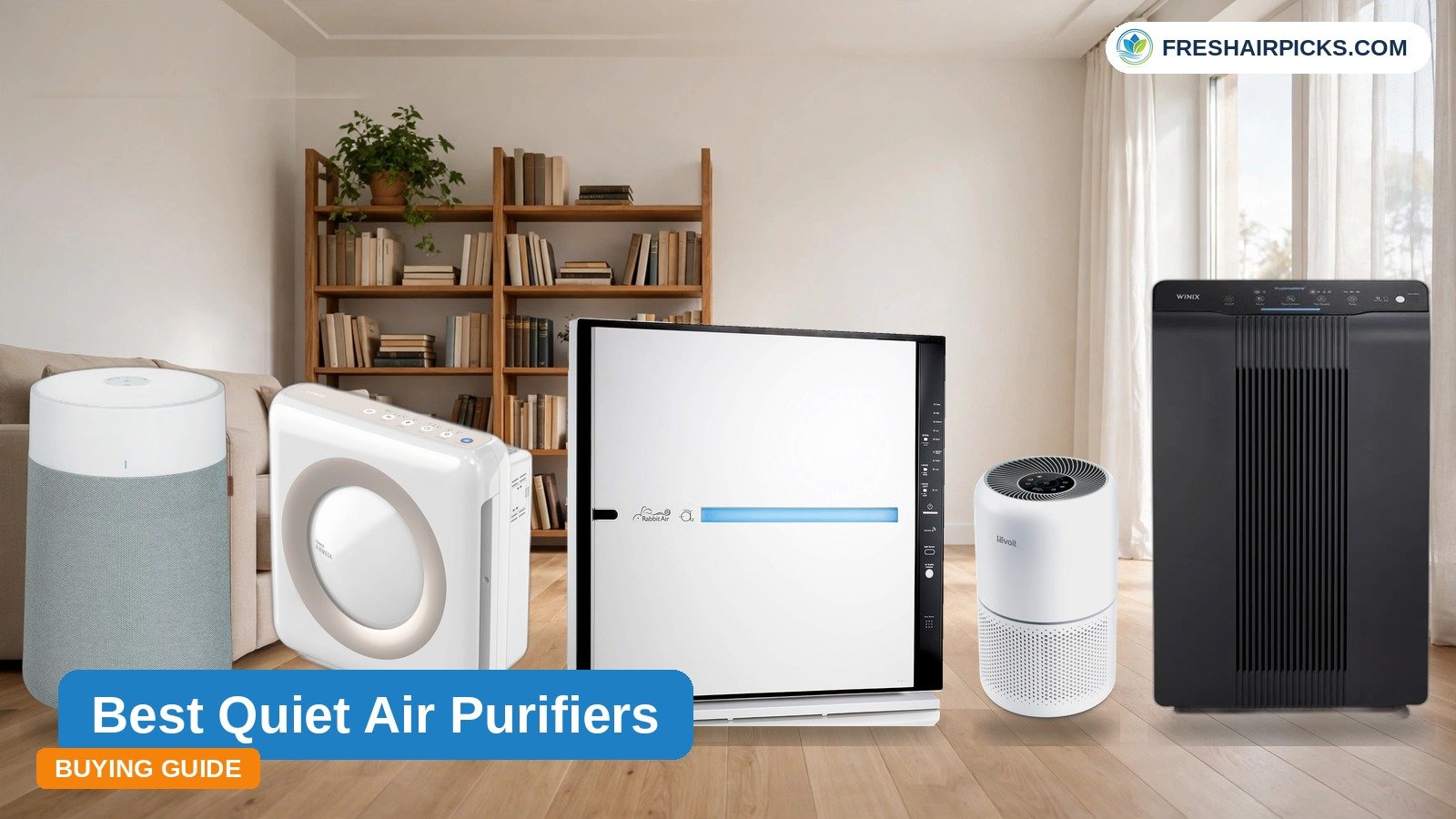
Every basement has “the smell” — that heavy, damp odor that soaks into stored boxes and drifts up the stairs. It is the hardest job a home purifier gets handed, because a basement combines everything purifiers struggle with: a big, stagnant space, cool surfaces that collect condensation, and a smell that is not a particle at all but a gas produced by mold and mildew growth.
That combination is why so many basement purifier purchases disappoint. A perfectly good bedroom unit gets carried downstairs, runs for a month, and the smell is still there — not because the machine is broken, but because it was sized for a 200-square-foot bedroom and its odor filter is a carbon sheet thinner than a credit card.
This guide ranks five purifiers genuinely suited to the job, using only numbers that can be checked independently: AHAM-verified CADR figures (or the ENERGY STAR record built on them), manufacturer-published carbon and filter data, and prices verified today. Where a manufacturer does not publish a number — and one famous brand here publishes almost none — the guide says so instead of filling the gap.
Quick answer: For most basements, buy the Coway Airmega ProX — its verified smoke CADR of 577 CFM covers about 894 sq ft at the 4.8 air-changes-per-hour standard, it carries pelleted carbon for odor, and it has no ionizer. If the musty smell itself is your main problem and the space is smaller, the Austin Air HealthMate Plus brings up to 15 lb of carbon — more odor capacity than everything else here combined — but it has no AHAM CADR, so buy it for odor, not whole-basement particle coverage. On a budget, the Winix 5510 ($179.99) is the cheapest pick with AHAM-verified numbers and a real pelleted-carbon layer. And whichever model you choose: fix the moisture first. A purifier manages airborne spores and odor; it cannot dry a wet basement, and the EPA is blunt that mold control is moisture control.
One disclosure: FreshAirPicks does not lab-test air purifiers, and this page contains no test results. The rankings rest on AHAM and ENERGY STAR data, manufacturer specifications, and prices checked in October 2026. Independent reviewers’ published measurements (HouseFresh’s, for example) are used and labelled as theirs.
How We Chose These Five
Basements reorder the usual priorities; the scoring here is basement-specific:
- Verified CADR and coverage (40%). Coverage is computed the same way across all our guides: smoke CADR × 1.55 gives the room size cleaned at roughly 4.8 air changes per hour with 8-foot ceilings (the AHAM two-thirds rule). Manufacturer “up to X sq ft” figures, usually calculated at one or two air changes, are ignored.
- Carbon and odor capacity (30%). The musty smell is made of gases (microbial VOCs, or MVOCs). HEPA filters cannot trap gases at all — only activated carbon adsorbs them, and a deep granular or pelleted bed outlasts a thin bonded sheet by months. Verified carbon weight counts heavily; unpublished carbon counts against.
- Running costs (20%). A basement purifier runs 24/7, so the filter bill and the wattage matter more than the sticker price. Three-year cost below means unit price plus three years of filters (electricity is handled in the buying guide).
- Basement practicality (10%). Washable pre-filters for dusty below-grade air, no ozone-emitting ionization in an enclosed space, wheels for a 50-pound machine, and controls that do not need babysitting.
Scores come from that rubric applied to the verified specs — hence the honest 7.9–8.7 range, not near-perfect marks.
My Top Picks at a Glance
| Product | Best for | CADR (smoke) | Coverage @4.8 ACH | Filter cost/yr | Price | Score |
|---|---|---|---|---|---|---|
| Coway Airmega ProX | Best overall for basements | 577 (AHAM via ENERGY STAR) | 894 sq ft | $199 | $999 list (street ~$850–900) | 8.7 |
| Austin Air HealthMate Plus | Best for musty odor | No AHAM CADR (~160 est.) | ~248 sq ft (est.) | ~$89 (5-yr filter) | $895 | 8.4 |
| Blueair Blue Pure 211i Max | Best for finished basements | 435 (Blueair) | 674 sq ft | ~$93–140 | $349.99 list (street ~$240–350) | 8.2 |
| Winix 5510 | Best value | 253 (AHAM) | 392 sq ft | ~$80 | $179.99 | |
| Levoit Vital 200S-P | Best for smaller basements | 250 (AHAM) | 388 sq ft | ~$50 | $159.99 | 7.9 |
Why Basements Smell Musty — and What a Purifier Can and Can’t Do
Basements sit below grade, surrounded by cool earth. Their surfaces are the coldest in the house, so humid air condenses on them; their air barely circulates; and small water intrusions — a weeping foundation crack, a sweating pipe — can keep materials damp for months without ever forming a puddle. Mold and mildew grow on the damp drywall, wood and stored cardboard, and as they grow they release microbial volatile organic compounds (MVOCs). Those gases are the musty smell.
The EPA’s position is the foundation of this guide: “There is no practical way to eliminate all mold and mold spores in the indoor environment; the way to control indoor mold growth is to control moisture.” Its guidance is to keep indoor relative humidity below 60 percent — ideally between 30 and 50 percent — and to dry wet materials within 24–48 hours. The detail is collected in the EPA’s Brief Guide to Mold, Moisture and Your Home, and our companion explainer, Do Air Purifiers Help With Mold?, walks through the full strategy.
So, honestly, here is the division of labor:
What a purifier CAN do in a basement:
- Trap airborne mold spores. Spores run roughly 3–40 microns — far larger than the 0.3-micron size HEPA filters are rated at — so a true HEPA stage captures essentially every spore that passes through it. The real variable is how much air the machine moves, which is what CADR measures.
- Adsorb the musty smell. Activated carbon captures MVOC gases. How long it keeps working depends on how much carbon there is — the biggest difference between the picks below.
- Cut the background dust and allergen load in a finished basement used as living space.
What a purifier CANNOT do:
- Fix the moisture. If your basement sits at 65% relative humidity, mold has everything it needs and the smell keeps being manufactured faster than any carbon bed can adsorb it. That is a dehumidifier’s job, not a purifier’s.
- Remove mold that is already growing on walls, joists or stored items. Surface growth has to be cleaned or removed; a purifier only handles what is airborne. The EPA’s home guidance puts do-it-yourself cleanup at small areas (under roughly 10 sq ft); its containment framework treats areas over roughly 100 sq ft — or growth inside HVAC systems — as professional remediation territory.
- “Kill” mold with a lamp or an ionizer. UV and ionization add-ons in consumer purifiers expose passing air too briefly to matter, and dead mold material can trigger allergic reactions anyway. Trapping beats killing. Our best air purifiers for mold guide applies the same standard.
The practical sequence, then: control the moisture (dehumidifier sized for the space, held at 30–50% RH), clean or remove visible growth, then run the purifier to capture spores and clear the residual smell. If musty odor is a problem beyond the basement, our guide to air purifiers for odors covers the whole-house picture.
1. Coway Airmega ProX — Best Overall for Basements
Score: 8.7/10 · $999 list (street prices around $850–900 in October 2026)
| Spec | Detail |
|---|---|
| CADR (smoke / dust / pollen) | 577 / 586 / 450 CFM (AHAM-tested values in the ENERGY STAR record) |
| Coverage @4.8 ACH | 894 sq ft |
| Filtration | Two washable pre-filters + two Max2 sets (True HEPA + pelleted activated carbon, bonded) |
| Filter cost | $199 per full set, ~12-month interval → $199/yr |
| 3-year cost (unit + filters) | ~$1,596 at list price |
| Noise | 37.4–53.6 dBA measured at 3 ft (HouseFresh); no manufacturer range published |
| Power | ~59 W at top speed, measured (HouseFresh) |
| Ionizer | None — ENERGY STAR lists ozone emissions of 0.0 ppb |
| Size / weight | 18.9 × 36.6 × 24.3 in; 51 lb; four wheels |
| Warranty | 3 years |
Most basements fail purifiers on size before anything else. A standard open basement is 600–1,200 sq ft of connected air, and at the 4.8 air-changes-per-hour standard this guide uses, that demands a smoke CADR of roughly 390–775. Almost no consumer purifier publishes verified numbers in that range. The ProX does: its ENERGY STAR record carries AHAM-tested CADRs of 577 smoke, 586 dust and 450 pollen — 894 sq ft of real coverage, the strongest verified figure in this guide, and the reason it takes the top slot despite its price.
The ProX’s design suits below-grade duty in specific ways. It draws air through two filtration towers, each fronted by its own washable pre-filter — in a dusty basement, a pre-filter you rinse monthly beats a bonded one you replace. The Max2 sets pair Green True HEPA media with pelleted activated carbon, a real odor stage rather than a carbon-dusted sheet; Coway does not publish the carbon weight, so this guide claims no number, but the form factor is the right one for musty air. And Coway dropped the ionizer entirely on this model: ENERGY STAR lists its ozone emissions at 0.0 ppb, which is what you want in an enclosed space running a machine around the clock.
The trade-offs are size, price and filters. At 51 lb and nearly three feet tall, the ProX is furniture — the wheels help, and a basement is the one place its footprint is rarely a problem. The $199 annual filter set is the most expensive here; three-year cost is about $1,596 at list, softened by street prices around $850–900 (October 2026). There is no app or Wi-Fi — a gap for some, a virtue in a set-and-forget location. Measured noise tops out around 53.6 dBA, reasonable for its class, and auto mode idles far below that.
Who it’s for: anyone with a large or open-plan basement — finished or not — who wants one machine, verified numbers, and a real carbon stage.
2. Austin Air HealthMate Plus — Best for Musty Odor
Score: 8.4/10 · $895
| Spec | Detail |
|---|---|
| CADR | No AHAM CADR — Austin does not participate in AHAM (see below) |
| Airflow | 400 CFM fan rating (airflow, not CADR); ~160 CFM PM1 CADR measured estimate (HouseFresh) |
| Coverage @4.8 ACH | ~248 sq ft, computed from that estimate |
| Filtration | PermaFilt pre-filter + up to 15 lb activated carbon / zeolite / potassium iodide + 60 sq ft True Medical Grade HEPA |
| Filter cost | $445 per filter, designed to last 5 years → ~$89/yr annualized |
| 3-year cost (unit + filters) | ~$1,162 |
| Noise | Austin publishes none; 42.5–61.5 dBA measured on the standard HealthMate (HouseFresh) |
| Power | 56 W (low) to ~132 W (high), dealer technical specs |
| Ionizer | None |
| Size / weight | 14.5 × 14.5 × 23 in; 47 lb; steel housing; casters |
| Warranty | 5-year mechanical + 5-year pro-rated filter |
If the smell is the whole problem — the basement is dry enough, there is no visible growth, but the musty odor will not quit — this is the specialist. Odor removal is a capacity game, and the HealthMate Plus plays it at a level nothing else here approaches: up to 15 lb of adsorption media, a blend of activated carbon, zeolite and potassium-iodide-impregnated carbon, in a bed over 780 cubic inches deep. The comparison that matters: the Winix 5510 below, a genuinely good odor performer for its price, carries 226 grams of carbon. The Austin carries roughly thirty times that — the difference between a carbon stage that fades in a season of musty air and one designed to work for years. Austin rates the filter at up to five years under normal residential use and backs it with a five-year pro-rated filter warranty.
The steel build suits a basement too: a sealed metal housing, a PermaFilt pre-filter you vacuum from outside, three speeds on a dial, casters, no app, no sensors, no ionizer — nothing to configure and little to break. Made in Buffalo, New York; five-year mechanical warranty.
Now the honesty paragraph, because this pick demands one. Austin Air does not participate in the AHAM CADR program at all, so there is no verified CADR for this machine — not a low one, none. The “400 CFM” in its marketing is fan airflow, not clean-air delivery. The best independent estimate, from HouseFresh’s measurements of the standard HealthMate (same fan and housing), is a PM1 CADR of roughly 160 CFM, which covers only about 248 sq ft at 4.8 ACH. So the trade is explicit: nothing here beats it on odor, and almost everything here beats it on verified particle coverage. Buy it for a musty room-sized problem or as the odor half of a two-machine setup — not as the sole purifier for a 900 sq ft basement. It is also the hungriest pick electrically (56 W even on low, ~132 W on high, per dealer technical specs) and, with no published noise figures, the measured numbers on its sibling suggest it is not quiet on high.
Who it’s for: the homeowner whose basement moisture is handled and whose remaining enemy is the smell itself — especially where stored belongings have absorbed it — and anyone who values a five-year filter over a five-feature app. Our cigarette smoke guide ranks this same machine first for the same reason: when gases are the problem, carbon mass is the answer.
3. Blueair Blue Pure 211i Max — Best for Finished Basements
Score: 8.2/10 · $349.99 list (street prices ~$240–350 in October 2026)
| Spec | Detail |
|---|---|
| CADR (smoke / dust / pollen) | 435 / 452 / 450 CFM (Blueair, current DOE basis) |
| Coverage @4.8 ACH | 674 sq ft (Blueair’s own recommended size) |
| Filtration | HEPASilent: electrostatic stage + mechanical filter; carbon layer in the wrap filter |
| Filter cost | $69.99, every 6–9 months → ~$93–140/yr |
| 3-year cost (unit + filters) | ~$630–770 |
| Noise | 23–53 dB (Blueair) |
| Power | 46 W max (Blueair) — the lowest of the large picks |
| Ionizer | Electrostatic stage is always on and cannot be switched off (see below) |
| Size / weight | 22.7 × 14.4 × 14.4 in; 16.2 lb |
| Warranty | 1 year, 3 years with registration |
A finished basement is a living room that happens to be downstairs, and the priorities shift: noise, power draw and polish matter as much as brute force. The 211i Max is built for exactly that room. Blueair rates it at 435 smoke CADR on the current DOE basis — enough for 674 sq ft at 4.8 ACH, the second-largest verified-basis coverage here — while drawing a maximum of just 46 W at a rated 23–53 dB. It delivers roughly three-quarters of the ProX’s rated CADR at a third of the price and a fraction of the bulk, and adds what a lived-in room appreciates: particle sensors, a proper auto mode, app control, and washable fabric pre-filters that shrug off basement dust.
Two disclosures decide whether it is right for you, and both are printed here rather than buried. First, HEPASilent is not conventional True HEPA. Blueair’s system charges incoming particles electrostatically so they stick to a less dense mechanical filter — how it moves so much air so quietly — but that electrostatic stage cannot be switched off. Buyers who want purely mechanical filtration should choose the ProX, the Winix or the Vital instead. Second, its odor stage is the lightest in this guide: the carbon is a layer inside the wrap-around filter, pitched by Blueair itself at light odors, and no carbon weight is published. Against mild finished-basement mustiness with the moisture fixed, it is adequate. Against a strong musty smell, it is the wrong tool — that is the Austin’s job, or the ProX’s pelleted stage.
Running costs sit in the middle: the $69.99 filter lasts 6–9 months, annualizing to roughly $93–140 a year — plan on the shorter interval in dusty below-grade air. The street price also moves a lot: $349.99 is list, but it was seen at $239.99 at Amazon in October 2026, so buy on a dip if your timing allows.
Who it’s for: finished-basement households — guest room, gym, home theater, office — up to ~670 sq ft, where moisture is solved, mustiness is mild, and quiet, efficient, app-controlled running matters.
4. Winix 5510 — Best Value
Score: 8.1/10 · $179.99
| Spec | Detail |
|---|---|
| CADR (smoke / dust / pollen) | 253 / 252 / 247 CFM (AHAM Verifide) |
| Coverage @4.8 ACH | 392 sq ft |
| Filtration | Washable pre-filter + 226 g pelleted activated carbon, separate layer + True HEPA |
| Filter cost | Filter Q set $79.99, 12 months → ~$80/yr |
| 3-year cost (unit + filters) | ~$420 |
| Noise | From 23.5 dB rated; 35.2–67.2 dBA measured at 3 ft (HouseFresh) |
| Power | 65 W max (Winix) |
| Ionizer | PlasmaWave — can be switched off; CARB-certified (EO G-24-234) |
| Size / weight | 15.9 × 11 × 25.2 in; 13.03 lb |
| Warranty | 2 years |
The Winix 5510 keeps earning slots in these guides — top pick in our mold guide, IndoorBreathing’s #1 basement pick — because it is the cheapest machine that does the two basement things properly at once: AHAM-verified CADR (253 smoke, good for 392 sq ft) and a separate layer of pelleted activated carbon, 226 g of it, replaceable without throwing away the HEPA. That is rarer than it should be under $200, and it is what musty air demands: carbon is a consumable, and a design that treats it as one will still be removing odor in year three.
It is also honest about its limits, so this guide will be too. 226 g of carbon is roughly a thirtieth of the Austin’s bed: enough for the mild-to-moderate mustiness of a basement whose moisture is controlled, not enough to overpower a wet one. Coverage of 392 sq ft suits a closed basement room or a smaller finished basement — not a whole open floor, whatever the box implies. HouseFresh’s measurements put its top speed at 67.2 dBA, which is genuinely loud; in an unfinished basement that is a shrug, but in a basement bedroom you will live on the middle speeds, where effective coverage is smaller. The washable pre-filter wants a vacuum or brush every two weeks per the manual — a fair trade for keeping the main filter alive in dusty air. The PlasmaWave ionizer can be switched off entirely, and for an enclosed basement that is how we would run it.
Who it’s for: budget-first buyers with a basement space up to ~390 sq ft who want verified numbers and a real carbon layer without crossing $200. One 5510 will under-serve a big open basement; two of them, placed at opposite ends, cost less than a ProX and together cover more air, at the price of two filter bills (~$160/yr combined).
5. Levoit Vital 200S-P — Best for Smaller Basements
Score: 7.9/10 · $159.99
| Spec | Detail |
|---|---|
| CADR (smoke / dust / pollen) | 250 / 254 / 289 CFM (AHAM Verifide) |
| Coverage @4.8 ACH | 388 sq ft |
| Filtration | Washable pre-filter panel + pelleted activated carbon + True HEPA |
| Filter cost | $49.99, ~12 months → ~$50/yr — the cheapest here |
| 3-year cost (unit + filters) | ~$310 |
| Noise | 24–54 dB (Levoit manual) |
| Power | ~50 W rated max; 44.6 W measured at top speed, 8 W at speed 2 (HouseFresh) |
| Ionizer | None |
| Size / weight | 15.6 × 8.5 × 19.8 in; 13.2 lb |
| Warranty | 2 years |
The Vital 200S-P is the pick for the basement that is really a room: a closed-off office, a small finished den, a storage room up to about 388 sq ft. On paper it nearly matches the Winix — AHAM smoke CADR of 250 against 253 — and it beats it on the two numbers that dominate 24/7 ownership: filters at $49.99 a year, the cheapest in this guide, and a remarkably light thirst for power. HouseFresh measured 44.6 W at top speed and just 8 W at speed 2; left on the middle speeds, its electricity is a few dollars a year. Its washable pre-filter is a separate panel, there is no ionizer, and the VeSync app covers schedules and filter tracking — useful for a machine you may not visit daily.
The reason it sits fifth rather than fourth is the basement-specific tiebreaker: odor stamina. Its carbon stage is pelleted — the right form — but its capacity is modest and Levoit publishes no carbon weight; the Winix’s verified 226 g separate layer is the safer bet when mustiness is more than faint. For a smaller basement room with moisture fixed and smell mild, though, the Vital is the smarter buy — cheaper to run in every dimension. For noticeable musty odor at the same size, spend the extra $20 on the Winix.
Who it’s for: smaller or sectioned basement spaces up to ~390 sq ft with mild mustiness, especially where the unit will run unattended for weeks — the lowest-effort ownership here.
Buying Guide: Sizing, Carbon and Running Costs for a Basement
Size by CADR, not by the box
Work backwards from your floor area: the smoke CADR you need ≈ your square footage ÷ 1.55 (8-foot ceilings, ~4.8 air changes per hour). Measure the actual open area — rooms sharing a wide-open doorway are one space; a closed door makes two.
| Basement size | Smoke CADR needed @4.8 ACH | Picks that cover it in one unit |
|---|---|---|
| 300 sq ft (small room) | ~195 | Winix 5510, Vital 200S-P |
| 400 sq ft | ~260 | Winix 5510 / Vital 200S-P (marginal), Blueair 211i Max |
| 600 sq ft | ~390 | Blueair 211i Max, Coway ProX |
| 900 sq ft | ~580 | Coway ProX |
| 1,200 sq ft | ~775 | None here in one unit — a ProX plus a second mid-size unit, or accept fewer air changes |
Two honest footnotes. First, these figures are at top speed; at the quieter middle speeds you live with, effective coverage is lower — size up rather than down. Second, the Austin is deliberately absent: with no AHAM CADR it cannot be sized by CADR at all. Treat it as an odor appliance for a few hundred square feet.
Carbon is the odor budget
Since the musty smell is gas, not particles, the carbon stage is the product for most basement buyers. Three tiers exist here, in descending order of stamina: a deep granular bed measured in pounds (the Austin’s up-to-15 lb — years of capacity, a five-year filter rating); pelleted carbon layers in mainstream units (the ProX’s Max2 sets, the Winix’s 226 g, the Vital’s modest stage — months to a year); and thin carbon bonded into a combination filter (the Blueair’s layer — light odors only). The signal that carbon is spent is always the same: the musty smell creeps back despite the machine running. Budget at the short end of the rated filter life in a basement — below-grade air is more humid and loaded than the conditions behind the ratings.
The 24/7 electricity math
Run it continuously, and price that honestly. At the US average residential rate of 18.44¢ per kWh (EIA, May 2026), a year of 24/7 running costs roughly:
| Average draw | Electricity per year (24/7) |
|---|---|
| 20 W (low/auto on a mid-size unit) | ~$32 |
| 30 W (typical auto/medium) | ~$48 |
| 50 W (working hard, or a large unit cruising) | ~$81 |
| 100 W (a big unit near full speed) | ~$162 |
Mapped to the picks: the Vital measured 8 W at speed 2 (HouseFresh), so medium-speed running costs a few dollars a year; the Blueair’s 46 W maximum caps its worst case near $74 a year; the ProX measured ~59 W at top speed (~$95/yr if it never idled, far less in auto); the Winix tops out at 65 W; and the Austin is the outlier — 56 W on its lowest speed means roughly $90 a year even idling, and ~$213 a year on high. Over a purifier’s life, filters plus electricity can exceed the purchase price — the core argument of our are air purifiers worth it analysis.
Placement and upkeep downstairs
Put the unit where the air is worst and the intake is unobstructed — near the musty corner or the stored-goods wall, not beside the furnace’s return vent, where it will fight the HVAC for air. Keep a foot or so of clearance on the intake sides, vacuum or rinse pre-filters monthly, and change the main filter on the short end of its rating if the space stays humid. And check the room, not just the machine: a $20 hygrometer confirming your basement holds 30–50% RH tells you more about your musty-smell future than any purifier feature. If it reads 60%+ week after week, spend the next dollar on the dehumidifier, not a bigger purifier.
Frequently Asked Questions
Will an air purifier get rid of my basement’s musty smell?
It can clear the smell from the air — provided the moisture behind it is fixed and the purifier has a substantial carbon stage. The smell is made of microbial VOC gases, which only activated carbon adsorbs; a HEPA filter alone does nothing for it. If the basement stays damp, mold keeps producing those gases faster than any carbon bed can adsorb them. Fix humidity first (the EPA’s target is 30–50% RH), then let carbon work — the Austin’s up-to-15 lb bed is the strongest odor tool in this guide.
Do I need a dehumidifier as well as an air purifier?
Usually, yes — they do different jobs. A dehumidifier removes moisture and stops mold growth at the source; a purifier removes airborne spores and odor gases. If your basement regularly exceeds 60% relative humidity, the dehumidifier is the first purchase and the purifier the second. If it already holds 30–50% RH and the smell is residual, a purifier alone can finish the job.
What size air purifier (CADR) do I need for my basement?
Divide your basement’s open square footage by 1.55: roughly 195 CADR for 300 sq ft, 390 for 600 sq ft, 580 for 900 sq ft (at ~4.8 air changes per hour). On that math the Coway Airmega ProX (577) is the only single unit here sized for a 900 sq ft basement; the Blueair 211i Max (435) covers about 674 sq ft; the Winix 5510 and Vital 200S-P (253 and 250) suit rooms up to about 390 sq ft. Verify any model’s listing in the AHAM directory before buying.
Can an air purifier remove mold from basement walls?
No. A purifier only cleans air that passes through it. Mold growing on walls, joists or stored items has to be cleaned or removed at the surface, and the moisture feeding it stopped. The EPA’s home guidance puts do-it-yourself cleanup at small areas — under roughly 10 sq ft — and treats areas over roughly 100 sq ft, or growth inside ductwork, as a job for a professional remediator. Where a purifier genuinely helps is during and after that work, capturing the spores cleanup throws into the air — the full sequence is in our explainer, Do Air Purifiers Help With Mold?.
Should I run a basement air purifier 24/7, and what does it cost?
Yes — basements generate spores and odor 24/7, and intermittent running lets both rebuild. At the US average rate of 18.44¢ per kWh, continuous running costs roughly $32 a year at a 20-watt average draw, $48 at 30 watts, and $81 at 50 watts. Efficient picks like the Vital (8 W measured at speed 2) cost a few dollars a year on realistic speeds; the Austin is the exception at 56 W even on low.
True HEPA or HEPASilent — which is better for a basement?
For mold spores, both capture effectively once air passes through the filter. A sealed True HEPA design (ProX, Winix, Vital, Austin) is purely mechanical — the safer default for an enclosed below-grade space. Blueair’s HEPASilent moves more air more quietly on less power, but its electrostatic stage cannot be switched off. If anyone in the house is sensitive to ionizer-style technologies, choose a mechanical model; if quiet and efficiency matter most and moisture is controlled, the Blueair is a strong pick with that caveat understood.
Can mold grow on the air purifier’s own filter?
It can. A filter loaded with spores and organic dust, sitting in damp basement air, can itself support growth — one more reason the purifier is the third step, not the first. Keep the room at 30–50% relative humidity, vacuum or rinse the pre-filter monthly, replace the main filter on schedule (short end of its rating in a humid basement), and wear a mask and gloves when handling a heavily loaded filter, bagging it straight away.
Conclusion
A basement rewards the buyer who solves the problem in order: moisture first, cleanup second, purification third. On that footing, the Coway Airmega ProX is the best all-round basement purifier here — the only pick with verified CADR for a whole large basement, with pelleted carbon and no ionizer. The Austin Air HealthMate Plus is the odor specialist, trading verified airflow for a carbon bed nothing else matches. The Blueair Blue Pure 211i Max suits finished basements where quiet and efficiency matter and the smell is mild; the Winix 5510 and Levoit Vital 200S-P bring the same discipline down to $180 and $160 for smaller spaces. None will rescue a wet basement — but in a dry one, each will make the air stop smelling like it.
Prices checked October 2026 and will change. CADR figures are AHAM/ENERGY STAR values where stated; manufacturer-rated and independently measured figures are labelled as such wherever they appear.