Yes — with a “but” that matters more than the yes. A good air purifier genuinely helps with mold: a true HEPA filter traps the airborne spores you would otherwise breathe, and a substantial activated carbon stage adsorbs the gases behind the musty smell. What it cannot do is the part the marketing leaves out. It cannot remove mold that is growing on a wall, inside drywall, or under a floor, and it cannot fix the moisture that is feeding the growth. The US Environmental Protection Agency’s position is the whole strategy in one sentence: “There is no practical way to eliminate all mold and mold spores in the indoor environment; the way to control indoor mold growth is to control moisture.” A purifier works on the air. Mold is a moisture problem with an airborne symptom, and the purifier only treats the symptom.
Used in the right order, though, it earns its place. Fix the moisture, remove the growth, and the purifier becomes the step that keeps the air in that room from quietly reseeding the problem and your lungs — including during the cleanup itself, when scrubbing knocks large numbers of spores loose. This page walks through what a purifier does and doesn’t do, the three-step order the EPA‘s guidance implies, and what to look for if you buy one. For the actual product picks, see our guide to the best air purifiers for mold.
Quick answer
- Yes, for the air: a true HEPA purifier traps airborne mold spores — at roughly 3–40 microns, spores are far larger than the 0.3-micron particle size HEPA is rated on, so capture is effectively total for the air that passes through the filter.
- Yes, for the smell — with the right filter: the musty odor is gas (microbial volatile organic compounds, or MVOCs). HEPA can’t touch gases; activated carbon can, and its capacity depends on how much carbon there is. A thin carbon sheet is not the same tool as a real carbon bed.
- No, for the growth: no purifier removes mold growing on surfaces or inside walls, and none removes humidity. Growth has to be physically removed and the moisture source fixed, or the mold returns.
- Order matters: fix moisture first, remove the growth second, run the purifier third — and keep it running during and after any cleanup, because disturbing mold releases spores into the air.
- Avoid: ozone generators (the EPA calls ozone a lung irritant that does little at safe levels) and UV-C as a mold feature (home units are too weak to matter, and dead spores can still trigger allergies — trapping beats “killing”).
What an air purifier does — and what it cannot do
It helps to split the mold problem into its three separate parts, because each part has a different tool. The growth on the surface is the source. The moisture feeding it is the cause. The spores and smell in the air are the airborne share. A purifier addresses only the third part — but it addresses it well.
What it does:
- Captures airborne spores. A purifier pulls room air through a dense filter and physically traps the spores in it. That lowers the number of spores you inhale and the number that settle elsewhere in the room. For people whose mold problem shows up as allergy or asthma symptoms, the airborne load is the part they actually live in.
- Cuts the musty smell — if the carbon is real. The smell is MVOC gas released by growing mold. Gases pass straight through a HEPA filter; activated carbon adsorbs them. How long that lasts depends on how much carbon the machine carries, which is why the mold guide on this site weighs carbon in pounds and grams rather than repeating the words “carbon filter.”
- Works hardest exactly when you need it: during cleanup. Scrubbing or disturbing a mold colony releases large numbers of spores into the air — the EPA warns that even peeling back wallpaper over hidden growth “can lead to a massive release of spores.” A purifier running in the room through the cleanup and afterwards captures much of that cloud instead of letting it resettle.
What it cannot do:
- Remove growth. Mold on a wall, in grout, or inside a wall cavity stays exactly where it is, however long the purifier runs. It has to be cleaned off or cut out and discarded — that is remediation, and no appliance substitutes for it.
- Fix moisture. A purifier does not lower humidity at all. If the leak, condensation, or damp that fed the mold is still there, the growth comes back on schedule, and the purifier will be cleaning up after it forever.
- Kill mold in any way that solves the problem. This one deserves its own emphasis because “kills 99.9% of mold” is a common selling line. The EPA’s cleanup guidance is blunt: “Dead mold may still cause allergic reactions in some people, so it is not enough to simply kill the mold, it must also be removed.” A dead spore left in the air or on a surface is still an allergen. The goal is to trap spores and take them out of the air — and to remove growth from surfaces — not to sterilize anything.
The 3-step approach: starve it, clean it, capture what’s airborne
Step 1 — Starve: fix the moisture
Mold needs water, full stop. The EPA’s rule for homes is to keep indoor relative humidity below 60 percent, and ideally between 30 and 50 percent, and to dry wet or damp materials within 24–48 hours of a leak or spill, before growth can start. In practice: fix the leak or the condensation source first, run bathroom and kitchen exhaust fans, use a dehumidifier in rooms that live above that range (basements are the usual case), and check the result with an inexpensive hygrometer rather than guessing. This step is the actual cure for a mold problem; the other two are cleanup and containment. If your question is whether a purifier or a dehumidifier comes first, this is why the dehumidifier wins that argument — it works on the cause. Our explainer on whether air purifiers are worth it covers where each appliance earns its money in more depth.
Step 2 — Clean: remove the growth
With the moisture stopped, the existing growth has to come off. The EPA’s homeowner guidance draws the DIY line by size: if the moldy area is less than about 10 square feet — roughly a 3 ft by 3 ft patch — “in most cases, you can handle the job yourself.” The method is unglamorous: scrub mold off hard surfaces with detergent and water, and dry completely. One correction to advice that circulates widely (including in an earlier version of this page): the EPA does not recommend bleach for routine mold cleanup — “the use of a chemical or biocide that kills organisms such as mold (chlorine bleach, for example) is not recommended as a routine practice during mold cleanup.” Killing was never the point; removing is, because dead mold is still allergenic. Porous materials are the exception to scrubbing: moldy ceiling tiles, carpet, and similar absorbent materials may have to be thrown away, because mold grows into their empty spaces where a scrub brush can’t reach. Don’t paint or caulk over mold — clean and dry first, or the paint peels and the growth continues underneath.
Above the DIY line, escalate rather than improvise. For areas larger than about 10 square feet, or where there has been heavy water damage, the EPA points homeowners to its remediation guidance for buildings; its Mold Course containment framework scales from limited containment at 10–100 square feet up to full containment for areas larger than 100 square feet — professional territory. The same goes for suspected hidden mold (a persistent musty smell with no visible source), mold in an HVAC system, sewage-contaminated water, and any cleanup someone with health concerns would be doing themselves. And while you clean: this is the moment the purifier from step 3 should already be running in the room, because the scrubbing that removes the growth is also what fills the air with spores.
Step 3 — Capture: the purifier’s job
Now the purifier. Its role is the ongoing one: keep the airborne spore count in the room low — during the cleanup, in the days after it while disturbed spores settle out, and indefinitely in rooms that stay damp-prone even with humidity controlled. Run it continuously or on auto in the room where the problem was, rather than in bursts. That continuity is also what makes it useful for the allergy side of mold: spores don’t schedule themselves, and neither does the fine fraction of mold fragments that rides the air with them. How this connects to allergy symptoms generally is covered in our explainer on whether air purifiers help with allergies.
What to look for in a purifier for mold
Three things decide whether a purifier is a mold tool or a box with a fan, and none of them is a feature badge.
True HEPA filtration. HEPA’s rating — 99.97% efficiency — is measured at 0.3 microns, which is the most penetrating particle size: the size a filter finds hardest to catch. Efficiency is higher for particles both larger and smaller. Mold spores, at roughly 3–40 microns, are far into the easy range, so any genuine true HEPA filter captures essentially every spore that passes through it. That also means capture percentage is not the contest — every true HEPA machine is at the ceiling. What separates them is how much air they move, which is the CADR point below. (“HEPA-type” and “HEPA-style” filters are not held to the standard; our explainer on what a true HEPA filter is walks through the difference.)
Substantial activated carbon, stated in weight. For the musty smell, this is the specification that matters and the one brands most often hide. Carbon capacity scales with mass and form: a pelleted or granular carbon stage holds far more MVOC gas than the thin carbon sheet bonded to the back of many filters, and a sheet can saturate quickly under a real odor load. If a manufacturer won’t state a carbon weight for a machine sold for mold or odor, treat the carbon as cosmetic. The EPA’s air-cleaner guidance makes the same point from the other side: gas-phase filters “can become overloaded quickly and may need to be replaced often.” When the smell comes back, either the carbon is spent or the source is still damp — check the moisture before you blame the filter.
Sizing by CADR, at honest air changes. Every guide on this site sizes the same way: at 4.8 air changes per hour (with standard 8-foot ceilings), a purifier’s smoke CADR × 1.55 gives the largest room in square feet it can serve. Smoke CADR is the anchor because it is a machine’s lowest and most conservative rating — not because spores are smoke-sized; they’re much larger, and the margin is the point. Worked example: a 12 × 15 ft bedroom is 180 sq ft, so you need a smoke CADR of at least 180 ÷ 1.55 ≈ 116 CFM; a machine with a smoke CADR of 141 covers about 219 sq ft and fits that room with headroom. Manufacturers’ headline room sizes are usually computed at one or two air changes an hour, which is why they run two to five times larger than the figures here. When in doubt, size up: a larger machine on a quiet medium speed out-cleans a small one running flat-out. Our mold purifier guide applies exactly this math to the current picks, with their verified CADRs and carbon weights side by side.
Technologies to be skeptical of
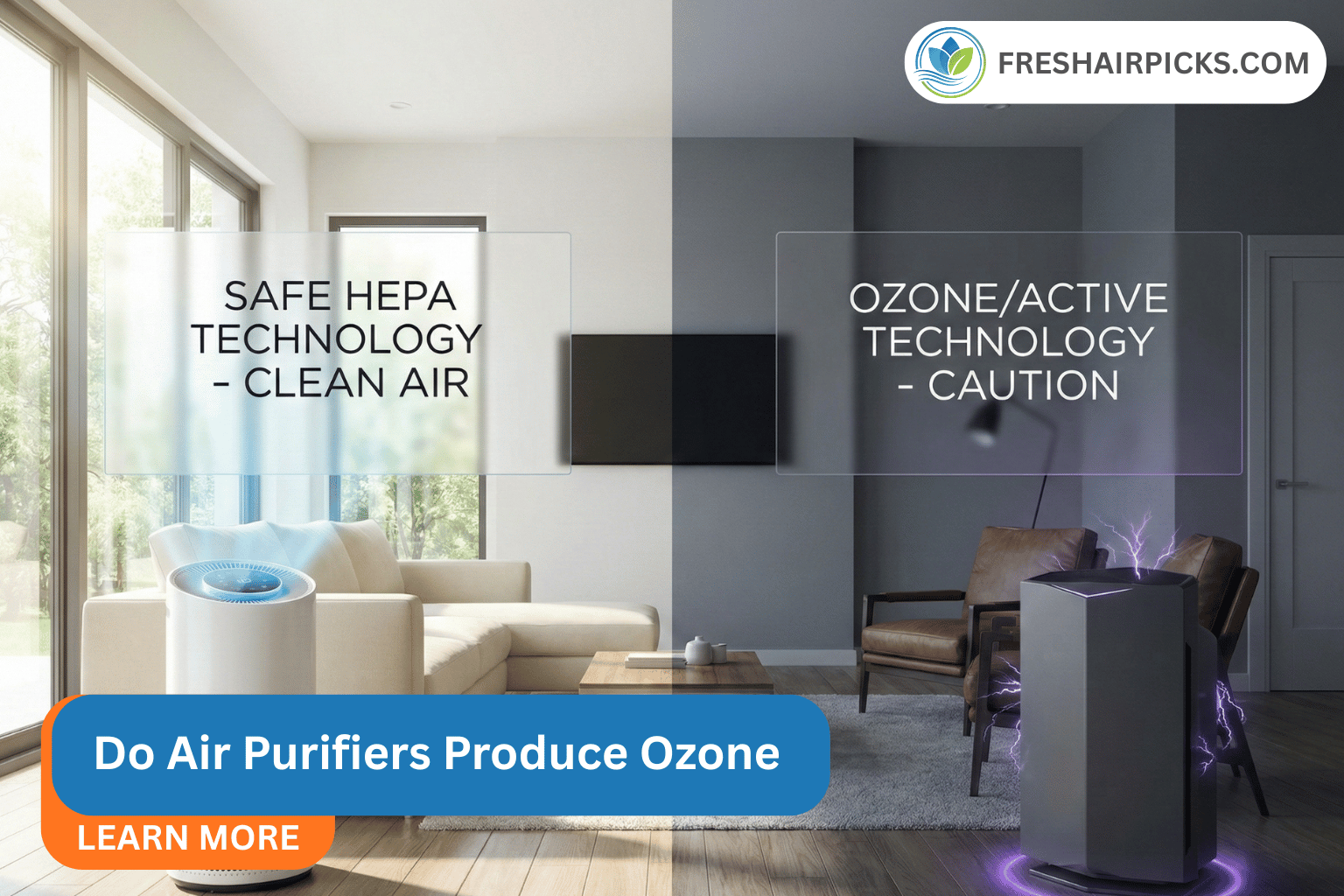
Ozone generators and ozone-producing ionizers. The EPA’s review is direct: ozone is a lung irritant, and “at concentrations that do not exceed public health standards, ozone has little effect in removing most indoor air contaminants.” A device that adds a lung irritant to a room where someone is already reacting to mold is solving the wrong problem. Some electronic air cleaners — ion generators and electrostatic precipitators — can also emit ozone as a byproduct. If a machine has an ionizer, the acceptable version is one that can be switched off and left off; the filtration should be doing the work.
UV-C lamps. UV-C sounds made for mold — ultraviolet light does damage microorganisms — and it is the feature most often oversold for it. The EPA’s guidance: typical UVGI cleaners used in homes “have limited effectiveness in killing bacteria and molds,” because destroying most mold spores takes far more UV exposure than a home unit delivers as air rushes past the lamp; UVGI “should be applied with, but not as a replacement for, filtration systems.” And even a perfectly “killed” spore solves nothing by itself: it is still an airborne allergen until a filter traps it (see the EPA’s dead-mold point above). UV-C is, at best, an accessory to a HEPA filter — never a reason to choose one machine over another for mold. Photocatalytic (PCO) units get the same caution from a different angle: per the EPA they “are not designed to remove particulate pollutants,” and spores are particles.
Can mold grow on the purifier’s filter?
Yes — and it is the right question to ask, because the setup is obvious once you see it: a filter that has trapped spores and other organic matter is, in a damp room, a surface with food on it. EPA’s technical guidance on air cleaners notes that high moisture can promote mold growth in filter media. The defenses are the same two as everywhere else in this plan. First, hold the room’s humidity in the 30–50% band (step 1) — a filter in a dry room is a poor mold habitat. Second, replace filters on the manufacturer’s schedule rather than stretching them; an old, loaded filter in a damp-prone room is exactly the combination to avoid. Beyond that, no special ritual is needed: handle a used filter the way you’d handle anything that has been collecting spores — swap it out, bag it, and don’t shake it out indoors.
Frequently asked questions
Do air purifiers kill mold?
No — and for mold, killing is the wrong goal. A HEPA purifier traps spores and removes them from the air; it doesn’t sterilize them, and it doesn’t need to. The EPA’s cleanup guidance makes the underlying point: “Dead mold may still cause allergic reactions in some people, so it is not enough to simply kill the mold, it must also be removed.” That is also why UV-C “mold killing” claims disappoint: a dead spore floating in your air is still an allergen. Trapping and removal are what work.
Will an air purifier remove the musty smell?
Yes, if it carries enough activated carbon. The musty smell is gas — microbial volatile organic compounds (MVOCs) given off by growing mold — and gases pass straight through a HEPA filter. Activated carbon adsorbs them, and capacity scales with how much carbon there is: a pelleted or granular bed will work for months where a thin carbon sheet saturates quickly. Two caveats: the carbon treats the smell, not the growth producing it, and if the smell returns, either the carbon is spent or the source is still damp — check the moisture first.
Air purifier or dehumidifier — which do I need for mold?
Both, in that order of priority — they do different jobs. A dehumidifier works on the cause: it holds indoor humidity in the EPA’s 30–50% target band, which is what stops mold growing. A purifier works on the airborne share: spores and odor already in the room’s air. If you can only buy one first, buy the one that fixes your moisture problem; a purifier in a still-damp room is bailing a boat without plugging the leak.
Can an air purifier detect mold?
No. Purifier sensors measure particles (PM2.5) or gases (VOCs) in general — they cannot identify mold, and none can tell you mold is present. A cleanup that knocks spores loose may spike the particle reading and spin the fan up, but that’s a dust reading, not a diagnosis. Your actual detectors are your eyes, your nose, and a hygrometer watching humidity. The EPA takes the same view of mold testing: if visible growth is present, sampling is usually unnecessary — clean it up and fix the moisture.
Should I run an air purifier during and after mold cleanup?
Yes — this is the purifier’s highest-value moment. Disturbing a mold colony releases large numbers of spores into the air; the EPA notes that even peeling wallpaper over hidden growth “can lead to a massive release of spores.” Running a HEPA purifier in the room during the cleanup and for some time afterwards captures much of that airborne load before it resettles on surfaces (where, if any moisture remains, it could start again). Wear the cleanup basics the EPA recommends for yourself, too — gloves, goggles, and an N-95 respirator for anything beyond the smallest patch.
Can mold grow on the air purifier’s own filter?
It can, if the loaded filter stays damp — trapped spores plus moisture plus time is the same recipe as anywhere else. The EPA’s technical guidance notes high moisture can promote mold growth in filter media. The two defenses are humidity control (keep the room in the 30–50% band, which step 1 of this plan does anyway) and replacing filters on the manufacturer’s schedule instead of stretching them. A filter kept dry and changed on time is not a realistic mold source.
Are UV-C or ionizer purifiers better for mold?
No — for mold they’re a distraction from the two specs that matter, true HEPA and carbon weight. Per the EPA, home UVGI units have limited effectiveness against mold because spores need far more UV exposure than a passing airstream gives them, and a “killed” spore is still an allergen until a filter traps it. Ionizers add a different problem: some emit ozone, which the EPA identifies as a lung irritant that does little against indoor contaminants at safe levels. If a machine has an ionizer, choose one that switches off — and judge the machine on its HEPA and carbon, not its lamp.
The bottom line
An air purifier helps with mold in the same way a good net helps with a leak in a boat: it handles what is already in the air around you, and it handles it well — spores trapped, musty odor adsorbed, cleanup clouds captured. It does not plug the leak. Fix the moisture and the mold has no future; remove the growth and the source is gone; run the purifier and the air in the room stops carrying the problem from one surface to the next. Skip either of the first two steps and the third one will never catch up.
FreshAirPicks has no lab and tests nothing. The guidance on this page rests on the US EPA’s published mold and air-cleaner guidance — the Brief Guide to Mold, Moisture and Your Home, the Mold Course, and the Guide to Air Cleaners in the Home — and on the verified ratings and measurements behind our product guides, not on hands-on testing or first-person trials. Guidance and product specifications can change after publication; if you spot an error, write to us and we’ll correct it.