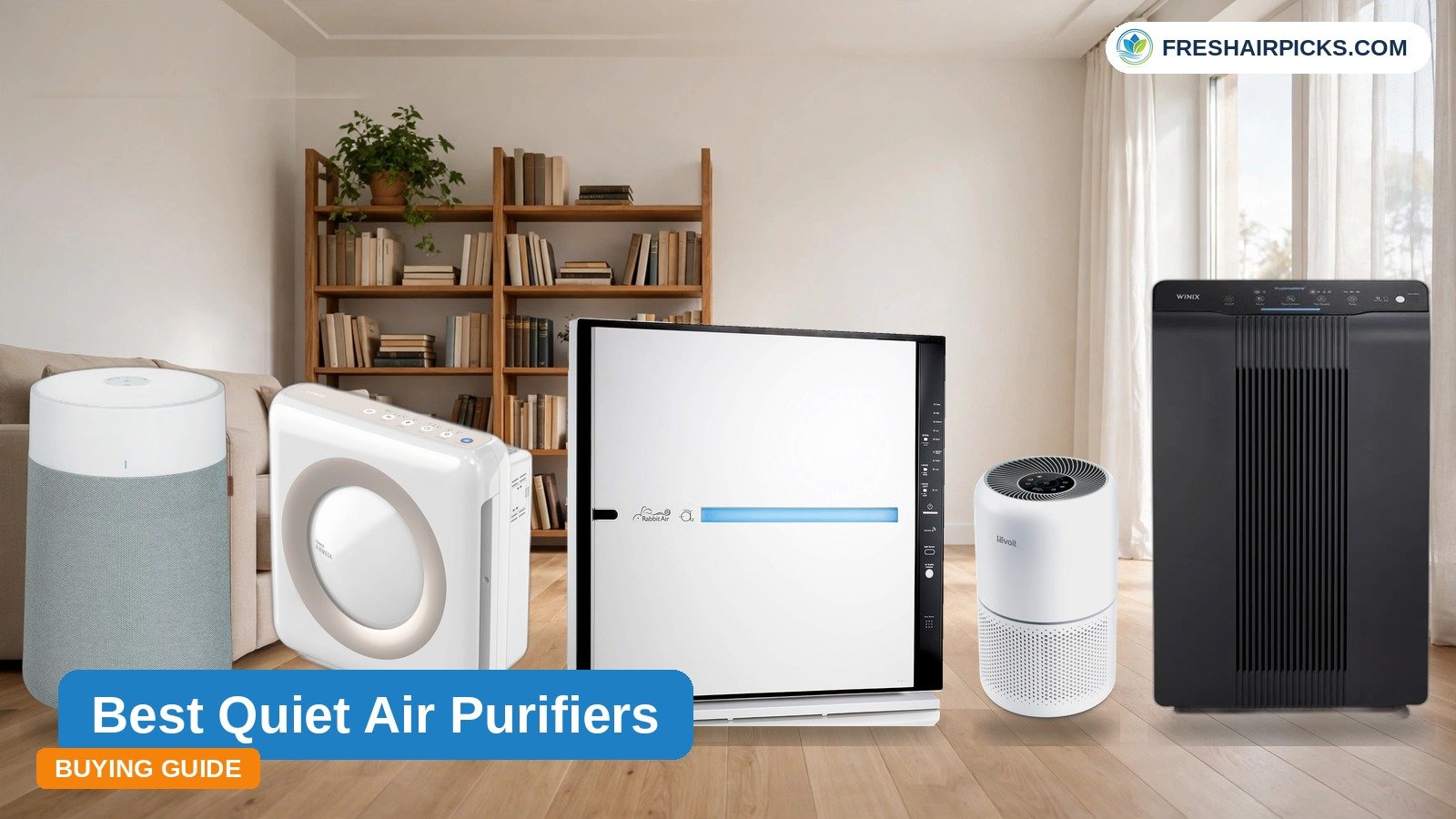
The budget air purifier market has one real trap, and it is not the machine — it is the year after you buy it. Manufacturers print “covers 1,000 square feet” on boxes for units barely strong enough for a bedroom, then sell proprietary filters that saturate in months. A $60 machine can cost $200 a year to keep running. This guide ranks under-$100 machines on what actually decides value: verified CADR per dollar, and the first-year total — machine plus filters — not the sticker price alone.
This guide contains no test results. FreshAirPicks does not lab-test air purifiers. Every number below traces to a manufacturer specification or a labelled independent measurement, and where a figure could not be verified, the guide says so.
Quick answer: For the strongest cleaning under $100, buy the Winix A231 (~$99.99 street) — AHAM ~159 smoke CADR covering 246 sq ft, first year roughly $150 all-in. For the best all-rounder, the Levoit Core 300S (~$99.99) pairs AHAM-verified 219 sq ft with a 22 dB sleep floor. For the cheapest first year, the Levoit Core 200S ($89.99) totals roughly $120–130 all-in with verified 118 CFM. For the tightest sticker price, the Coway Airmega 50 ($79.99) has a carry handle — but its CADR is manufacturer-rated, not AHAM-verified. For a desk or tiny bedroom, the Blueair Blue Pure Mini Max (typically under $100 — check current price) brings AHAM-verified 60 CFM in a 2.8 lb machine.
My Top Picks at a Glance
| Product | Best for | Verified coverage | Machine price | First-year total | Score |
|---|---|---|---|---|---|
| Winix A231 | Strongest cleaning | 246 sq ft (AHAM) | ~$99.99 | ~$150 | 8.2 |
| Levoit Core 300S | Best all-rounder | 219 sq ft (AHAM) | ~$99.99 | ~$145–160 | 8.0 |
| Levoit Core 200S | Cheapest first year | 183 sq ft (manual) | $89.99 | ~$120–130 | 7.8 |
| Coway Airmega 50 | Tightest sticker price | ~103 sq ft (Coway-rated, not AHAM) | $79.99 | Not computable (filter price unverified) | 7.4 |
| Blueair Blue Pure Mini Max | Desk / tiny bedroom | 93 sq ft (AHAM) | Check current price | Not computable (filter price unverified) | 7.0 |
How We Chose These Five
Budget ranking needs different weights from a living-room guide:
- Verified CADR per dollar (35%). Only AHAM or labelled measurements count. A box claim for 1,000 sq ft at one air change per hour is not a bargain — it is a rounding trick.
- First-year total cost (30%). Machine price plus one year of filters. The sticker price is the down payment; the filter bill is the price.
- Noise (20%). A budget machine that buzzes gets switched off, and a switched-off machine cleans nothing.
- Size (15%). Budget machines usually serve small rooms — footprint and weight decide whether they fit the room they are bought for.
1. Winix A231 — Best Strongest Cleaning Under $100
Score: 8.2/10 · ~$99.99 street
| Spec | Detail |
|---|---|
| CADR (smoke) | ~159 CFM (AHAM) |
| Coverage @4.8 ACH | 246 sq ft (manual Verified Room Size) |
| Filtration | True HEPA + carbon filter; vacuum-cleanable pre-filter |
| Filter cost | Filter O ~$50/yr (12 months, often discounted into the $30s) |
| First-year total | ~$150 (machine + one year of filters) |
| Power | 55 W rated |
| Noise | 35.2 dB at speed 1 (HouseFresh measured) |
| Size / weight | 9.5 × 9.5 × 14.6 in; ~7 lb |
| Extras | Auto mode with air quality sensor; PlasmaWave switchable — advise OFF |
The A231 is the strongest cleaning you can buy under $100, full stop: AHAM smoke CADR near 159 CFM covering 246 sq ft — more verified coverage than anything else at this price — with a vacuum-cleanable pre-filter that stretches the main filter’s life. At ~$99.99 street with ~$50 annual filters, the first year totals roughly $150, and the filter math stays fair after that.
Two flags, both stated plainly. First, the price hovers on the line: list is $129.99, street is ~$99.99, and it drifts — check the price before buying, and if it has drifted over $100, the Core 200S below is the under-$100 answer that day. Second, as in every Winix entry on this site: PlasmaWave is switchable, and it should stay OFF.
Who it’s for: The buyer who wants the most verified clean air per dollar and does not mind a machine sitting exactly on the budget line.
2. Levoit Core 300S — Best All-Rounder Under $100
Score: 8.0/10 · ~$99.99
| Spec | Detail |
|---|---|
| CADR (smoke / dust / pollen) | 141 / 156 / 175 CFM (AHAM) |
| Coverage @4.8 ACH | 219 sq ft |
| Filtration | True HEPA + carbon pre-filter |
| Filter cost | ~$45–60/yr |
| First-year total | ~$145–160 (machine + one year of filters) |
| Power | 26 W max |
| Noise | 22 dB sleep floor |
| Size / weight | 8.7 × 8.7 × 14.2 in; 7.5 lb |
| Extras | VeSync app, auto mode, sleep mode, display-off |
The Core 300S is the budget all-rounder: AHAM-verified 141 smoke CADR covering 219 sq ft, a 22 dB sleep floor with display-off mode for a dark room, app control and auto mode, at ~$99.99 with $45–60 annual filters — a first year of roughly $145–160. It is the machine this site recommends most often for small rooms generally, and the budget guide is no exception.
The same line flag as the A231: ~$99.99 is a street price, and it drifts — check before buying. And the standing warning: buy the standard Core 300S, never the Core 300S-P “PlasmaPro” variant — the names are nearly identical and the -P adds a plasma ionizer function a budget buyer does not need. Check the suffix on the box.
Who it’s for: The default under-$100 pick — verified coverage, quiet sleep, app control, fair first year.
3. Levoit Core 200S — Best Cheapest First Year
Score: 7.8/10 · $89.99
| Spec | Detail |
|---|---|
| CADR | 118 CFM (manual-verified) |
| Coverage | 183 sq ft |
| Filtration | True HEPA + carbon pre-filter |
| Filter cost | ~$30–40/yr |
| First-year total | ~$120–130 (machine + one year of filters) |
| Power | 37 W rated |
| Noise | 24–48 dB |
| Size / weight | 8.1 × 8.1 × 12.6 in; 6.6 lb |
| Extras | VeSync app; no auto mode |
The Core 200S is the cheapest honest year one in this guide: $89.99 — comfortably under the line, no price-drift worry — with a manual-verified 118 CFM covering 183 sq ft and $30–40 annual filters, for a first-year total of roughly $120–130. Its 8.1-inch-square footprint is the smallest of the full-size picks here, and its 24 dB floor is genuinely quiet.
Its trade-off is features: no auto mode, so it runs at the speed you set and stays there. For a bedroom that is often the whole routine — set it low, leave it — but it is a step below the app-and-sensor machines above. And 183 sq ft is a bedroom, not a living room.
Who it’s for: The buyer who wants the lowest verified first-year cost with no price-line anxiety.
4. Coway Airmega 50 — Best Tightest Sticker Price
Score: 7.4/10 · $79.99
| Spec | Detail |
|---|---|
| CADR (smoke) | 66.7 CFM (Coway-rated, NOT AHAM) |
| Coverage | ~103 sq ft (from Coway CADR, not AHAM) |
| Filtration | True HEPA + carbon pre-filter |
| Filter cost | Check current filter pricing before buying (not verified here) |
| First-year total | Not computable — filter pricing not verified in this guide |
| Power | 14 W |
| Noise | Not published in the sources used |
| Size / weight | 11.0 × 8.9 × 4.9 in; carry handle |
| Extras | Carry handle |
The Airmega 50 is the cheapest sticker price in this guide at $79.99, with a carry handle and a 14 W draw — the lowest power here. For a small bedroom or a first apartment, that combination is genuinely attractive.
The disclosure that decides its rank: its 66.7 smoke CADR is Coway-rated, not AHAM-verified, so its ~103 sq ft figure is the manufacturer’s arithmetic, not an independent verification — and its filter pricing could not be verified in this guide, so its first-year total cannot be computed. That missing number is exactly the budget trap this guide warns about: a $79.99 machine with expensive filters can cost more by year two than the Core 200S. Buy it for the sticker price and the handle, but check the filter price first.
Who it’s for: The tightest sticker budget, bought with eyes open about the unverified filter bill.
5. Blueair Blue Pure Mini Max — Best Desk / Tiny Bedroom
Score: 7.0/10 · Typically under $100 — check current price
| Spec | Detail |
|---|---|
| CADR | 60 CFM (AHAM, ANSI/AHAM AC-1-2020) |
| Coverage @4.8 ACH | 93 sq ft |
| Filtration | HEPASilent + carbon layer; washable fabric pre-filter |
| Filter cost | FMINI filter every 6 months — check current filter price |
| First-year total | Not computable — machine and filter prices vary |
| Power | 2–10 W |
| Noise | 20–44 dB(A) |
| Size / weight | 6.8 × 6.8 × 11.4 in; ~2.8 lb |
| Extras | Two-button control; no app, no sensor |
The Mini Max is the smallest machine in this guide and the only one that honestly belongs on a desk: AHAM-verified 60 CFM covering 93 sq ft, 2–10 W power draw, 20 dB at its quietest, and 2.8 lb. Its washable fabric pre-filter is a real Blueair feature at this size, and its two-button control is the whole interface — no app, no sensor, nothing to learn.
Its limits are the price of that smallness: 93 sq ft is a desk zone or a tiny bedroom, not a room, and its filter changes every 6 months — twice the rhythm of the other picks. Its US price and filter price could not be verified in the October 2026 sources used (one retailer lists it as no longer available), so both are flagged as “check current price” rather than stated as fact. If it is in stock under $100, it is the desk pick; if it is not, the Core 200S is the small-room answer.
Who it’s for: A desk, a nightstand, or a tiny bedroom — the smallest verified machine here, bought only after checking it is actually in stock.
Buying Guide: The Sticker Price Is the Down Payment
Compute the first year before you buy. Machine price plus one year of filters is the honest comparison: the Core 200S at ~$120–130 beats the A231 at ~$150 on year one, even though the A231 cleans more. Decide whether you are buying coverage or buying cheap — both are legitimate, but they are different purchases.
Distrust round coverage numbers. A box claim for 1,000+ sq ft usually assumes roughly one air change per hour. At the 4.8–5 ACH benchmark used in this guide, that same machine covers a fifth of the claim. Divide any box number by the ACH it assumes before believing it.
Watch the filter rhythm. A 6-month filter costs twice as often as a 12-month filter, whatever the sticker says. The Mini Max’s twice-yearly FMINI and the Airmega 50’s unverified filter price are the two places this guide could not complete the math — and that incompleteness is itself the warning.
What the old post got wrong, plainly. Its title promised “Lab-Tested” results and its intro claimed rigorous testing with a laser particle meter, energy meters and decibel monitors — testing this site does not do, and instruments it does not own. Its budget pick (Core 200S-P) is the ionizer variant; the standard Core 200S below is the cleaner pick. Its small picks (MOOKA B-D02L, Afloia Kilo) could not be verified to this guide’s standard, and its desktop pick (Mini Max) is kept only with its price and availability flagged as unverified. The budget trap it warned about is real — and the verified first-year totals above are how this guide proves it instead of asserting it.
Frequently Asked Questions
What is the best air purifier under $100?
By verified cleaning, the Winix A231 (~$99.99 street, AHAM ~159 smoke CADR, 246 sq ft). By cheapest honest first year, the Levoit Core 200S ($89.99, ~$120–130 all-in). By tightest sticker price, the Coway Airmega 50 ($79.99) — with its filter price unverified. There is no single answer; there is a trade-off, and the table above states it.
Are cheap air purifiers worth it?
Yes, if the CADR is verified and the filter math is fair. The A231, Core 300S and Core 200S all carry verified CADR figures and fair annual filter costs. What is not worth it is an unverified machine with an unknown filter bill — that is where budget guides become expensive.
How much do filters cost for budget air purifiers?
Verified here: Winix Filter O ~$50/yr, Levoit Core 300S ~$45–60/yr, Core 200S ~$30–40/yr. Not verified here: the Airmega 50’s filter price and the Mini Max’s FMINI price — check both before buying, because they decide whether the budget pick stays a budget pick.
Can a sub-$100 air purifier clean a living room?
No — not at a real air-change rate. The biggest verified coverage under $100 here is 246 sq ft (A231). A living room of 300+ sq ft wants a mid-size machine like the Vital 200S-P (388 sq ft, AHAM) or the Blueair 211i Max (674 sq ft, AHAM) — both over $100, both verified. A budget machine in a living room is a zone machine, not a room machine.
Do I need to spend more than $100 for allergies?
Not necessarily. Allergies are a particle problem, and verified particle CADR is what matters — the A231’s AHAM ~159 smoke CADR and the Core 300S’s 141 both clear bedroom air well. Spend more when the room is bigger, the noise floor must be lower, or the problem is gas-phase (odors, VOCs), where carbon weight — not CADR — decides.
Why do some budget air purifiers cost so much to run?
Because the filter is the business model. A machine sold near cost with a proprietary filter changed every 3–6 months earns its margin after the sale. The defense is arithmetic: multiply the filter price by its yearly rhythm before buying, and prefer machines with 12-month filters and published filter prices.
Is the Blueair Mini Max still worth buying?
Only after checking price and availability. Its verified numbers (AHAM 60 CFM, 93 sq ft, 20 dB floor, 2–10 W) are genuine for a desk or tiny bedroom, but its US price and filter price could not be verified in the October 2026 sources used, and one retailer lists it as no longer available. If it is in stock under $100, it is the desk pick; if it is not, buy the Core 200S.
Conclusion
Budget air is decided by verified numbers and first-year arithmetic: the Winix A231 is the strongest answer, the Levoit Core 300S the all-round answer, the Levoit Core 200S the cheapest-year answer, the Coway Airmega 50 the tightest-sticker answer, and the Blueair Mini Max the desk answer — each with its CADR verified or its limit admitted, and its first-year total computed or its incompleteness stated. Check the price on the day, count the filters, and let the arithmetic choose.
Prices checked October 2026 and will drift; specifications are drawn from AHAM Verifide listings, manufacturer publications and labelled independent measurements, as noted throughout. This guide contains no hands-on test results.