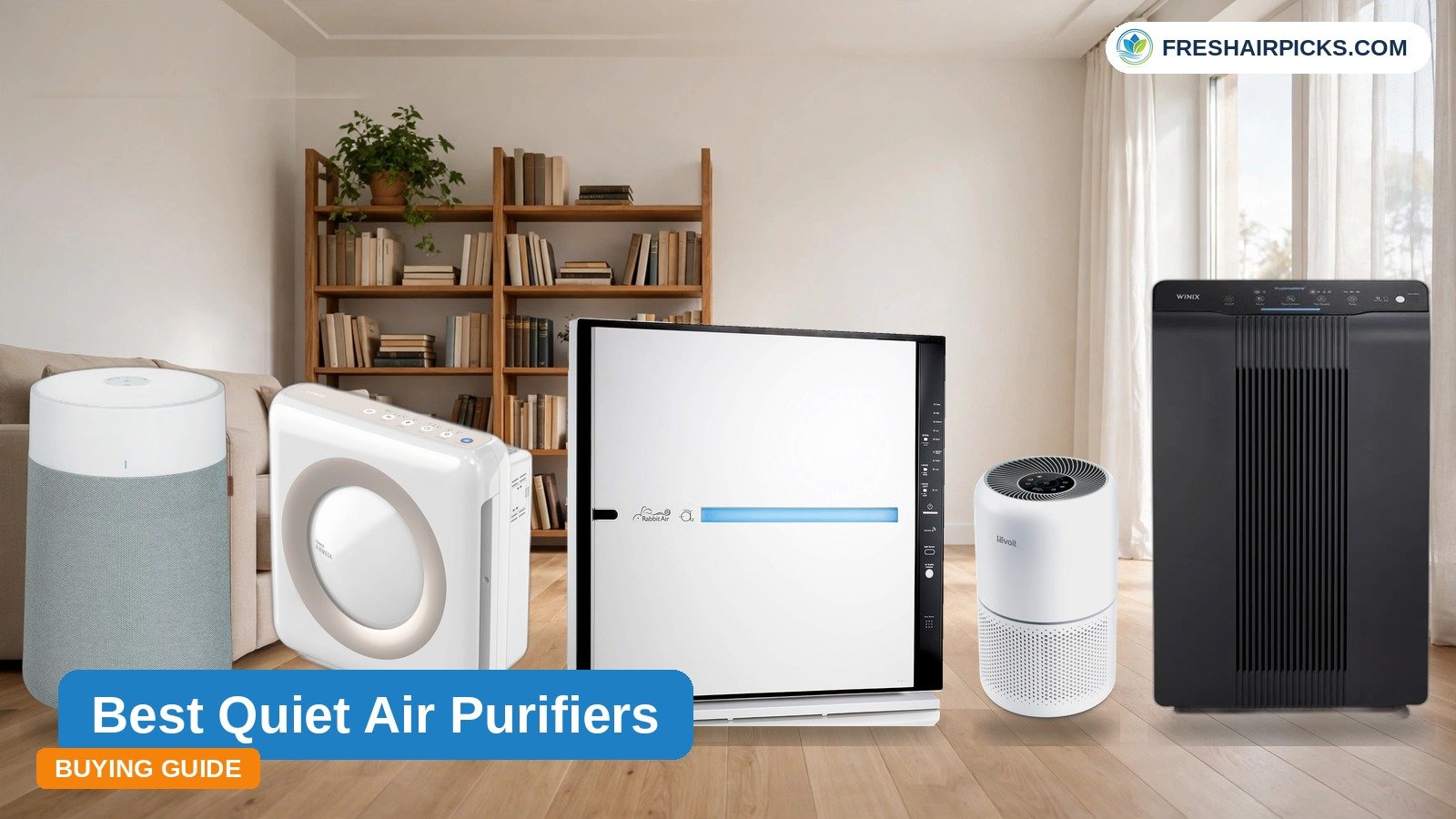
A dorm room is a bedroom, a cafeteria and a library in 100–200 square feet, shared with a roommate who did not agree to your appliance choices. The machine you put in there has to clear stale food smells and dust without taking up desk space, without buzzing through late-night study sessions, and without eating a student budget in filters over four years. Standard living-room advice does not apply here. This guide ranks dorm machines on what actually matters in a dorm: sleep noise, verified small-room CADR, size and weight, and four-year running costs.
This guide contains no test results. FreshAirPicks does not lab-test air purifiers. Every number below traces to a manufacturer specification or a labelled independent measurement, and where a figure could not be verified, the guide says so. One correction up front: an air purifier reduces airborne particles — it does not prevent colds, flu or the so-called freshman plague, and no machine here claims otherwise.
Quick answer: For the quietest dorm room, buy the Blueair 511i Max (~$113–140) — 19 dB on its night setting, the quietest verified figure here, in a 4.2 lb machine. For the best all-rounder, the Levoit Core 300S (~$99.99) pairs a 22 dB sleep floor with AHAM-verified 219 sq ft. For the strongest small-room numbers, the Winix A231 (~$99.99) brings AHAM ~159 smoke CADR. For the tightest budget, the Coway Airmega 50 ($79.99) has a carry handle for move-in day. For the cheapest verified CADR, the Levoit Core 200S ($89.99) covers 183 sq ft with $30–40 annual filters.
My Top Picks at a Glance
| Product | Best for | Verified coverage | Sleep noise | Price | Score |
|---|---|---|---|---|---|
| Blueair 511i Max | Quietest dorm room | 237 sq ft (AHAM) | 19 dB night | ~$113–140 | 8.4 |
| Levoit Core 300S | Best all-rounder | 219 sq ft (AHAM) | 22 dB sleep | ~$99.99 | 8.2 |
| Winix A231 | Strongest small-room CADR | 246 sq ft (AHAM) | 35.2 dB speed 1 (HouseFresh) | ~$99.99 | 8.0 |
| Coway Airmega 50 | Tightest budget, move-in | ~103 sq ft (Coway-rated, not AHAM) | Not published | $79.99 | 7.4 |
| Levoit Core 200S | Cheapest verified CADR | 183 sq ft (manual) | 24 dB floor | $89.99 | 7.2 |
How We Chose These Five
Dorm ranking needs different weights from a living-room guide:
- Sleep noise (35%). A roommate’s sleep is the binding constraint. Night-mode and sleep-floor figures decide this, not top-speed numbers.
- Small-room verified CADR (30%). Dorm rooms are 100–200 sq ft. AHAM or labelled measurements only — box claims for 1,000+ sq ft are meaningless here.
- Dorm fit (20%). Footprint, weight and move-in portability. A machine that blocks a desk or needs two people to carry up three flights fails the brief.
- Running costs (15%). Filter price times four years, not one. A cheap machine with expensive filters is the most expensive machine in this guide by graduation.
1. Blueair 511i Max — Best Quietest Dorm Room
Score: 8.4/10 · ~$113–140
| Spec | Detail |
|---|---|
| CADR (smoke) | 153 CFM (AHAM-listed) |
| Coverage @4.8 ACH | 237 sq ft |
| Filtration | HEPASilent + carbon layer; washable fabric pre-filter sleeve |
| Filter cost | ~$40/yr (Particle + Carbon filter ~$30–36, up to 9 months) |
| Power | 17 W max |
| Noise | 19 dB night mode — quietest verified figure here |
| Size / weight | 10.6 × 10.6 × 18.9 in; 4.2 lb |
| Extras | App, auto mode, air quality sensor |
The 511i Max is the dorm pick because it wins the constraint that matters most: sleep. Nineteen decibels on its night setting is the quietest verified figure in this guide, and it comes in a 4.2 lb machine one person carries up the stairs with one hand. Its AHAM-listed 153 smoke CADR covers 237 sq ft — more than most dorm rooms — and at 17 W max it costs almost nothing to run all semester. Four-year filter math: roughly $160 at the ~$40 annual rate, the cheapest four-year total here after the Core 200S.
The disclosure that travels with every Blueair on this site: HEPASilent is a mechanical plus electrostatic stage, not a True HEPA filter in the conventional sense, and it cannot be switched off. For a dorm that restricts ionizers, check your dorm’s rules — the electrostatic stage is always on in this machine, and that matters more in a dorm than in a house.
Who it’s for: Light sleepers, shared rooms, and anyone whose roommate’s sleep is the deciding vote.
2. Levoit Core 300S — Best All-Rounder
Score: 8.2/10 · ~$99.99
| Spec | Detail |
|---|---|
| CADR (smoke / dust / pollen) | 141 / 156 / 175 CFM (AHAM) |
| Coverage @4.8 ACH | 219 sq ft |
| Filtration | True HEPA + carbon pre-filter |
| Filter cost | ~$45–60/yr |
| Power | 26 W max |
| Noise | 22 dB sleep floor |
| Size / weight | 8.7 × 8.7 × 14.2 in; 7.5 lb |
| Extras | VeSync app, auto mode, sleep mode, display-off |
The Core 300S is the dorm all-rounder: AHAM-verified 141 smoke CADR covering 219 sq ft, a 22 dB sleep floor with a display-off sleep mode for a dark room, app control and auto mode, at ~$99.99 with $45–60 annual filters (roughly $180–240 over four years). Its 8.7-inch-square footprint fits a desk corner or a nightstand, and it is the machine this site recommends most often for small rooms generally — the dorm is its natural habitat.
The standing warning: buy the standard Core 300S, never the Core 300S-P “PlasmaPro” variant — the names are nearly identical and the -P adds a plasma ionizer function a dorm room does not need, and one some dorms restrict. Check the suffix on the box before you buy.
Who it’s for: The default dorm pick — verified coverage, quiet sleep, app control, fair price.
3. Winix A231 — Best Strongest Small-Room CADR
Score: 8.0/10 · ~$99.99
| Spec | Detail |
|---|---|
| CADR (smoke) | ~159 CFM (AHAM) |
| Coverage @4.8 ACH | 246 sq ft (manual Verified Room Size) |
| Filtration | True HEPA + carbon filter; vacuum-cleanable pre-filter |
| Filter cost | Filter O ~$50/yr (12 months, often discounted into the $30s) |
| Power | 55 W rated |
| Noise | 35.2 dB at speed 1 (HouseFresh measured) |
| Size / weight | 9.5 × 9.5 × 14.6 in; ~7 lb |
| Extras | Auto mode with air quality sensor; PlasmaWave switchable — advise OFF |
The A231 is the strongest small machine on this site by verified numbers: AHAM smoke CADR near 159 CFM and a HouseFresh-measured 148 CFM PM1 at top speed, covering 246 sq ft — the largest verified coverage of any dorm pick here. Its vacuum-cleanable pre-filter is a dorm feature too: vacuum it and the main filter lasts longer through dusty semesters. At ~$99.99 street with ~$50 annual filters (roughly $200 over four years, often less on sale), it is fairly priced for the strongest numbers.
Its dorm trade-off is noise: 35.2 dB at its lowest measured speed is not the 19–22 dB sleep floor of the two picks above, and at 55 W rated it is the thirstiest small machine here. If your roommate sleeps lightly, the Blueair or the Core 300S wins; if your room faces a dusty street or a smoky courtyard, the A231’s extra CADR wins. And as in every Winix entry on this site: PlasmaWave is switchable, and in a small shared room it should stay OFF.
Who it’s for: Dusty or smoky dorm locations where verified CADR matters more than the last few decibels of sleep quiet.
4. Coway Airmega 50 — Best Tightest Budget
Score: 7.4/10 · $79.99
| Spec | Detail |
|---|---|
| CADR (smoke) | 66.7 CFM (Coway-rated, NOT AHAM) |
| Coverage | ~103 sq ft (from Coway CADR, not AHAM) |
| Filtration | True HEPA + carbon pre-filter |
| Filter cost | Check current filter pricing before buying (not verified here) |
| Power | 14 W |
| Noise | Not published in the sources used |
| Size / weight | 11.0 × 8.9 × 4.9 in; carry handle |
| Extras | Carry handle — the move-in pick |
The Airmega 50 is the cheapest machine in this guide at $79.99, and the easiest to move: a carry handle on a slim tower, 14 W power draw, and a price that fits a student budget. For a small single dorm room — the classic 100–150 sq ft box — its Coway-rated coverage is roughly enough, and its handle is genuinely useful on move-in day and every room change after.
The disclosure that decides its rank: its 66.7 smoke CADR is Coway-rated, not AHAM-verified, so its ~103 sq ft figure is the manufacturer’s arithmetic, not an independent verification — and its noise floor is not published in the sources used. Buy it for a small single room on a tight budget, not for a double or a suite, and check filter pricing before buying, since it is not verified in this guide.
Who it’s for: A small single dorm room on the tightest budget, where the handle and the $79.99 price matter most.
5. Levoit Core 200S — Best Cheapest Verified CADR
Score: 7.2/10 · $89.99
| Spec | Detail |
|---|---|
| CADR | 118 CFM (manual-verified) |
| Coverage | 183 sq ft |
| Filtration | True HEPA + carbon pre-filter |
| Filter cost | ~$30–40/yr |
| Power | 37 W rated |
| Noise | 24–48 dB |
| Size / weight | 8.1 × 8.1 × 12.6 in; 6.6 lb |
| Extras | VeSync app; no auto mode |
The Core 200S is the cheapest verified CADR in this guide: a manual-verified 118 CFM covering 183 sq ft — enough for most dorm rooms — at $89.99 with $30–40 annual filters, roughly $120–160 over four years, the cheapest four-year total here. Its 8.1-inch-square footprint is the smallest in this guide, and its 24 dB floor is genuinely quiet.
Its trade-off is features: no auto mode, so it runs at the speed you set and stays there — fine for a dorm, where a set-and-forget low speed is often the whole routine, but a step below the app-and-sensor machines above. And 183 sq ft is a single room, not a double or a suite common room.
Who it’s for: The budget buyer who wants verified numbers and the cheapest four-year cost, and does not need auto mode.
Buying Guide: Noise, Size and Four Years of Filters
Judge a dorm machine by its quiet speeds, not its loudest one. A dorm machine lives six inches from a bed and a roommate. Night-mode and sleep-floor figures are the numbers that decide whether it stays on — and a machine switched off cleans nothing. The Blueair’s 19 dB and the Core 300S’s 22 dB are the figures to beat.
Check your dorm’s appliance rules before buying. Some dorms restrict ionizers, high-draw appliances or specific device types, and rules vary by school and building. The machines here are low-draw (14–55 W), but the ionizer question matters: avoid the Core 300S-P PlasmaPro variant, keep the Winix PlasmaWave OFF, and note the Blueair’s always-on electrostatic stage.
Count four years, not one. A $79.99 machine with unverified filter pricing can cost more by graduation than a $99.99 machine with $40 annual filters. Multiply the annual filter cost by four before deciding — the table above does that math for every pick whose filter pricing could be verified.
What the old post got wrong, plainly. Its title promised “Expert Tested” results and its intro claimed rigorous empirical testing and measured CADR against acoustic outputs — testing this site does not do. Its “freshman plague” framing implied a machine could fight illness; purifiers reduce airborne particles and nothing more. Its budget pick (Core 300) has a smart successor, its compact pick (Blue Pure 511) has a newer 511i Max with a verified 19 dB night mode, and its auto pick (Airmega 100) is replaced by smaller, cheaper verified machines. The AROEVE avoid-warning survives: the MK01 has no verified CADR and is not ranked here.
Frequently Asked Questions
Will an air purifier stop me getting sick in a dorm?
No. An air purifier reduces airborne particles — dust, pollen, smoke — and that can help with allergies and stale air. It does not prevent colds, flu or any infection, and no machine here claims otherwise. Ventilation, sleep and handwashing do more against dorm illness than any filter.
How quiet does a dorm air purifier need to be?
Quiet enough that your roommate leaves it on. Night-mode figures under ~25 dB are the safe zone: the Blueair’s 19 dB and the Core 300S’s 22 dB sleep floor both clear it. A machine that buzzes at 35+ dB on its lowest setting gets switched off at 2 a.m. — and a switched-off machine cleans nothing.
What size air purifier do I need for a dorm room?
Most dorm rooms are 100–200 sq ft, and every pick here covers that range at a real air-change rate except the Airmega 50, which suits a small single room only. Measure your room, not the box claim: a machine advertised for 1,000+ sq ft delivers roughly one air change per hour there, far below the 4.8–5 ACH benchmark used in this guide.
Are air purifiers allowed in dorm rooms?
Usually yes, but check your dorm’s rules first — they vary by school and building. Some restrict ionizers, high-draw appliances or specific device types. The machines here draw 14–55 W, but the ionizer question matters: avoid the Core 300S-P PlasmaPro variant and keep the Winix PlasmaWave OFF.
How much will a dorm air purifier cost over four years?
The machine plus roughly four years of filters: about $160 for the Blueair 511i Max (~$40/yr), $180–240 for the Core 300S, about $200 for the Winix A231 (often less on sale), and $120–160 for the Core 200S. The Airmega 50’s filter pricing was not verified in this guide — check it before buying, since it decides the four-year total.
Should I buy a bigger air purifier for a shared suite?
Only for the common room, and only if it is a real room. A suite common room of 300+ sq ft wants a mid-size machine like the Vital 200S-P (388 sq ft, AHAM) or the Core 300S’s bigger siblings — not a dorm pick stretched past its ceiling. For the bedrooms themselves, one small machine each beats one big machine in the hall.
Is the AROEVE MK01 really a bad dorm pick?
Yes — as an avoid, not a rank. The MK01 has no verified CADR in the sources used, so its cleaning rate cannot be compared with any pick here, and its tiny size suits a desk, not a room. A dorm budget is better spent on the Core 200S ($89.99, verified 118 CFM) than on an unverified desk gadget.
Conclusion
Dorm air is decided by sleep, size and four years of filters: the Blueair 511i Max is the quietest answer, the Levoit Core 300S the all-round answer, the Winix A231 the strongest-numbers answer, the Coway Airmega 50 the tightest-budget answer, and the Levoit Core 200S the cheapest-verified answer — each with its sleep noise stated, its coverage verified, and its four-year cost counted. Check your dorm’s rules, buy on the quiet speeds, and let the machine run.
Prices checked October 2026 and will drift; specifications are drawn from AHAM Verifide listings, manufacturer publications and labelled independent measurements, as noted throughout. This guide contains no hands-on test results.