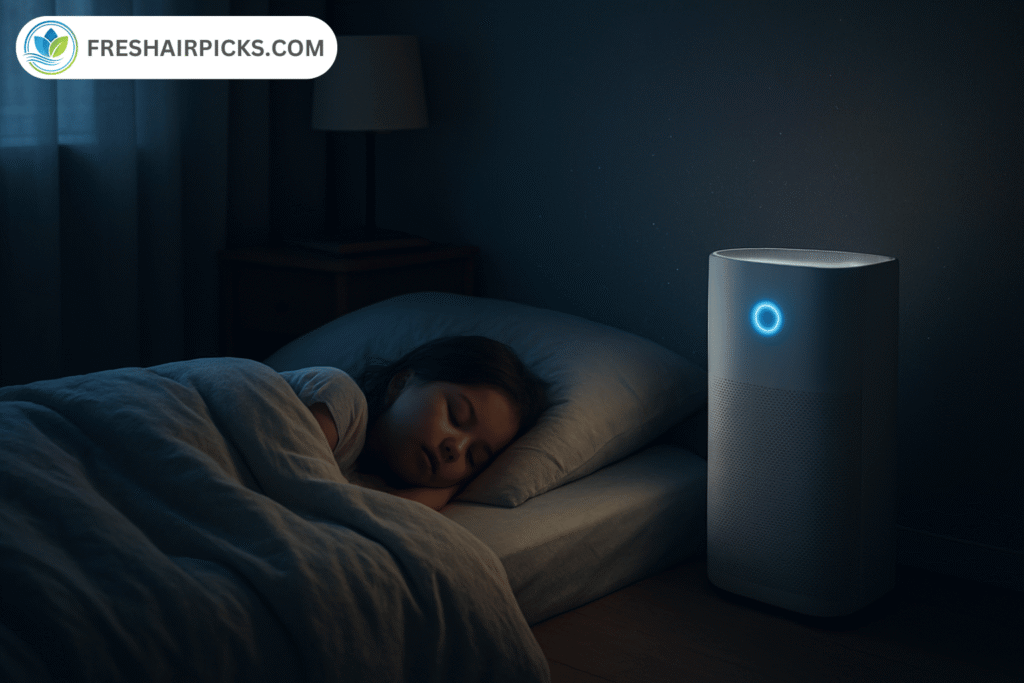
Waking up with a stuffy nose, a dry, scratchy throat, or a snoring partner is a frustrating way to start the day. It’s that “sleep fog” that a second cup of coffee just can’t seem to cut through. As someone who has obsessed over every piece of data related to sleep quality, I’ve been down this exact rabbit hole. You suspect the air in your bedroom might be the culprit, but can a machine actually help you sleep better?
The short answer is: yes, a high-quality air purifier can significantly improve sleep quality, especially for individuals with allergies, asthma, or chronic congestion.
This guide moves beyond marketing claims to explain the science of how invisible particles fragment your sleep, the clinical data that proves filtration works, and—most importantly—how to choose a model that is whisper-quiet and pitch-dark so it solves sleep problems without creating new ones.
The “Why”: How Invisible Irritants in Your Bedroom Are Costing You Sleep

The problem isn’t just “dirty air”—it’s the tangible, physical reaction your body has to that air while you’re trying to rest. Your bedroom, which should be a sanctuary, can often be the most polluted room in the house, concentrating “sleep thieves” that you inhale all night.
It’s Not Just Dust: Meet the “Sleep Thieves” (PM2.5 and Allergens)
When I started digging into the research, I was shocked at what’s floating around. The main culprits interfering with your sleep are:
- Biological Allergens: This is the stuff that triggers most people. We’re talking dust mites, pet dander, pollen that gets tracked in, and mold spores.
- Fine Particulate Matter ($PM_{2.5}$): This is the really nasty stuff. These are microscopic particles (30 times smaller than a human hair) from cooking, wildfire smoke, and outdoor pollution that can lodge deep in your lungs.
- Volatile Organic Compounds (VOCs): These are gaseous chemicals that “off-gas” from new mattresses, furniture, cleaning products, and even paint.
How Airborne Particles Trigger Nighttime Symptoms
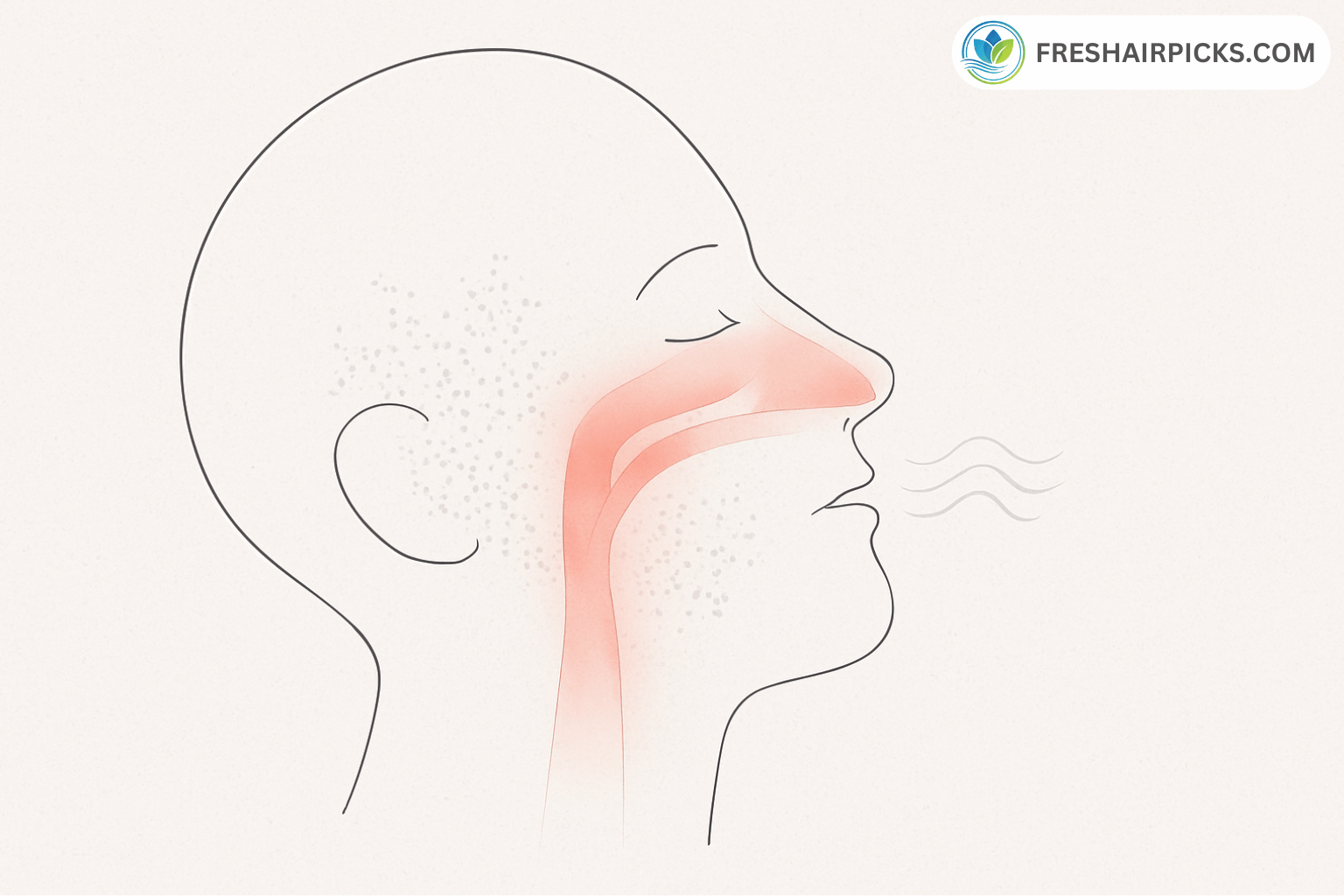
Here’s the core connection. Your body is smart. When you inhale these particles, it goes on the defensive, even while you’re asleep.
- The Inflammation Response: Your immune system sees these irritants and triggers an inflammatory response. This inflammation in your airways, nose, and throat leads directly to the symptoms that wake you up: nasal congestion, coughing, sneezing, and a dry, scratchy throat.
- The Snoring Connection: Does an air purifier help with snoring? It absolutely can. Snoring is often caused or worsened by airway inflammation and congestion. By removing the airborne irritants that cause that inflammation, a purifier can help open up airways, reducing the turbulence that creates the sound of snoring.
- The Eczema Link: For those with sensitive skin, this is key. Airborne allergens like dust mites and pollen don’t just affect your lungs. They can settle on your skin and trigger atopic dermatitis, or eczema, leading to that unbearable nighttime itching that destroys sleep.
The Sleep Fragmentation Effect: When Your Body Fights Instead of Rests
This is the most insidious part. Even if you don’t fully wake up, your body is still working. The research calls this “physiological stress” or “micro-awakenings.”
This continuous, low-level fight against invisible irritants fragments your “sleep architecture.” It shatters the delicate cycles of NREM and REM sleep, preventing you from getting the restorative deep sleep your body and brain desperately need. You don’t wake up coughing, but you still wake up feeling exhausted.
The Proof: What Clinical Data Says About Air Filtration and Sleep
This is what convinced me. This isn’t just a theory; the impact of clean air on sleep has been measured in clinical studies.
The Objective Data: More Deep Sleep, Fewer Awakenings
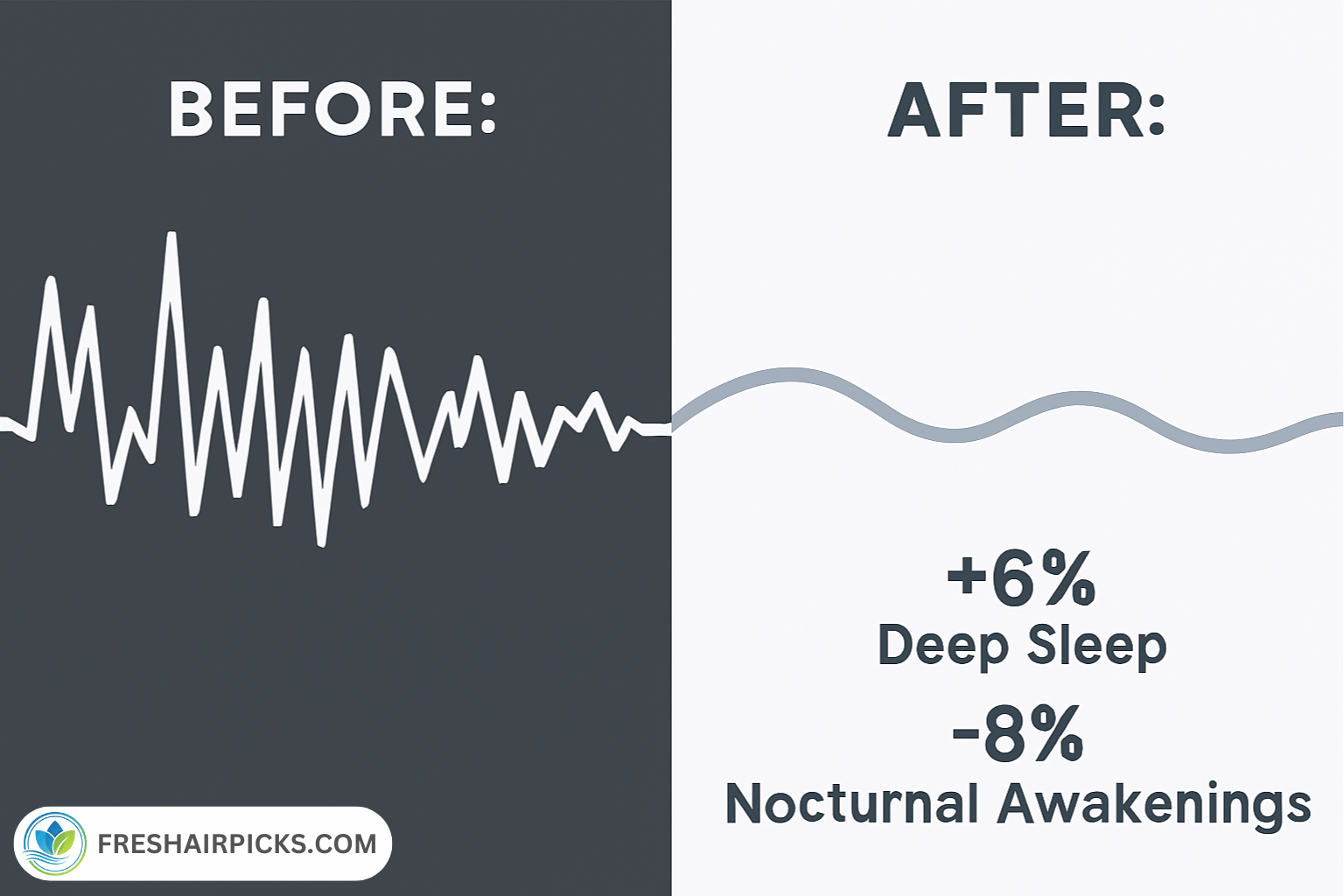
This is the data that matters. In scientific studies where participants used a HEPA filter in their bedroom, researchers measured objective, undeniable improvements, including:
- A 6% relative increase in deep sleep
- An 8% decrease in nocturnal awakenings
That might not sound like a lot, but a 6% increase in deep sleep, night after night, is the difference between waking up groggy and waking up refreshed.
Expert Opinion: Why Sleep Specialists and Pulmonologists Agree
The U.S. Environmental Protection Agency (EPA) provides the “why” with one stunning fact: “Americans spend… 90% of their time indoors, where pollutant concentrations are often 2 to 5 times higher…” than outside.
Your bedroom is a sealed box, trapping and concentrating these pollutants. It’s no wonder that a consensus of scientific research concludes, “Enhancing environmental quality and reducing $PM_{2.5}$ levels may lead to improved sleep quality.”
The “Smoking Gun”: PM2.5 and Your Sleep Stages
For the data-obsessed like me, this was the clincher. A major study found that even a tiny “1 $\mu g/m^3$ increase in $PM_{2.5}$ is statistically associated with adverse alterations” in your deep (NREM) and dream (REM) sleep.
This proves that even small amounts of these invisible particles have a direct, measurable, and negative impact on your sleep.
How Air Purifiers “Scrub” the Air While You Sleep
So, how does the machine actually fix this? A good purifier is a two-stage defense system.
The Particle Shield: What a True HEPA Filter Actually Removes
The engine of any real air purifier is its True HEPA filter. HEPA (High-Efficiency Particulate Air) is a medical-grade standard.
- What it does: It is certified to trap 99.97% of particles down to 0.3 microns in size (which is considered the hardest particle size to catch).
- Why it matters: This is the gold standard for capturing all the physical “sleep thieves”: dust, dander, pollen, mold, and that dangerous $PM_{2.5}$.
- Trust Signal: HEPA technology was originally developed during the Manhattan Project to trap radioactive particles. It’s powerful, proven technology.
The Gas & Odor Sponge: The Role of Activated Carbon
Here’s a critical fact: a HEPA filter does nothing to stop gases, odors, or VOCs. That “new mattress smell”? That’s formaldehyde and other VOCs, and they fly right through a HEPA filter.
That’s where Activated Carbon comes in. This is a porous, charcoal-based material that works through adsorption, chemically trapping gas and odor molecules.
For a true sleep sanctuary, you need both: a HEPA filter for the particles (allergies, PM2.5) and an Activated Carbon filter for the gases (VOCs, odors).
The “Silent Solution”: How to Find a Purifier That Won’t Wake You Up
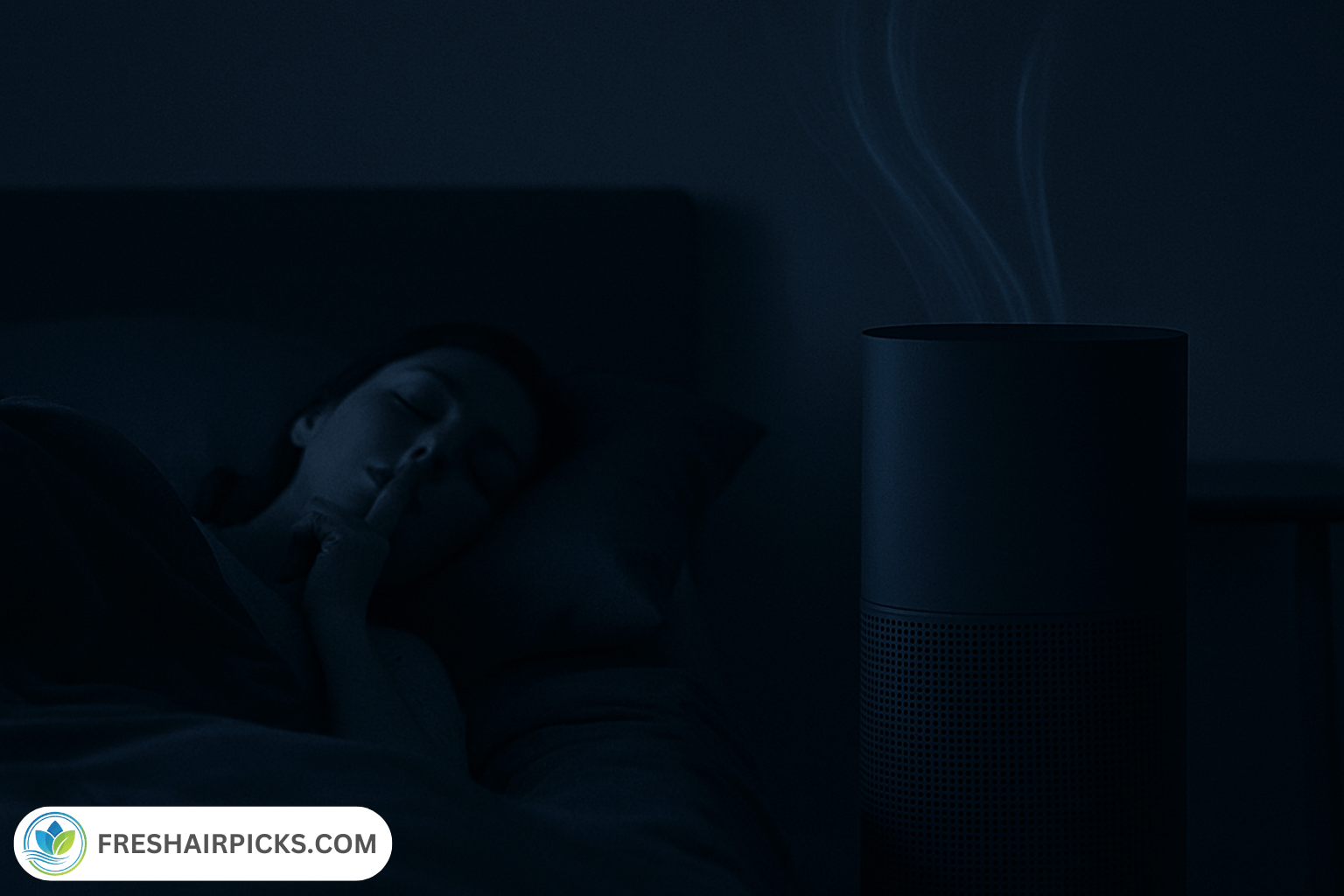
Here is the most important part of this entire guide. I’ve seen it a dozen times: someone buys a powerful purifier, and it’s so loud or bright that it just creates a new sleep problem.
The goal is to find a purifier that is medically effective but sensorially invisible.
Debunking the Myth: Why “Max CADR” Is the Enemy of Sleep
You’ll see a metric called CADR (Clean Air Delivery Rate). This is the unit’s “horsepower.” But there’s a trade-off.
The highest CADR number is always measured on the highest, loudest fan speed. This “turbo” mode can be 60-70 decibels (dB)—as loud as a vacuum cleaner. Nobody can sleep through that. The goal is to find a purifier that provides sufficient cleaning at a quiet fan speed.
Understanding Decibels (dB): What “Whisper Quiet” Really Means
Don’t trust vague marketing terms like “whisper quiet.” Look for the actual decibel (dB) rating on the lowest setting.
- 30 dB: A soft whisper. This is virtually silent.
- 40-50 dB: A quiet library or a gentle hum. This is the ideal range for a “sleep setting.” Some people even find this low-level “pink noise” masks other sounds and improves sleep.
- 60+ dB: A normal conversation. This is disruptive and will fragment your sleep.
Must-Have Features for Uninterrupted Sleep
For me, these two features are non-negotiable for a bedroom purifier:
- Dedicated “Sleep Mode”: A setting that runs the fan at its quietest level (ideally under 45 dB).
- “Lights-Out” Display / Dark Mode: This is critical. Even a single, bright LED indicator light can be enough to disrupt your body’s melatonin production. You must be able to turn all the lights off.
How to Choose the Right Air Purifier for Your Bedroom (A 3-Step Guide)
Don’t get overwhelmed by the options. When I’m helping friends or family, I tell them to ignore the marketing and focus on these three objective steps.
Step 1: Match the CADR to Your Room Size (The 2/3 Rule)
As we just discussed, CADR is the cleaning “horsepower.” The Association of Home Appliance Manufacturers (AHAM) created a simple, industry-standard rule to get this right.
- The Rule: Your purifier’s Smoke CADR number should be at least two-thirds (2/3) of your bedroom’s square footage.
- Example: My bedroom is 12′ x 10′, which is 120 sq ft.
- 120 x (2/3) = 80
- I need a purifier with a minimum Smoke CADR of 80. (Smoke is the smallest particle, so it’s the best metric to use).
Step 2: Aim for 4-5 Air Changes Per Hour (ACH)
ACH (Air Changes Per Hour) tells you how many times per hour the purifier cleans the entire volume of air in your room. For allergy and asthma sufferers, the widely recommended standard is 4 to 5 ACH to keep pollutant levels consistently low all night. The good news? If you follow the 2/3 CADR rule, you’ll almost always land in this perfect 4-5 ACH range.
| Room Size (sq ft) | Example Dimensions | Minimum Smoke CADR |
|---|---|---|
| 100 sq ft | 10′ x 10′ | 67 |
| 150 sq ft | 10′ x 15′ | 100 |
| 200 sq ft | 14′ x 14′ | 134 |
| 250 sq ft | 15′ x 17′ | 167 |
Step 3: Look for These Key Trust Signals
- AHAM Verifide®: This is the gold standard. It’s a third-party guarantee that the CADR claims on the box are real and have been independently tested.
- True HEPA: Don’t be fooled by “HEPA-like” or “HEPA-type.” If it doesn’t say “True HEPA,” it’s not the real 99.97% standard.
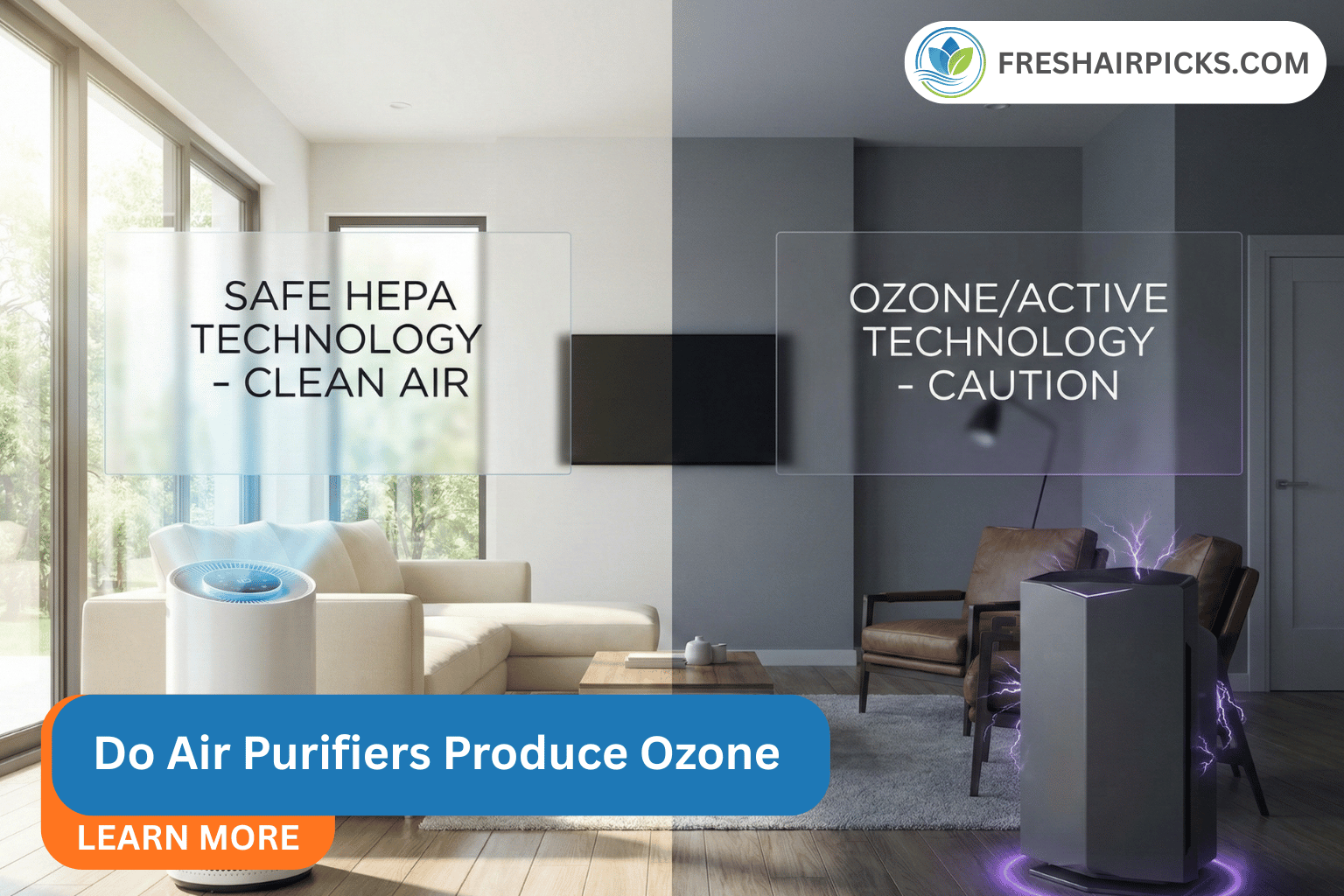
- Ozone-Free: This is a critical safety check. Avoid “ionizers” or “PCO” models that can produce ozone as a byproduct. Ozone is a known lung irritant that can worsen asthma and sleep-related respiratory issues.
Frequently Asked Questions
Will an air purifier really stop my (or my partner’s) snoring?
It can significantly help. While snoring has many causes (like anatomy or alcohol), a major one is nasal congestion and airway inflammation. By removing the airborne allergens and particles that cause this inflammation, a purifier helps keep airways open and clear, which can dramatically reduce snoring.
Does an air purifier help with eczema?
Yes, it can be a very effective tool. Many eczema flare-ups are triggered by airborne allergens like dust mites, pet dander, and pollen. When these allergens are inhaled or land on the skin, they can cause an inflammatory reaction. A HEPA purifier removes these triggers from the air before they can land on your skin or be inhaled, helping to reduce nighttime itching and irritation.
Are air purifiers noisy? Can I run one all night without it waking me up?
They are only noisy if you buy the wrong one or run it on the wrong setting. A purifier designed for a bedroom will have a “Sleep Mode” that is often quieter than a soft whisper (under 40 dB). The key is to buy a unit that is powerful enough (using the 2/3 CADR rule) so you don’t have to run it on high to get the job done.
What is the difference between a HEPA filter and an Activated Carbon filter?
Think of it as a 1-2 punch. A HEPA filter is a physical net that traps solid particles (dust, pollen, $PM_{2.5}$). An Activated Carbon filter is a chemical “sponge” that adsorbs gases and odors (VOCs, smoke, cooking smells). You need both for truly clean air.
How do I know what size (CADR) I need for my bedroom?
Easy. Measure your room’s square footage (length x width) and multiply that number by 0.67 (or 2/3). That is the minimum Smoke CADR rating you should look for.
Are air purifiers safe? Will they produce ozone?
A high-quality air purifier is extremely safe. The only safety concern is with certain technologies (like ionizers or PCO) that can create ozone. Ozone is a lung irritant. To be 100% safe, only buy a purifier that uses mechanical filtration (HEPA) and activated carbon, and is explicitly labeled as “Ozone-Free.”
The Final Verdict: Is an Air Purifier Your Key to Better Sleep?
After all my research, my conclusion is this: an air purifier isn’t just a wellness gadget; it’s an evidence-based tool for reducing the physiological stress that fragments your sleep.
If you consistently wake up with congestion, a dry throat, allergy symptoms, or an itchy-skin feeling, the data shows that filtering your bedroom’s air can lead to measurably deeper, more restorative, and less interrupted rest.
The key is to choose a model that is medically effective (with a True HEPA filter and a CADR matched to your room) and designed for sleep (with whisper-quiet operation and a dark mode). By removing the invisible irritants, you finally allow your body to stop fighting the air and do the one thing it’s supposed to be doing at night: rest.