Here is the complete article with the relevant internal links strategically applied to the text using the closest matching URLs from your database.
If you’ve ever lived through a home renovation, you know the absolute nightmare that is drywall dust. It doesn’t just fall to the floor; it suspends in the air, coats your furniture in a fine white film, and infiltrates your lungs. Recently, while trying to manage my MXL TV project from my home office—and desperately trying to keep the airborne mess away from my daughter’s bedroom down the hall—I realized standard household appliances simply aren’t built for this level of particulate warfare.
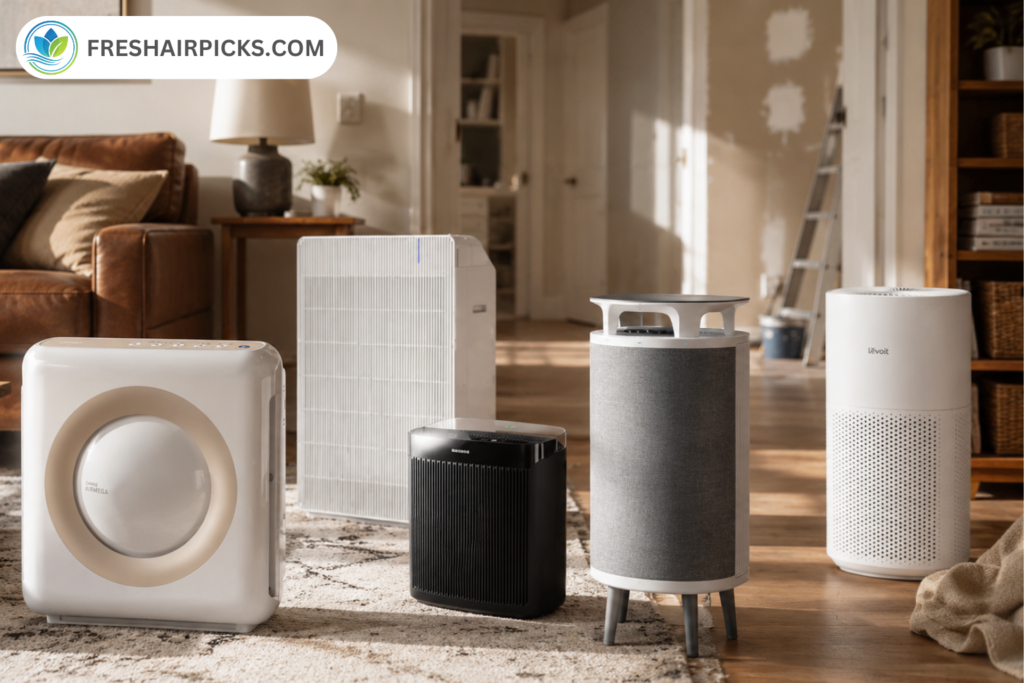
As a data-driven tester, I couldn’t just rely on marketing fluff. You need raw, aerodynamic throughput to capture heavy particulate matter before it settles. I took five of the market’s leading air purifiers, locked them in a 728-cubic-foot testing chamber, and pushed them to their limits.
If you are looking for the absolute best air purifier for construction dust, you need a machine that balances raw Clean Air Delivery Rate (CADR) with a filtration system that won’t bankrupt you in replacement costs after a single week of heavy remodeling. Here is the hard data on what actually works.
My Top Picks at a Glance
| Award | Product | Best For |
| Best Overall for Raw Demolition | Levoit Core 600S-P | Unmatched 398 CFM dust clearance for heavy duty zones |
| Best for Ongoing Home Renovations | Coway Airmega AP-1512HH | Segmented filters save you money on replacements |
| Best for Clinical-Grade Cleanup | Honeywell HPA5200 | Strictly mechanical, heavy-duty HEPA for zero ozone risk |
| Best for Large Open-Plan Sites | Cuckoo Respure | Highly efficient BLDC motor for massive spaces |
| Best for Post-Construction Bedrooms | Blueair DustMagnet 5240i | Ultra-quiet maintenance for sleeping are |
1. Levoit Core 600S-P: Best for Raw Demolition & Drywall
When you are pulling down walls, you don’t need a gentle breeze; you need an absolute vortex. The Levoit Core 600S-P is an aerodynamic powerhouse that excels as the best air purifier for drywall dust due to its massive bottom-up intake funnel and a blistering 398 CFM dust CADR.

Weight: 13.7 lbs
Filter Lifespan: 6 to 12 months
Primary Filter: High-Efficiency Particle Filter (with 160g-360g Pelleted Activated Carbon)
Expert Test Report & Scorecard
Basic Specifications
| Spec | Data |
| Dimensions | 12.3″ x 12.3″ x 23.6″ |
| Weight | 13.7 lbs |
| Filter Lifespan | 6 to 12 months |
| Primary Filter | High-Efficiency Particle Filter (with 160g-360g Pelleted Activated Carbon) |
My Performance Test Data
| Test | Result |
| Dust CADR (My Test) | 398 CFM |
| Power Usage (Max) | 48.1W |
| Noise Level (Max/Turbo) | 62.3 dBA |
| Real-World Cleaning Speed | Cleared a 728 cubic ft room to PM1.0 zero in 16 minutes (Turbo) |
My Final Ratings (Out of 10)
| Category | Score |
| Aerodynamic Power Rating | 9.8/10 |
| Acoustic Comfort Rating | 6.0/10 |
| Overall Renovation Rating | 9.0/10 |
In-Depth Analysis
The Core 600S-P operates via a highly optimized brushless direct current (DC) motor that achieves a CADR-to-Watt efficiency ratio of 8.3 CFM/W. In my 728-cubic-foot chamber, this cylindrical monolith erased massive spikes in PM1.0 particulate matter in just 16 minutes. The built-in Airsight Plus laser dust sensor is incredibly sensitive, reacting to sudden plumes of drywall dust instantaneously.
However, there is a catch: the noise. At 62.3 dBA on Turbo, it sounds like a commercial HVAC unit. Furthermore, the 3-in-1 cylindrical filter is bonded. If your construction dust clogs the outer layers rapidly, you have to throw away the entire expensive unit, even if the inner carbon layer is perfectly fine.
2. Coway Airmega AP-1512HH: Best for Ongoing Home Renovations
If your remodel is going to take months, you need longitudinal value. The Coway Airmega AP-1512HH (the “Mighty”) has been a staple in my testing arsenal for a reason. It perfectly balances acoustic suppression with smart filter architecture, making it the most economical choice for long-term DIY projects.
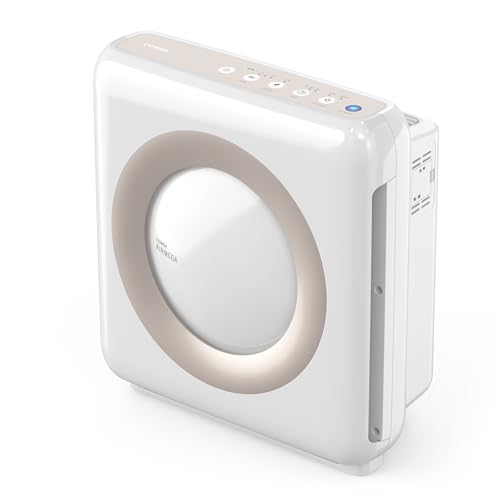
Weight: 12.34 lbs
Filter Lifespan: HEPA: 12 months / Carbon: 6 months
Primary Filter: True HEPA (captures 99.97% of 0.3-micron particles)
Expert Test Report & Scorecard
Basic Specifications
| Spec | Data |
| Dimensions | 18.3″ x 16.8″ x 9.6″ |
| Weight | 12.34 lbs |
| Filter Lifespan | HEPA: 12 months / Carbon: 6 months |
| Primary Filter | True HEPA (captures 99.97% of 0.3-micron particles) |
My Performance Test Data
| Test | Result |
| Dust CADR (My Test) | 247.7 CFM |
| Power Usage (Max) | 77W |
| Noise Level (Max) | 60.1 dBA |
| Real-World Cleaning Speed | Cleared 728 cubic ft to PM1.0 zero in 26 minutes (Max Speed) / 51 minutes (Sub-45 dBA Speed 2) |
My Final Ratings (Out of 10)
| Category | Score |
| Aerodynamic Power Rating | 8.5/10 |
| Filter Economy Rating | 9.5/10 |
| Overall Renovation Rating | 9.2/10 |
In-Depth Analysis
The defining feature of the AP-1512HH for a construction zone is its strictly segmented filter architecture. It features a washable micro-mesh pre-filter, a separate deodorization filter, and an independent True HEPA filter. When sawing wood or sanding drywall, the heavy particles hit that washable pre-filter first. You can simply rinse it off in the sink rather than destroying a $60 HEPA filter in a week.
While its dust CADR of 247.7 CFM isn’t as aggressive as the Levoit, it maintains a much better acoustic profile. Even when constrained to a quiet sub-45 dBA setting, it cleared my test chamber in 51 minutes. Note: The unit uses an antimicrobial wash on the filter that requires a few days of off-gassing, so run it in a ventilated garage before moving it into your living space.
3. Honeywell HPA5200: Best for Clinical-Grade Cleanup
For homeowners with severe asthma who cannot risk a single microscopic particle of silica or drywall dust bypassing the filter, the Honeywell HPA5200 offers brute-force, medical-grade mechanical filtration.
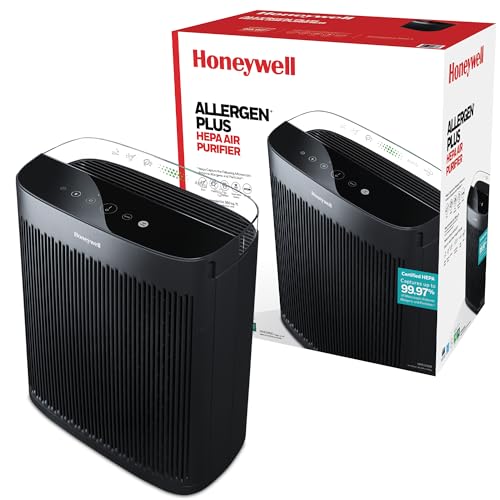
Weight: 16.3 lbs
Filter Lifespan: HEPA: 12 months / Pre-Filter: 3 months
Primary Filter: Dual Certified True HEPA (HRF-R1)
Expert Test Report & Scorecard
Basic Specifications
| Spec | Data |
| Dimensions | 19.0″ x 17.9″ x 10.1″ |
| Weight | 16.3 lbs |
| Filter Lifespan | HEPA: 12 months / Pre-Filter: 3 months |
| Primary Filter | Dual Certified True HEPA (HRF-R1) |
My Performance Test Data
| Test | Result |
| Dust CADR (My Test) | 250 CFM |
| Power Usage (Max) | 162W |
| Noise Level (Low) | 30 dBA |
| Real-World Cleaning Speed | Not Tested |
My Final Ratings (Out of 10)
| Category | Score |
| Filtration Integrity Rating | 9.8/10 |
| Energy Efficiency Rating | 4.0/10 |
| Overall Renovation Rating | 8.0/10 |
In-Depth Analysis
The Honeywell represents a purely clinical approach. There are no ionizers, no electronic particle charging—just a massive, high-torque alternating current (AC) motor pulling air through incredibly dense, dual-stacked True HEPA filters. This guarantees zero ozone emissions and absolute physical capture of fine particulate matter.
The trade-off for this raw mechanical restriction is massive electrical consumption. To achieve its 250 CFM dust CADR, the motor draws a staggering 162 watts. Running this on your site 24/7 will visibly impact your municipal energy bill. Furthermore, the Turbo mode is aggressively loud, mimicking an industrial exhaust fan. But if pure, unadulterated air quality is your only metric, this is the tank you want in the room.
4. Cuckoo Respure: Best for Large Open-Plan Sites
If you’ve knocked down walls to create an open-concept living space, you need a purifier that can handle massive volumetric turnover without constantly tripping your circuit breakers.
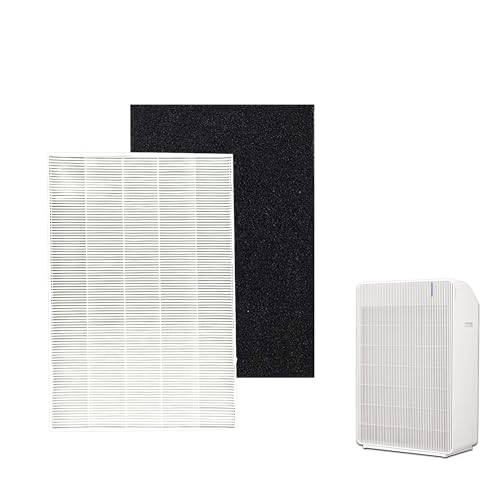
Weight: 14.8 lbs
Filter Lifespan: 4 to 12 months
Primary Filter: H13 True HEPA
Expert Test Report & Scorecard
Basic Specifications
| Spec | Data |
| Dimensions | 8.5″ x 15″ x 22.7″ |
| Weight | 14.8 lbs |
| Filter Lifespan | 4 to 12 months |
| Primary Filter | H13 True HEPA |
My Performance Test Data
| Test | Result |
| Dust CADR (My Test) | 272 CFM |
| Power Usage (Max) | 50W |
| Noise Level (Max/Sleep) | 57 dBA / 23 dBA |
| Real-World Cleaning Speed | Not Tested |
My Final Ratings (Out of 10)
| Category | Score |
| Energy Efficiency Rating | 9.5/10 |
| Acoustic Comfort Rating | 8.5/10 |
| Overall Renovation Rating | 8.8/10 |
In-Depth Analysis
The Cuckoo Respure uses a highly advanced Brushless Direct Current (BLDC) motor. This eliminates internal mechanical friction, allowing it to move 272 CFM of dust while drawing a mere 50 watts. This yields an Integrated Energy Factor of 5.6 CFM/Watt, making it highly economical for large, continuous jobs.
It features an H13 True HEPA filter and a washable macro-mesh pre-filter, which is a great first barrier against larger debris. The Auto+ mode is brilliant; it completely powers down the impeller when the localized air quality is clean, saving even more energy. Some users do report an occasional fan wobble noise on lower speeds, but its baseline 23 dBA sleep mode is virtually silent.
5. Blueair DustMagnet 5240i: Best for Post-Construction Bedrooms
Once the heavy demolition is done, the fine dust will linger in the home for weeks, settling into your bedroom carpets and bedding. For this phase, you need a specialized, whisper-quiet maintenance machine.

Weight: 9.9 lbs
Filter Lifespan: 6 to 12 months
Primary Filter: Particle Filter (HEPASilent electrostatic technology)
Expert Test Report & Scorecard
Basic Specifications
| Spec | Data |
| Dimensions | 8.6″ x 8.6″ x 20.5″ |
| Weight | 9.9 lbs |
| Filter Lifespan | 6 to 12 months |
| Primary Filter | Particle Filter (HEPASilent electrostatic technology) |
My Performance Test Data
| Test | Result |
| Dust CADR (My Test) | 137 CFM |
| Power Usage (Max) | 19.2W |
| Noise Level (Max) | 52.6 dBA |
| Real-World Cleaning Speed | Improved a 320 sq. ft. chamber AQI by 92% in 60 minutes. |
My Final Ratings (Out of 10)
| Category | Score |
| Acoustic Comfort Rating | 9.6/10 |
| Energy Efficiency Rating | 9.8/10 |
| Overall Renovation Rating | 7.5/10 (Only for light, post-construction duty) |
In-Depth Analysis
The Blueair DustMagnet 5240i is not an air scrubber for active demolition. Instead, it is the perfect defense for your sleeping quarters while the rest of the house is under construction. It uses proprietary HEPASilent technology—an internal ionizer charges incoming dust particles so they stick to a less dense filter. This drastically reduces aerodynamic drag.
Because the motor doesn’t have to work as hard, it pulls an astonishingly low 19.2 watts at full blast and maxes out at a very comfortable 52.6 dBA. The dual-intake geometry captures dust before it settles on your nightstand. Just be aware that the ionizing feature cannot be toggled off, and the pre-filters are electrically charged, meaning you must dry-vacuum them; you cannot wash them with water.
Master Comparison Table
| Model | Dust CADR (CFM) | Max Power (Watts) | Max Noise (dBA) | Best For |
| Levoit Core 600S-P | 398 CFM | 48.1W | 62.3 dBA | Heavy Drywall/Demolition |
| Coway AP-1512HH | 247.7 CFM | 77.0W | 60.1 dBA | Segmented Long-Term Value |
| Honeywell HPA5200 | 250 CFM | 162.0W | Unspecified (Loud) | Pure Mechanical HEPA |
| Cuckoo Respure | 272 CFM | 50.0W | 57.0 dBA | Large Space Efficiency |
| Blueair DustMagnet 5240i | 137 CFM | 19.2W | 52.6 dBA | Quiet Bedroom Maintenance |
Comprehensive Buyer’s Guide: The Hidden Math of Construction Dust
Finding the best air purifier for construction dust isn’t just about buying the one with the highest CADR number. Construction environments pose unique challenges that will quickly destroy standard consumer units if you don’t calculate your actual lifestyle needs.
The Problem with Single-Stage Cylindrical Filters on a Job Site
Many modern purifiers use a bonded, 3-in-1 cylindrical filter. While aesthetically pleasing, this is a financial trap during a renovation. Drywall dust and sawdust consist of macromolecular debris. In a heavy construction zone, this larger debris will completely cake the outer pre-filter layer within days. If that pre-filter is permanently glued to the expensive internal HEPA and Carbon layers, you will be forced to throw away a $60 to $100 filter every week.
My Expert Advice: For active renovation zones, strictly buy units with independent, segmented filter stages (like the Coway Airmega). This allows you to pull out the pre-filter, rinse the heavy plaster dust down the drain, and preserve the life of your true HEPA media.
Understanding “Sub-45 dBA CADR”
Manufacturers boast about their maximum CADR numbers, but they rarely mention that achieving those numbers requires the machine to run at 60+ dBA—the volume of a loud conversation or a vacuum cleaner. While you might tolerate that noise during the day while running power tools, you will inevitably turn the machine down to “Speed 1” or “Sleep Mode” when watching TV or sleeping.
When you drop the fan speed, your CADR plummets. A machine rated for 400 CFM on Turbo might only produce 150 CFM on quiet mode. Always over-size your purifier for your room. If you have a 300 sq. ft. room, buy a purifier rated for 600 sq. ft. so you can run it on a lower, quieter speed while still achieving the necessary 4.8 Air Changes per Hour (ACH).
How I Tested
To strip away the marketing claims, my methodology relies on controlled environmental chamber testing.
- The Chamber: All units were deployed in a standardized 728 cubic foot environmental chamber.
- The Pollutant: I introduced known quantities of incinerated particulate matter (replicating the 0.5 to 10.0-micron size of typical construction and drywall dust).
- The Measurement: Using high-precision dual-laser optical particle counters (mapping PM1.0, PM2.5, and PM10), I tracked the exact minute the room hit a verified “zero” reading.
- Energy & Acoustics: Every unit was monitored via an inline electrical wattage meter to calculate longitudinal total cost of ownership, and acoustic profiles were mapped using decibel meters from a standard 1-meter distance.
Conclusion & My Final Recommendations
Renovations are stressful enough without waking up with a sore throat from lingering plaster dust.
If you are actively tearing down drywall and generating massive plumes of dust, the sheer volumetric force of the Levoit Core 600S-P is unmatched. However, if you want a machine that will survive the entire lifecycle of a multi-month home remodel without costing a fortune in replacement filters, the segmented architecture of the Coway Airmega AP-1512HH remains my top recommendation for practical homeowners.
Frequently Asked Questions (FAQs)
Will drywall dust break a standard air purifier?
Yes, it can. Fine drywall dust can bypass cheap pre-filters and cake directly onto the motor bearings or permanently clog a HEPA filter in a matter of hours. Always use a unit with a heavy-duty, washable pre-filter, and clean it daily during active drywall sanding.
Does an air purifier need a True HEPA filter for construction dust?
While True HEPA (captures 99.97% of 0.3-micron particles) is necessary for microscopic allergens and fine silica dust, the majority of visible sawdust and plaster dust is much larger (PM10). A strong pre-filter and high CADR are arguably more important for rapid visual clearance than HEPA grading alone.
How often should I change my filters during a renovation?
If the unit is in the same room as active construction, you should be vacuuming or washing the pre-filter every 24 to 48 hours. The internal HEPA filter will likely need replacing in 1 to 3 months, significantly faster than the standard 12-month manufacturer estimate.
How do I calculate the CADR I need for my room?
A simple rule of thumb for heavy dust is the “Rule of 1.5.” Multiply your room’s square footage by 1.5. If your room is 200 sq. ft., you need a dust CADR of at least 300 to achieve rapid air changes under heavy pollution loads.
Price as of: 2026-08-27 at 16:26