I remember the first time I plugged in a high-performance air purifier for my daughter’s room. I felt a wave of relief knowing the air was clean, followed immediately by a wave of anxiety as I looked at the electric meter. Was I solving a health problem only to create a financial one?
This is what I call the “24/7 Dilemma.” We know these machines need to run constantly to work effectively, but we are terrified of buying a “vampire appliance” that will cause our utility bills to skyrocket.
Here is the short answer to put your mind at ease: For most modern, energy-efficient units, running an air purifier 24/7 costs about the same as a standard streaming service subscription—roughly $4 to $8 per month.
In this guide, I’m going to break down the exact math so you don’t have to guess. We will look at how many watts an air purifier uses, compare it to appliances like your fridge, and I’ll show you the “Auto Mode” trick that can cut your costs in half.
Key Takeaways
- Monthly Cost: Expect to pay between $0.80 and $9.00 per month depending on the speed setting and your local electricity rates.
- The “Auto” Advantage: Using “Auto Mode” significantly reduces energy consumption compared to running the unit on “High” 24/7.
- Not an AC Unit: An air purifier uses roughly 1/20th the electricity of an air conditioner.
- Trust the Star: Always look for the Energy Star label, which guarantees the motor is optimized for efficiency.
The Short Answer: Monthly Cost Estimates by Mode
If you are a “Cost-Anxious Health Optimizer” like me, you just want the numbers.
The table below breaks down the estimated monthly cost based on a standard electricity rate of $0.17 per kWh (the approximate US average). These numbers assume you are running the device 24 hours a day, 7 days a week.
| Sleep / Low | 5 W – 15 W | $0.61 – $1.83 | An LED Lightbulb |
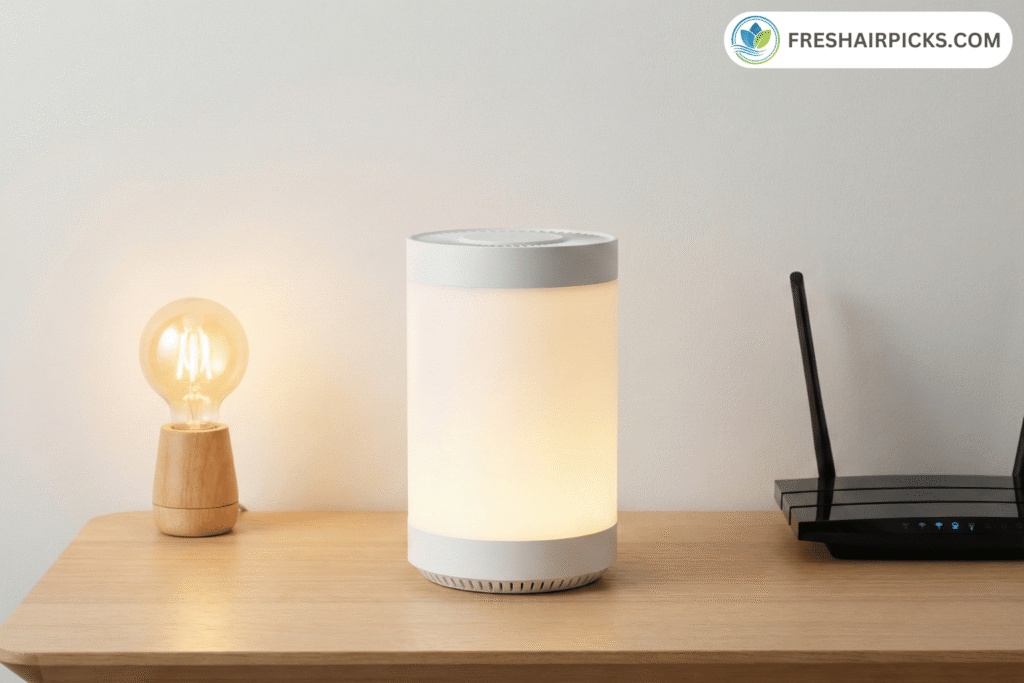
| Medium / Auto | 20 W – 50 W | $2.45 – $6.12 | Wi-Fi Router |
| High / Turbo | 50 W – 100 W | $6.12 – $12.24 | Ceiling Fan |
| Max / Heavy Duty | 100 W+ | $12.24+ | Old Laptop |
As you can see, the fear that air purifiers use a lot of electricity is largely a myth, provided you aren’t running an industrial unit on max speed constantly.
How to Calculate Your Air Purifier’s Exact Electricity Cost
While the averages above are helpful, you might be a data-driven skeptic who wants to verify the numbers for your specific model. To figure out how much electricity an air purifier uses per month in your specific home, we use a simple formula.
The Simple FormulaPurifier vs. OtherThe Simple Formula
- Find the Wattage: Check the label on the bottom or back of your unit. Look for “Rated Power.” (Note: This is usually the maximum wattage).
- Convert to Kilowatts (kW): Divide the wattage by 1,000.
- Multiply by Hours: Multiply by the hours you run it per day (usually 24).
- Multiply by Rate: Check your utility bill for your “cents per kWh” rate.
Step-by-Step Example
Let’s say you have a standard Levoit or Coway unit that uses 40 Watts on its medium setting, and you run it all day. Your electricity rate is $0.17.
- Step 1: $40 \text{ Watts} / 1000 = 0.04 \text{ kW}$
- Step 2: $0.04 \text{ kW} \times 24 \text{ hours} = 0.96 \text{ kWh per day}$
- Step 3: $0.96 \text{ kWh} \times \$0.17 = \mathbf{\$0.16 \text{ per day}}$
- Step 4: $\$0.16 \times 30 \text{ days} = \mathbf{\$4.80 \text{ per month}}$
So, how much power does an air purifier use compared to your budget? In this scenario, it costs less than a fancy coffee.
If you are looking for units that are specifically designed to keep this number as low as possible, you should check out our roundup of the most efficient models.
Air Purifier vs. Other Household Appliances (Putting it in Context)
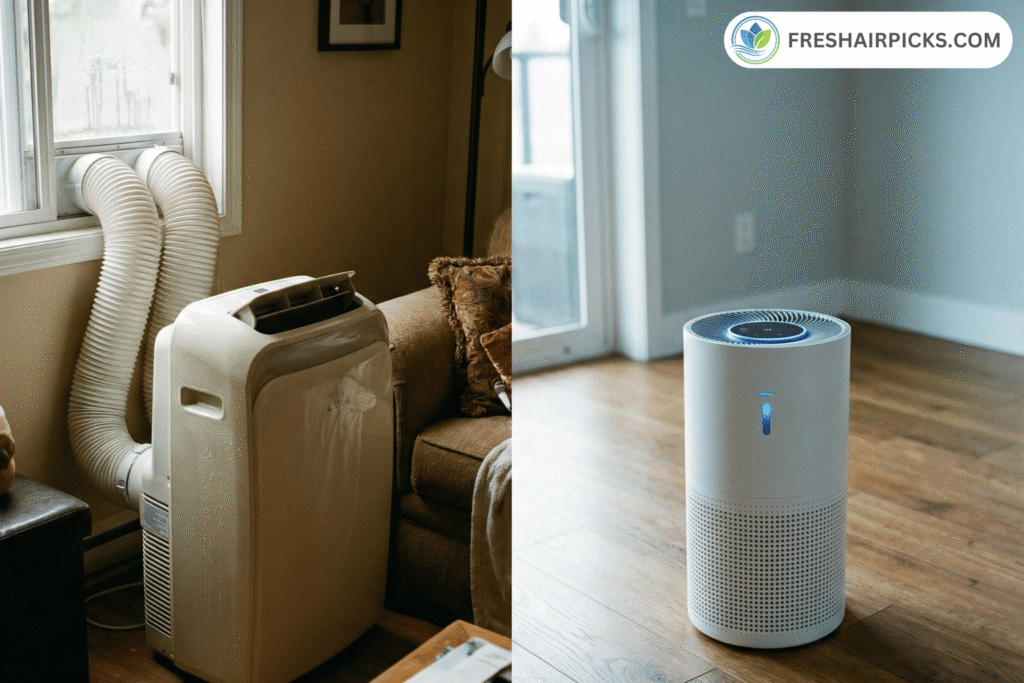
A major reason people worry that air purifiers run up your electric bill is because they physically resemble portable air conditioners. They are both white plastic boxes that sit in the corner and blow air.
However, the physics are completely different. An air conditioner uses a compressor to pump heat (thermodynamics), which is energy-intensive. An air purifier is simply a fan pushing air through a filter (aerodynamics).
Here is how the energy consumption compares:
- Central Air Conditioning: 3,000 – 5,000 Watts (100x more power)
- Dehumidifier: 280+ Watts (7x more power)
- Refrigerator: 150 – 400 Watts (4x more power)
- Air Purifier (High): 50 – 80 Watts (Baseline)
- Wi-Fi Router: 10 – 20 Watts (1/4 the power)
Does an air purifier use a lot of electricity? Compared to your AC or heating system, the answer is a definitive no. It is much closer to a ceiling fan than an air conditioner.
The “Auto Mode” Factor: Why You Shouldn’t Run on High 24/7
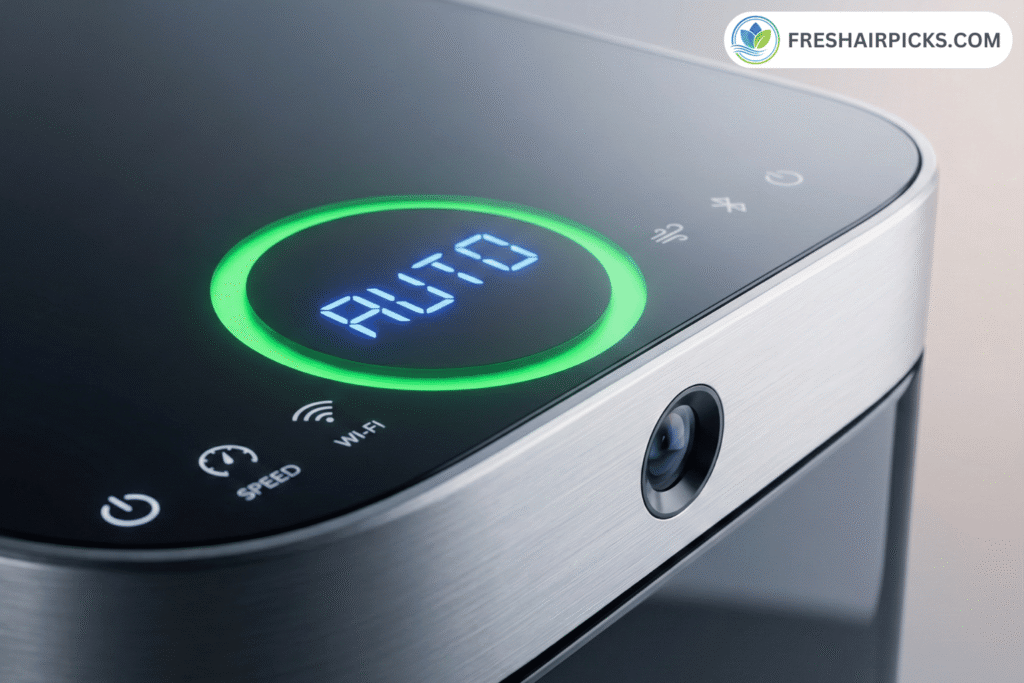
If you want the benefits of clean air without the “Turbo” mode costs, “Auto Mode” is your best friend.
This comes down to the physics of the Fan Affinity Laws. In simple terms, to double the fan speed, the motor needs roughly eight times the power. This means that running your purifier on “High” uses exponentially more energy than “Medium” or “Low.”
How Auto Mode Saves Money:
Smart air purifiers use laser sensors to detect particles in the air. When the air is clean (which is most of the day), the fan drops to a low idle (consuming ~5-10 Watts). It only ramps up to high speed (50+ Watts) when it detects smoke from cooking, pet dander, or dust.
By using Auto Mode, do air purifiers consume a lot of electricity? Rarely. You get the protection of high speed only when you need it, and the savings of low speed for the other 20 hours of the day.
This feature is particularly useful in larger spaces where you need a powerful unit but don’t want it roaring constantly.
3 Factors That Impact Your Bill (Beyond Wattage)
Not all machines are created equal. If you are asking, “does air purifier cost a lot of electricity?”, the answer depends heavily on the specific technology inside the box.
1. Filter Resistance (True HEPA vs. Ionic)
To capture microscopic viruses and smoke, we use True HEPA filters. These filters are very dense, which creates high “pressure drop.” The motor has to work harder to push air through them compared to a cheap fiberglass filter.
While “filterless” or ionic purifiers use very little electricity, they often fail to actually clean the air effectively. In my opinion, the slight extra cost of electricity for True HEPA is the necessary price of performance.
2. Motor Type (AC vs. DC Brushless)
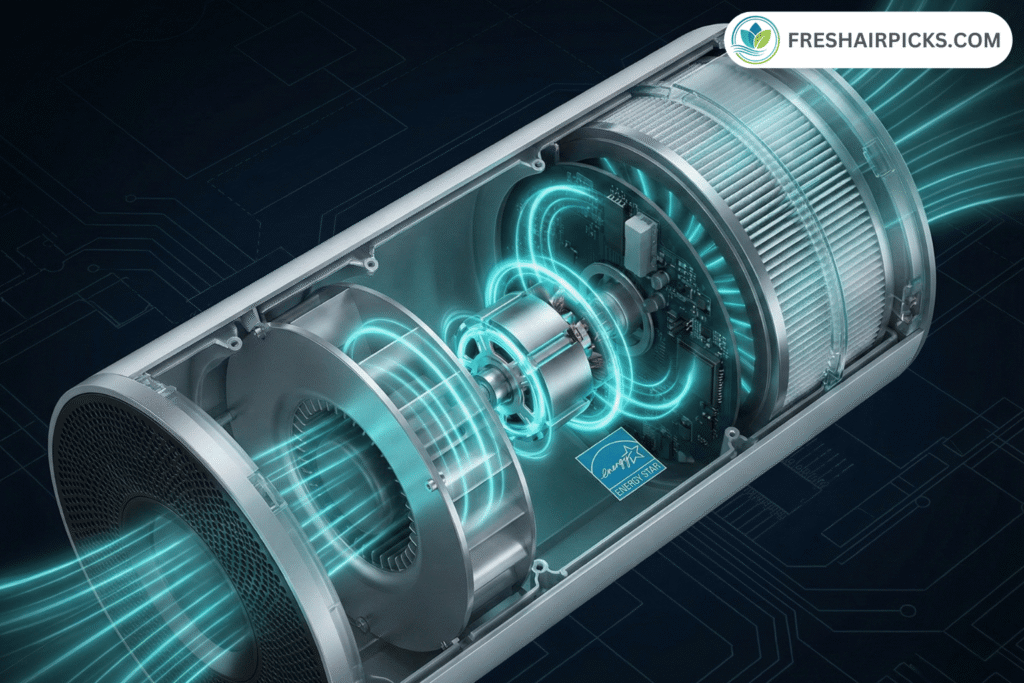
This is the single biggest differentiator.
- AC Motors: Found in older or cheaper units. They get hot and waste energy.
- BLDC (Brushless DC) Motors: Found in modern Energy Star units. They are 80-90% efficient and run cool.
If you are wondering, “does Levoit air purifier use a lot of electricity?” or similar brands, the answer is usually no, because most of their modern lineup uses these efficient DC motors.
3. Standby Power (“Vampire Draw”)
Modern purifiers are “smart” devices. Even when the fan is off, they draw power for Wi-Fi and sensors. However, Energy Star regulations cap this at <2 Watts. This amounts to about $2 to $4 per year. It is not worth unplugging your unit and losing your smart schedules to save this tiny amount.
Common Myths About Air Purifier Energy Use
Myth: “Running it on Low saves money and is just as good.”
Fact: It definitely saves money, but it might not be “just as good.” On the lowest setting, the airflow (CADR) is often too weak to clean a standard-sized room effectively. You end up saving pennies but getting zero health benefits. Use Auto or Medium instead.
Myth: “Dirty filters make it use more electricity.”
Fact: This is counter-intuitive. On older, dumb units, a dirty filter blocks airflow, so the fan actually does less work (moves less air) and wattage drops. However, on smart units that try to maintain constant airflow, the motor will ramp up power to force air through the clog. Regardless of the electricity cost, a dirty filter ruins performance.
FAQ: Your Energy Questions Answered
Should I run my air purifier 24/7?
Yes. Indoor pollutants accumulate continuously from furniture, cooking, and outdoor drafts. For the best health outcomes, leave it on. To manage costs, keep it on “Auto Mode.”
Is it cheaper to run a ceiling fan or an air purifier?
They use similar amounts of electricity on high speeds (50-80 Watts). However, they do different jobs. A ceiling fan cools your skin; an air purifier cleans your lungs.
How do I find the wattage on my specific model?
Look for a sticker on the bottom or back of the unit. Look for the line that says “Power Consumption” or “Rated Power.”
Do air purifiers take up a lot of electricity compared to heating?
No. An electric space heater can use 1,500 Watts. You could run 30 air purifiers for the same cost as one space heater.
Final Verdict: Is the Cost Worth the Health Benefit?
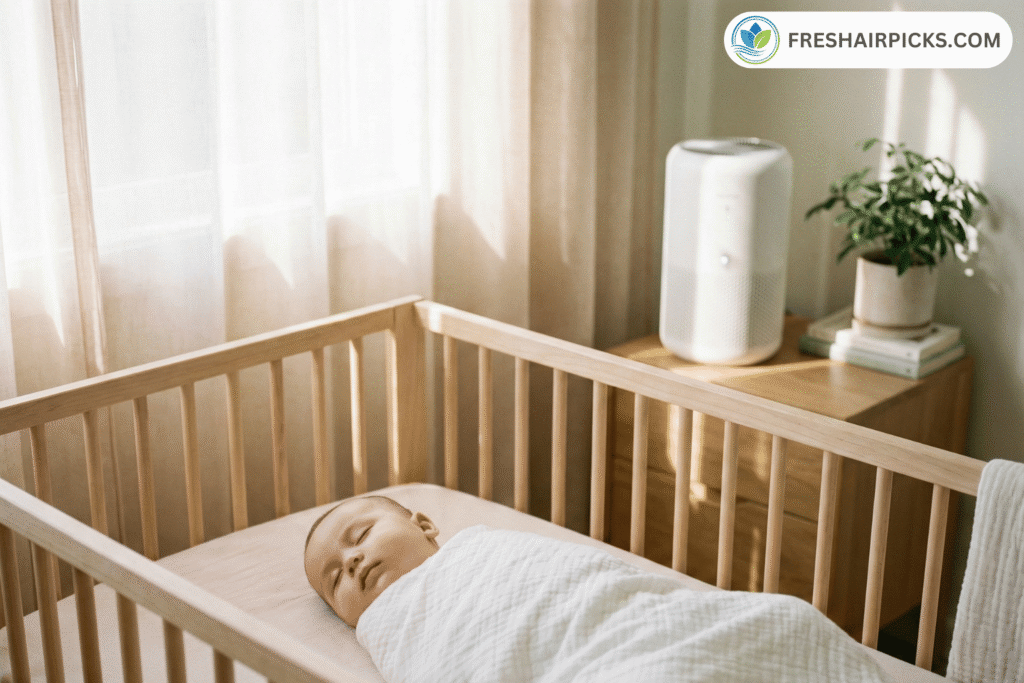
So, how much electricity does a small air purifier use? About as much as a lightbulb. Even a large whole-home unit costs less to run than your internet router.
When you weigh the monthly cost ($4 to $8) against the benefits—fewer allergy symptoms, better sleep, and protection from wildfire smoke—it is one of the most cost-effective investments you can make for your home.
My final advice: Don’t stress about the bill. Enable “Auto Mode,” ensure you have an Energy Star certified model, and breathe easy knowing you aren’t breaking the bank.