I get it. You love your cat, but your allergies are making you miserable. That constant tickle in your throat, the itchy eyes, the sneezing… it’s exhausting. And it leads to that awful, gut-wrenching question: “Do I have to choose between my health and my furry companion?”
As a dad who deep-dived into air quality research because of my own child’s sensitivities, this question hits home. You’re looking for a real solution, not just a marketing promise.
So let’s get right to it. Yes, a high-quality air purifier can be a life-changing tool for managing cat allergies, but it’s not a magic cure.
It’s a crucial part of a larger strategy. This guide will give you the science-backed answers so you can understand what they do, what they don’t do, and how to choose one that actually works.
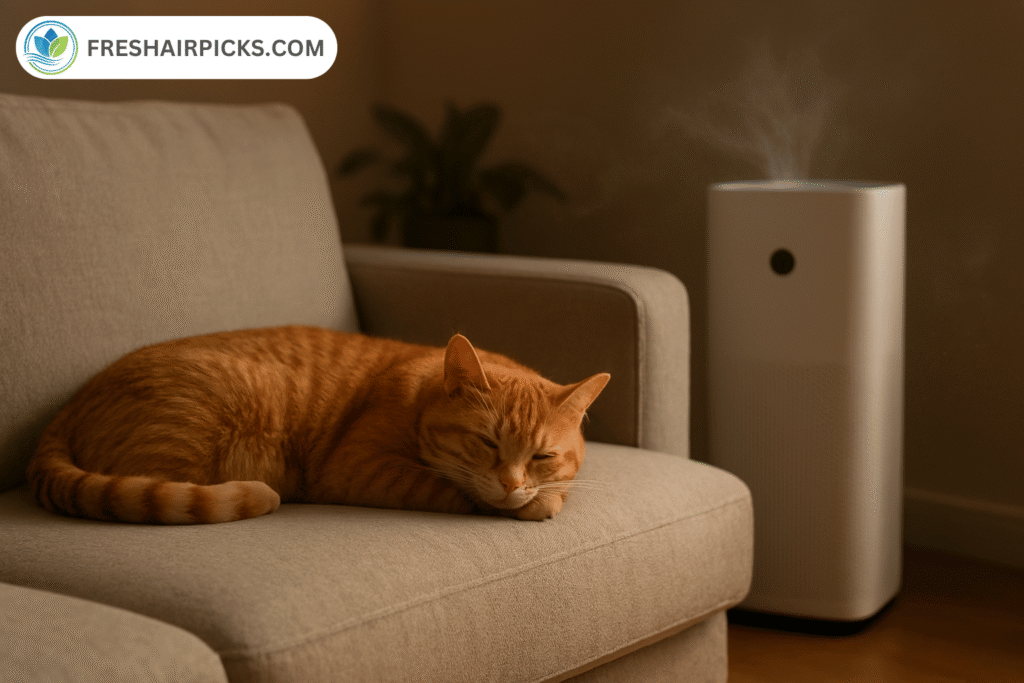
The Short Answer: Yes, but They Are a Tool, Not a Magic Cure
Here’s the honest truth: an air purifier is highly effective at solving one-half of the cat allergy problem.
It’s designed to constantly suck in the air in your room, force it through a dense filter, and release clean air back out. This process is fantastic at removing the fur that you breathe in—the tiny, floating particles that trigger your symptoms.
The critical part to understand is what they can’t do. An air purifier can’t clean your sofa. It can’t clean your carpets, your bedding, or your curtains. These surfaces are what I call the “surface reservoir”—where the heavier allergen particles have settled and are just waiting to be stirred up.
An air purifier is an essential, non-negotiable component of a whole-home allergy control plan, but it’s not a single-step cure.
Understanding What Causes Your Cat Allergies (It’s Not the Fur)
To win the battle, you have to know your asthma enemy. And for 90% of allergic cat lovers, the enemy is not the fur.
Meet the Real Culprit: The Fel d 1 Protein
Your allergy is almost certainly to a tiny, “sticky” protein called Fel d 1. This protein is produced in your cat’s salivary and skin (sebaceous) glands.
Here’s the chain of events:
- Your cat produces Fel d 1.
- It spreads this protein to its dander (microscopic skin flakes) and fur when it grooms itself.
- This dander and saliva-coated fur becomes the “delivery vehicle” for the protein, shedding into your home.
The “Dual-State” Problem: Airborne vs. Surface Allergens
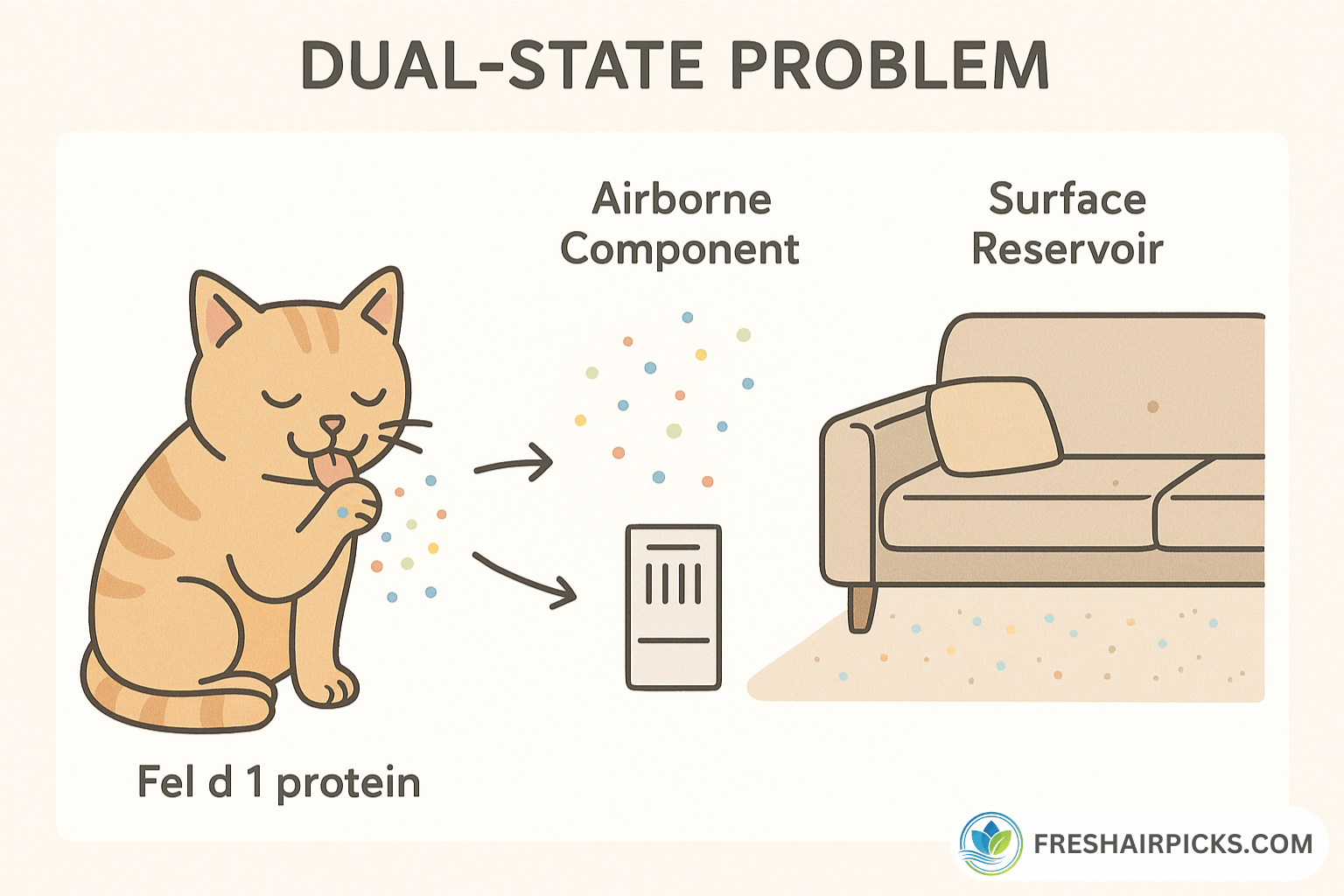
This is the most important concept you need to grasp. Fel d 1 allergens exist in your home in two states:
- The Airborne Component: These are the tiniest, lightest particles (some smaller than 4.7 microns). They are so lightweight they can defy gravity and stay floating in the air for hours, where you constantly breathe them in. This is what an air purifier targets.
- The Surface Reservoir: These are heavier dander flakes and particles that settle out of the air and land on your carpets, sofa, bedding, and bookshelves. An air purifier cannot reach these. They are removed by vacuuming and cleaning.
If you only vacuum, you’re missing the airborne particles. If you only use an air purifier, you’re missing the massive reservoir on your furniture. You have to tackle both.
How Air Purifiers Capture Cat Allergens (The Science of “Clean”)
So, how does a machine catch something that’s microscopic? It’s all about the right tool for the job.
The HEPA Filter: Your “Allergen Net”
Think of an air purifier as a powerful fan attached to an incredibly fine “net.” That net is the HEPA filter.
HEPA stands for High-Efficiency Particulate Air. To be called “True HEPA” in the United States, a filter must be tested and certified to capture 99.97% of airborne particles down to 0.3 microns in size.
For context, a single Fel d 1-carrying dander particle can be 5 or 10 microns, while the smallest, most problematic particles are even smaller. A True HEPA filter is the non-negotiable standard for capturing these allergens.
Myth vs. Fact: Why the 0.3 Micron “Worst-Case” Is Good News
I see this confusion all the time. People read “0.3 microns” and think, “But what about particles smaller than that? Do they just pass through?”
This is the most misunderstood part of HEPA, and the truth is actually great news.
That 0.3-micron number isn’t a minimum size limit. It’s the MPPS (Most Penetrating Particle Size). In other words, 0.3 microns is the “worst-case” particle size—the one that is hardest for the filter to catch.
The physics is a little complex, but HEPA filters use three mechanisms to catch particles:
- Impaction: Large particles (>1.0 micron) are too heavy and slam straight into the filter fibers.
- Interception: Medium particles (0.4 – 1.0 micron) follow the airflow but get snagged on the side of a fiber.
- Diffusion (Brownian Motion): This is the magic. Ultrafine particles (<0.1 micron) are so light they get bounced around by air molecules in a random, zig-zag path. This random motion makes it statistically impossible for them to pass through the filter matrix without hitting and sticking to a fiber.
The 0.3-micron particle is the “worst-case” because it’s in a “sweet spot” where it’s almost too small for impaction but almost too big for high-efficiency diffusion.Smoke CADR The 0.3-micron particle is the “worst-case” because it’s in a “sweet spot” where it’s almost too small for impaction but almost too big for high-efficiency diffusion.
The takeaway: A HEPA filter is actually more efficient at capturing particles that are both larger and smaller than 0.3 microns. It is scientifically designed to trap the entire spectrum of Fel d 1 allergen particles.
How to Know If a Purifier Is Powerful Enough (HEPA vs. CADR)
Okay, so you need a True HEPA filter. That’s Checkbox #1.
But a great filter is useless if it’s paired with a weak fan that can’t actually move any air. This is where your second non-negotiable metric comes in: CADR.
What Is a CADR (Clean Air Delivery Rate) Rating?
CADR is a standardized rating from the Association of Home Appliance Manufacturers (AHAM). It measures the purifier’s power.
It tells you the volume of clean air (in cubic feet per minute) that the purifier delivers. A higher CADR means a more powerful unit that can clean your room’s air faster.
The Most Important Number: Why You Need the “Smoke” CADR
You’ll see three CADR numbers on a certified purifier: Dust, Pollen, and Smoke.
For cat allergies, pay closest attention to the Smoke CADR.
Why? Because the test particles used for the “Smoke” rating are the smallest (0.09–1.0 micron). This particle size range is the best proxy we have for the smallest, most persistent, and most problematic airborne cat allergen particles.
The “2/3 Rule”: A Simple Way to Match a Purifier to Your Room
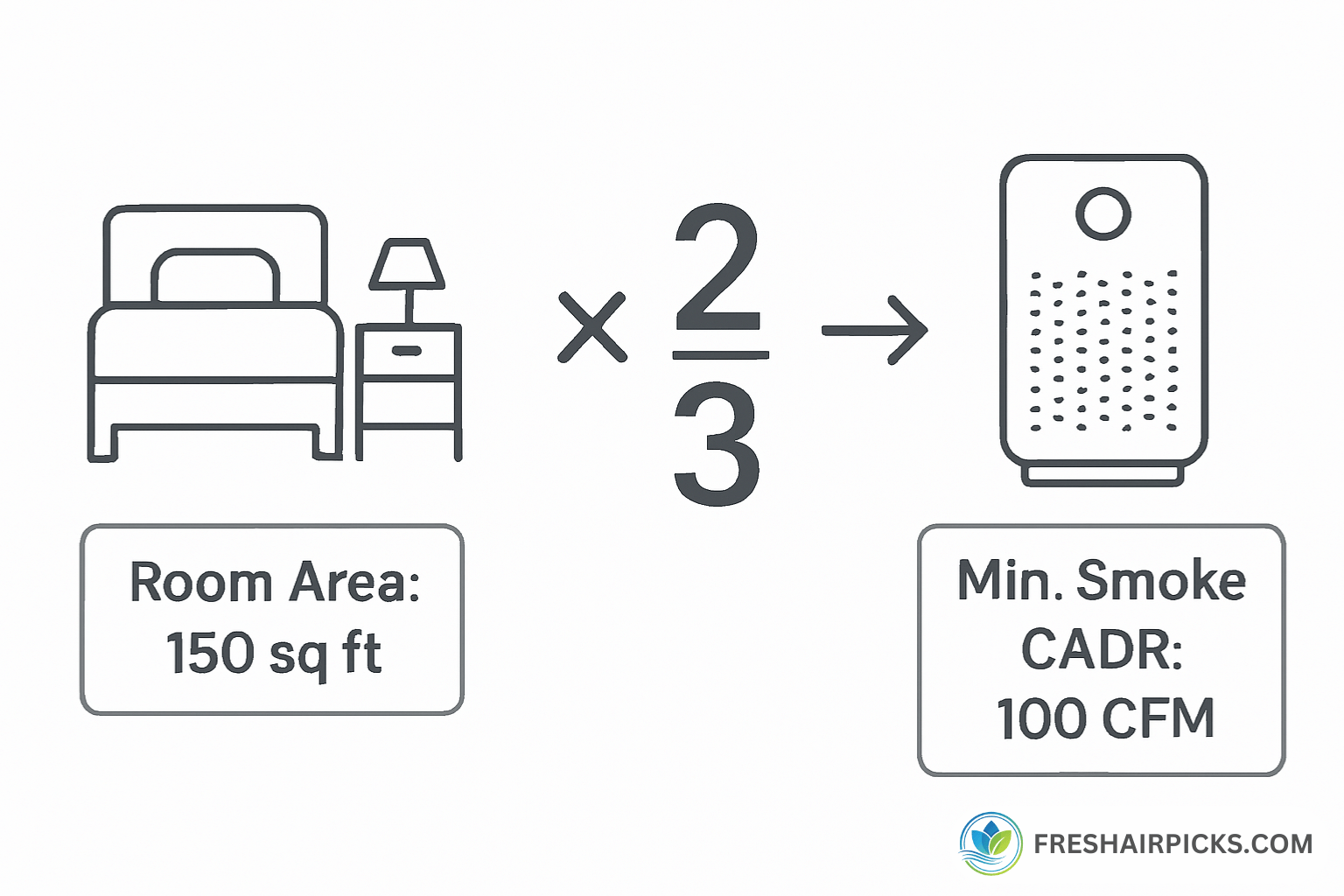
AHAM provides a simple, fantastic rule of thumb for this.
Your purifier’s Smoke CADR rating should be at least two-thirds (2/3) of your room’s area in square feet.
- Example: If your bedroom is 150 square feet.
- Calculation: 150 x (2/3) = 100.
- Result: You need a purifier with a Smoke CADR of at least 100.
This rule is designed for a room with an 8-foot ceiling. If you have higher ceilings, you’ll want to buy a purifier that is even more powerful.
The Real Goal: Understanding ACH (Air Changes per Hour)
What the “2/3 Rule” is really doing is helping you buy a purifier powerful enough to achieve 4-6 Air Changes per Hour (ACH).
ACH is the medical and engineering gold standard. It means the purifier is powerful enough to clean the entire volume of air in your room 4 to 6 times every hour. For allergy sufferers, this high turnover is critical for keeping allergen levels down.
The 3 Biggest Myths About Air Purifiers and Cat Allergies
Let’s bust three common myths right now. Understanding these will save you from disappointment.
Myth 1: An Air Purifier Is a “Cure-All”
Fact: As we covered, an air purifier only handles the airborne allergens. You must still clean the surface reservoir. A complete plan includes a HEPA purifier, a HEPA vacuum, and regularly washing bedding and textiles.
Myth 2: It Will Remove the Litter Box Smell
Fact: This is the #1 mistake I see. A HEPA filter is a particulate filter. It traps solid particles like dander. Odors are gases, not particles.
Those gas molecules will pass right through a HEPA filter like it’s not even there.
Solution: To remove cat smells, you need a purifier with a separate Activated Carbon filter. Carbon has millions of tiny pores that adsorb (trap) gas and odor molecules. If the smell is your main problem, a HEPA-only unit will not help. For a detailed breakdown of models that excel at this, you can read our in-depth guide to purifiers that destroy litter box odor.
Myth 3: A “Sealed System” Is Just Marketing
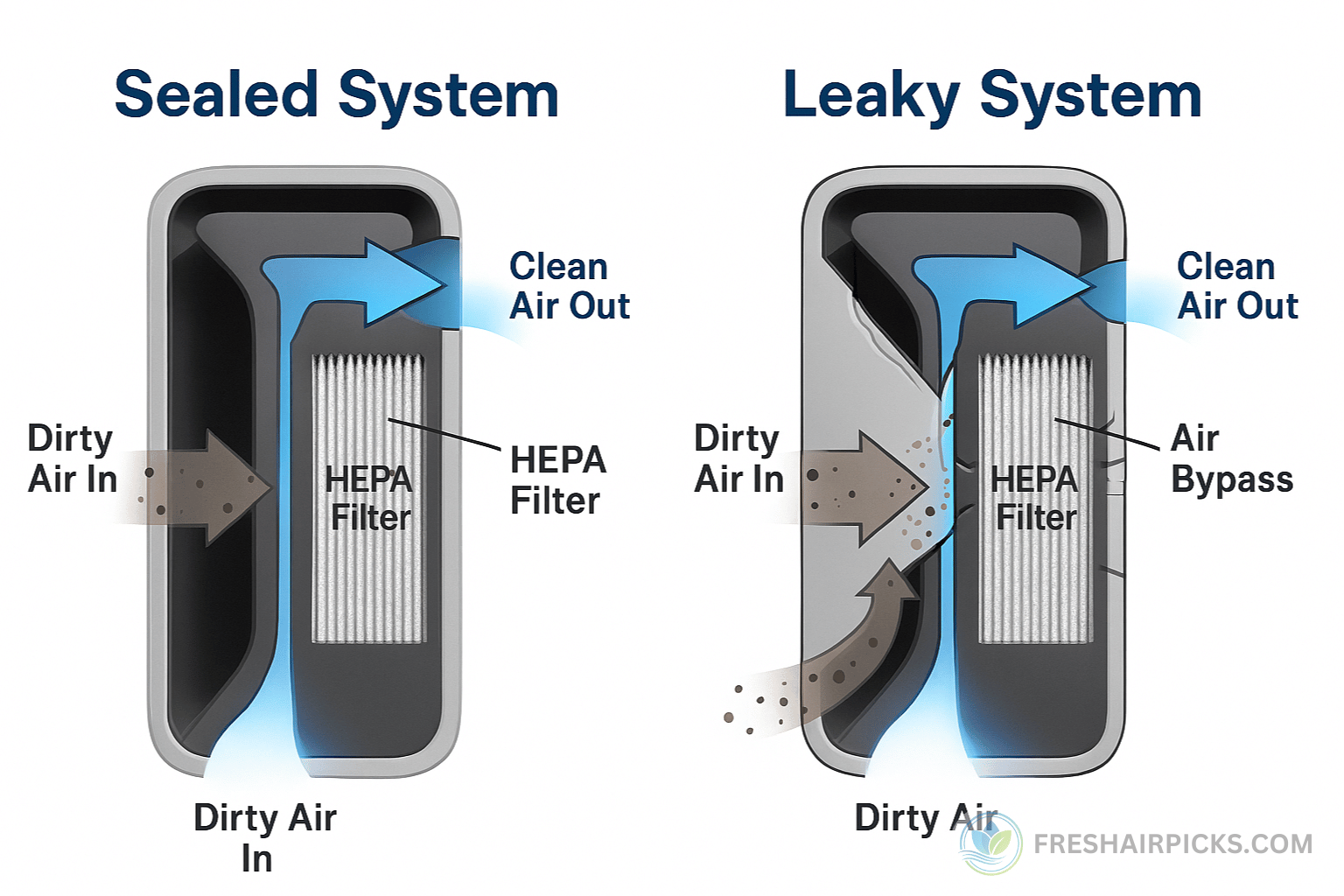
Fact: This is actually a key, high-performance feature. A cheap purifier can have a great HEPA filter, but if the housing has gaps, cracks, and leaks, the dirty air will just bypass the filter and shoot right back out into your room.
A fully sealed system ensures that 100% of the air the machine sucks in must go through the filter, with no leaks. It guarantees that what’s captured stays captured.
Your 4-Step Plan for Coexisting Comfortably with Your Cat
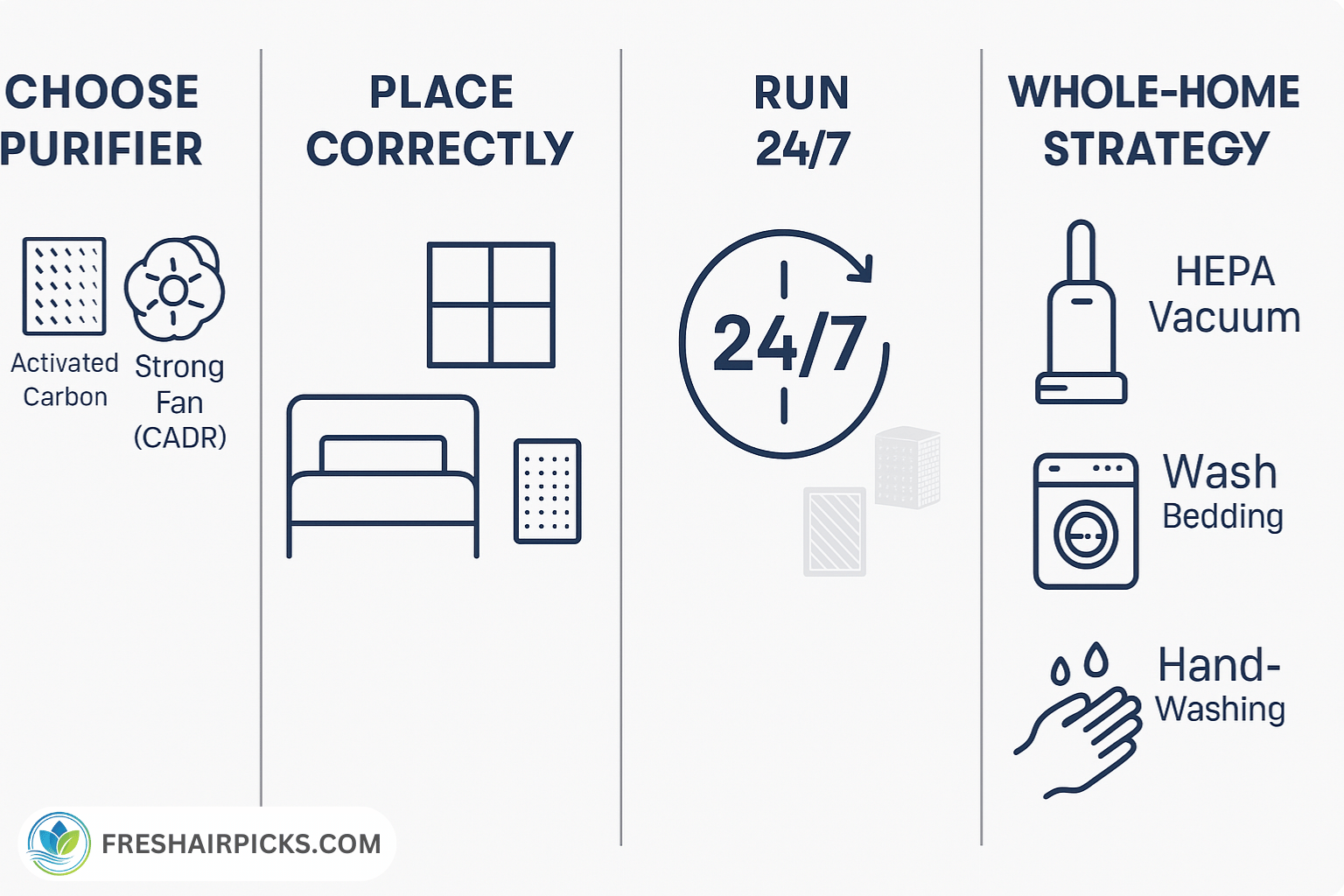
Here is your actionable plan.
Step 1: Choose the Right Purifier (The 3-Checklist)
Don’t get overwhelmed by marketing. Just check these three boxes:
- Filter 1: A True HEPA filter (for particles/allergens).
- Filter 2: A substantial Activated Carbon filter (for odors).
- Power: A Smoke CADR rating that is at least 2/3 of your room’s square footage.
Step 2: Place It Correctly
Put the purifier in the room where you spend the most time. For 99% of people, this is the bedroom. Run it there all night, and you’ll be breathing clean air for 8+ hours, allowing your body’s inflammation to go down. The living room or home office is your next best spot.
Step 3: Run It 24/7 (and Budget for Filters)
Your cat produces allergens 24/7. Your purifier should run 24/7. Run it on a lower, quieter setting when you’re in the room and turn it up when you’re out. And yes, you will need to replace the filters. This is a long-term investment in your health, so budget for it.
Step 4: Create a Whole-Home Strategy
The purifier is your air support. You still need a ground game.
- Vacuum floors and furniture at least weekly with a HEPA-filter vacuum.
- Wash your bedding in hot water every week.
- Invest in allergen-proof mattress and pillow covers.
- Wash your hands after petting your cat, and try not to touch your face or eyes.
The Final Verdict: An Essential Tool for Allergic Cat Lovers
So, do air purifiers help with cat allergies?
Absolutely, yes. They are not a magic cure, but they are arguably the single most powerful tool in your arsenal.
By scientifically removing the constant stream of airborne Fel d 1 allergens, a high-quality, properly-sized HEPA purifier can dramatically reduce your daily symptom load. It lowers the “allergen baseline” in your home, giving your immune system a break and helping you and your cat live together happily and comfortably.
Frequently Asked Questions (FAQ)
What is a HEPA filter, and is it the best for pet dander?
A True HEPA filter is a medical-grade air filter certified to capture 99.97% of airborne particles at 0.3 microns (the “worst-case” size). It is the non-negotiable standard and the best technology for capturing pet dander, Fel d 1 protein, and other airborne allergens.
Where is the best place to put an air purifier for cat allergies?
The bedroom. You spend 7-9 hours there every day, and running a purifier all night gives your body an extended, 8-hour break from breathing in allergens. This can dramatically reduce overall inflammation and daytime symptoms. The second-best place is the living room or home office—wherever you spend the next-most amount of time.
Will an air purifier help with cat-related asthma?
Yes. By removing the airborne triggers (like Fel d 1) that can cause inflammation and irritate the airways, a HEPA air purifier can be a very effective tool for managing asthma. Many studies have shown a link between HEPA filtration and improved respiratory symptoms for asthmatics.
How long will it take for me to notice a difference in my allergies?
You’ll get “clean air” in the room within an hour or two of turning the machine on. However, noticing a real difference in your symptoms can take a few days to a week. This is because the purifier is only one part of the solution. You’ll get the fastest relief by running the purifier 24/7 and doing a deep clean (HEPA vacuuming, washing bedding) to reduce the “surface reservoir” of allergens.
Will an air purifier also get rid of cat smells?
Only if it has an Activated Carbon filter. A HEPA filter only traps solid particles and has no effect on odors (which are gases). To remove litter box or cat odors, you must buy a unit that has both a HEPA filter (for allergens) and a substantial activated carbon filter (for smells).