The short answer is: Yes, air purifiers are HSA (Health Savings Account) and FSA (Flexible Spending Account) eligible, provided they are medically necessary.
However, unlike buying a prescription or a box of bandages, you can’t just swipe your card and walk away without a little homework. Because air purifiers can be used for general comfort (like removing cooking odors), the IRS classifies them as “Dual-Purpose Equipment.” This means the burden of proof is on you to show that you are buying it to treat a specific medical condition, not just because you enjoy fresh air.
I know the phrase “IRS regulations” usually triggers immediate anxiety. I’ve been there—staring at a pile of receipts, wondering if I’m going to get a letter in the mail for trying to keep my home breathable. But here is the good news: qualifying is actually a straightforward checklist. You don’t need a law degree; you just need to understand the “Letter of Medical Necessity.”
Below, I’ll walk you through exactly how to use your tax-advantaged funds to buy the right unit, skipping the confusion and getting straight to the relief.
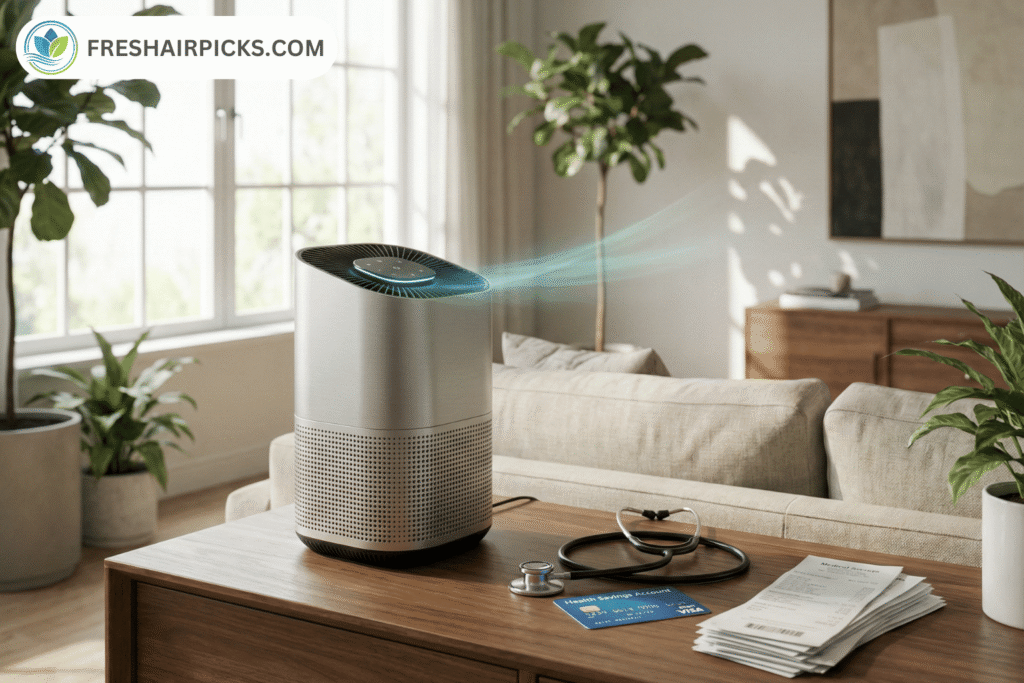
Key Takeaways
- It is “Dual-Purpose”: Air purifiers are not automatically eligible like insulin; you must prove they are for a medical condition.
- The “Golden Ticket”: You need a Letter of Medical Necessity (LMN) from a doctor to be compliant.
- Portable is Safe: Portable air purifiers are generally fully deductible with an LMN. Whole-house HVAC systems are much more complicated and often not deductible.
- The “Checkout Unlock”: Many modern retailers now allow you to get an LMN approved instantly at checkout via telehealth partnerships.
The Golden Rule: Understanding “Dual-Purpose” Eligibility
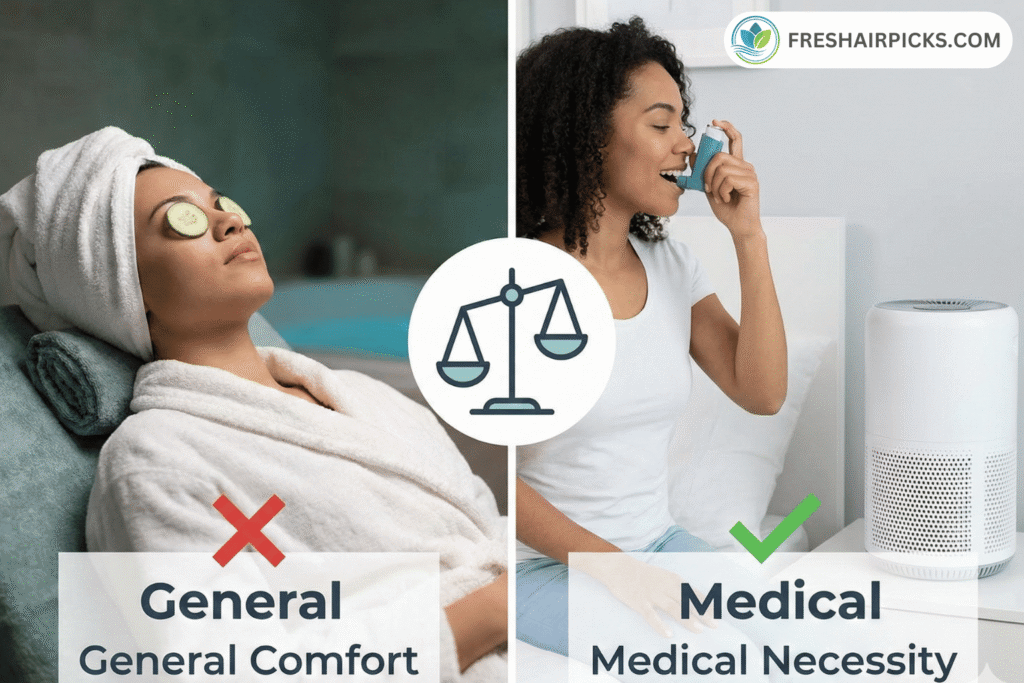
To understand why the rules are the way they are, we have to look at how the tax code views your health. The IRS draws a hard line between “medical care” and “general health.”
A gym membership improves your general health, but it’s not tax-deductible. A treadmill is just exercise equipment, unless a doctor prescribes it specifically for rehabilitation after a stroke.
Air purifiers fall into this same gray area, known as Dual-Purpose Equipment.
- Scenario A: You buy a purifier because you want your living room to smell like a meadow. (Not Eligible)
- Scenario B: You buy a purifier because your pulmonologist says your asthma triggers must be reduced to prevent an attack. (Eligible)
The “But For” Test
In the eyes of a tax auditor, you have to pass what is theoretically called the “But For” test. You essentially need to prove: “I would not have purchased this device but for my medical condition.”
Who Qualifies? (The Medical Conditions)
You generally cannot use HSA/FSA funds for “prevention” in a healthy person (e.g., buying one for a healthy newborn’s nursery “just in case”). You need a diagnosed condition. Based on current medical standards, the following conditions typically qualify:
- Asthma & Severe Allergies: The most common reason. The device mitigates triggers like dust mites, pollen, and dander.
- COPD & Emphysema: Clean air is critical to preventing acute exacerbations.
- Immune Compromise: For individuals undergoing chemotherapy, or those with cystic fibrosis or post-transplant status, preventing airborne infection is a medical necessity.
- Sleep Apnea: When nasal congestion from allergens exacerbates the condition.
The “Key” to Approval: The Letter of Medical Necessity (LMN)
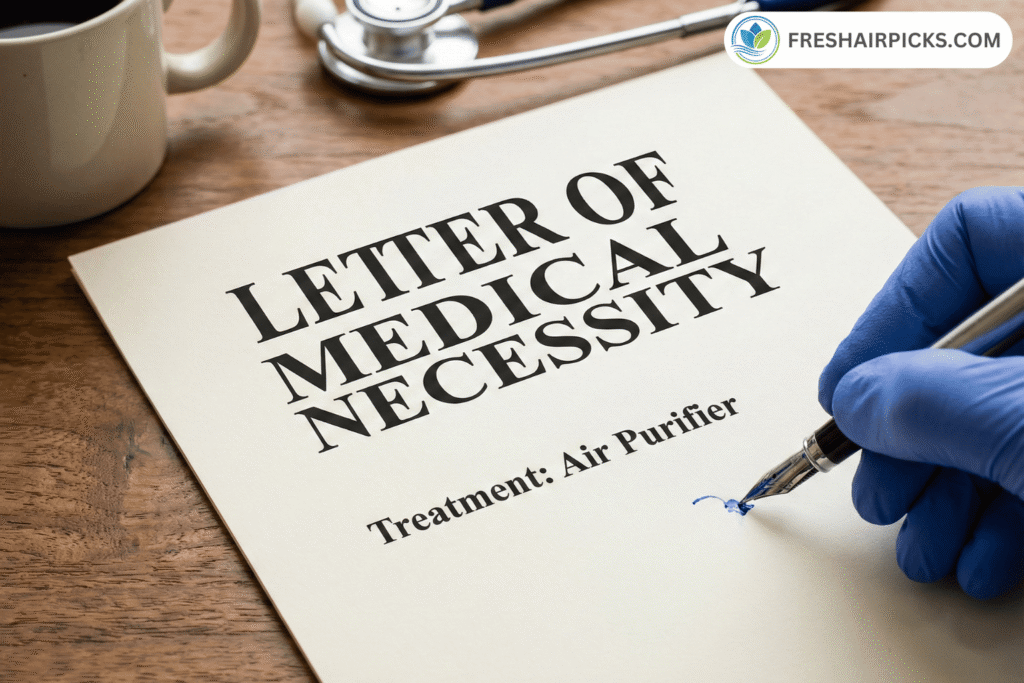
If you take nothing else away from this guide, remember this: The Letter of Medical Necessity (LMN) is your shield. Without it, your purchase is considered a personal expense. With it, it is a medical expense.
An LMN is basically a prescription, but more detailed. It connects the device to the diagnosis. It must include:
- Patient Diagnosis: (e.g., Allergic Rhinitis or Asthma).
- Recommended Treatment: Explicitly stating “Air Purifier” or “HEPA Filtration.”
- Duration: How long the treatment is needed (often “Lifetime” for chronic issues).
- Doctor’s Signature: It must be signed by a licensed practitioner.
Option A: The Traditional Route (Your Doctor)
You can schedule an appointment with your General Practitioner or Specialist. Tell them, “I need an LMN for an air purifier to help manage my [Condition].” Most doctors are very familiar with this and will write one for you. You then keep this document in your records.
Option B: The “Checkout Unlock” (Modern & Fast)
This is the “insider” tip that saves the most time. Many top-tier air purifier retailers have realized that getting a doctor’s note is a hassle. They have partnered with telehealth compliance services (like TrueMed) to handle this during the purchase.
How it works:
- You select “Pay with HSA/FSA” at checkout.
- You answer a 2-minute health survey regarding your symptoms and condition.
- A remote doctor reviews it instantly.
- If approved, they issue the LMN on the spot, and your card is charged.
This creates “One-Click Compliance,” ensuring you have the documentation you need without a separate trip to the clinic.
Step-by-Step Guide: How to Buy Without Getting Declined
Even with an LMN, the process can sometimes be glitchy. Here is my proven workflow to ensure your purchase goes through and stays audit-proof.
1. Confirm the “Medical Grade” Specs
If you buy a cheap, decorative unit that doesn’t actually clean the air, an auditor could technically argue it’s not a medical device. To be safe, ensure the unit has:
- True HEPA Filtration: It must capture 99.97% of particles at 0.3 microns.
- High CADR (Clean Air Delivery Rate): The unit must be powerful enough for the room size. As a rule of thumb, the CADR should be at least 2/3 of the room’s square footage.
2. The Payment Process
Scenario 1: Using Your HSA/FSA Card Directly
If you are buying from a dedicated “FSA Store” or a pharmacy, your card will likely work immediately because their inventory system (IIAS) marks the items as eligible.
Scenario 2: Buying from Amazon or Big Box Retailers
Often, general retailers do not code air purifiers as medical items. If you swipe your HSA card, it might be declined. Do not panic.
- Simply pay with your personal credit card.
- Log into your HSA/FSA administrator portal (like HealthEquity or Navia).
- Submit a “Reimbursement Claim.”
- Upload your Receipt and your LMN.
- The funds will be transferred to your bank account, usually within a few days.
3. Save Your Documentation
Create a digital folder named “Tax Health Docs [Year].” Save your receipt and your LMN there. IRS rules generally require you to keep these records for 3 to 7 years. You do not need to send them to the IRS when you file taxes, but you must have them if they ever ask.
A Critical Warning: Portable Units vs. Whole-House Systems
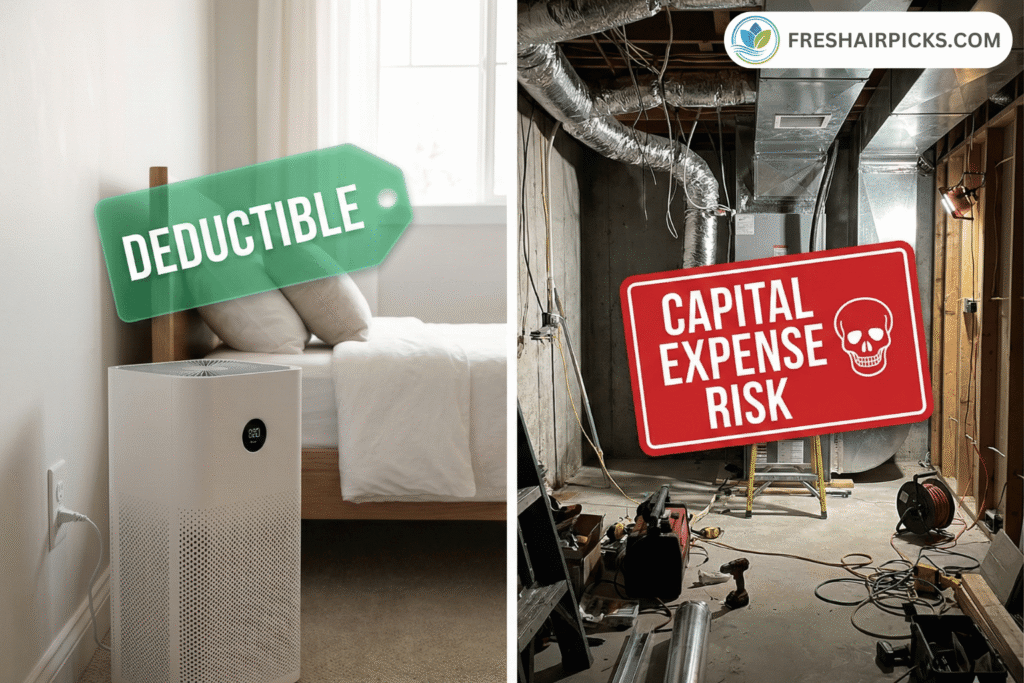
I need to save you from a potential financial nightmare here. There is a massive difference in how the tax code treats a portable machine versus a system installed into your home’s HVAC.
Portable Units: These are treated like “equipment” (like a wheelchair). If you have an LMN, the full cost is usually deductible.
Whole-House Systems: These are considered “Capital Expenses” (Home Improvements). The IRS uses a strict formula:
$$Medical Deduction = Cost of Improvement – Increase in Home Value$$
The Trap: If you spend $5,000 installing a hospital-grade filtration system, and an appraiser says it increased your home’s value by $5,000, your deduction is $0. Because the improvement added value to your asset, the IRS does not view it as a pure medical loss.
My Advice: Stick to portable, high-performance units for your bedrooms and living areas. They are more effective at “source control” and the tax eligibility is far cleaner.
Frequently Asked Questions (FAQ)
Can I buy replacement filters with my HSA?
Yes. If the air purifier itself was medically necessary (meaning you have an LMN for it), the maintenance costs to keep it running—specifically replacement HEPA and carbon filters—are also eligible expenses.
Do I need a new LMN every year?
Usually, yes. Most LMNs are valid for 12 months. However, if you have a lifelong chronic condition like COPD or permanent asthma, you can ask your doctor to write “Lifetime Necessity” on the letter, which may prevent you from needing a renewal.
Why was my HSA card declined at Amazon?
Amazon sells everything from books to beds, so their system doesn’t automatically know your air purifier is for a medical need. It is likely not coded as an “FSA Eligible” SKU. In this case, just use your personal card and file for reimbursement using your LMN.
Can I deduct the electricity bill for running it?
Technically, yes, but it is difficult. You are allowed to deduct the extra electricity used to run medical equipment. However, you would need to calculate the exact kilowatt-hours used by the device, multiply it by your utility rate, and prove this increase to the IRS. For most people, saving $50 a year isn’t worth the documentation headache.
Is a Dyson air purifier FSA eligible?
Yes, brand names like Dyson, Alen, or IQAir are eligible if you have the Letter of Medical Necessity. The eligibility attaches to the purpose (treating your condition), not the brand name. However, ensure the model you choose actually has True HEPA filtration to justify the medical need.
Conclusion

Can you use your HSA for an air purifier? Absolutely. It is one of the smartest ways to invest those pre-tax dollars, turning “monopoly money” into genuine respiratory relief.
Don’t let the paperwork scare you off. The process is simply:
- Diagnose: Confirm you have a qualifying condition (Asthma, Allergies, etc.).
- Document: Get that Letter of Medical Necessity (either from your doc or at checkout).
- Deploy: Buy a high-quality unit that actually cleans the air.
If you are suffering from respiratory issues, clean air isn’t a luxury—it’s a prescription. Treat it like one.